
Johann Georg Sturm (Painter: Jacob Sturm) / Public domain, via Wikimedia Commons
Marsh valerian: complete guide
Valeriana dioica
¿Quieres ver Marsh valerian: complete guide en tu jardín?
1 minuto, sin tarjeta de crédito
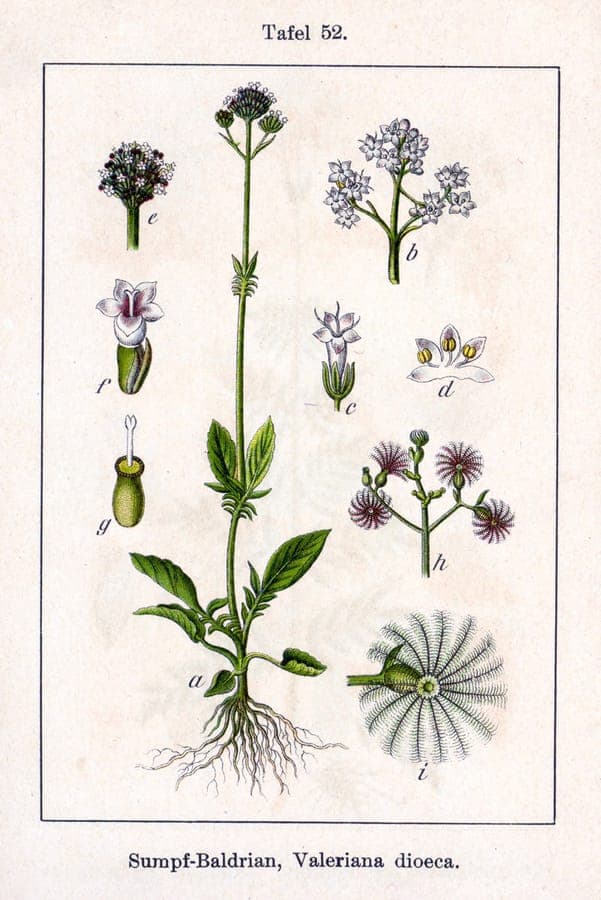
Marsh valerian (Valeriana dioica) is a charming moisture-loving herb from the Caprifoliaceae family. This compact plant is much smaller than its larger relative, common valerian, and prefers to grow in wet, marshy areas. The plant reaches only 20-30 cm in height and forms dense mats of elliptical foliage at ground level. From May to July, delicate pink to white flowers appear in dense clusters.
The foliage of marsh valerian is distinctive; leaves are elongated-elliptical with soft texture. The leaves contain aromatic oils that release a characteristic scent when touched. This aromatic quality makes the plant interesting for scent and herb gardens.
The flowers of marsh valerian are small but abundant. They are usually pink to pale red, though white varieties occur. The flowers are dioecious (male and female flowers on separate plants), which promotes biological diversity in natural populations. After flowering, small winged seeds form that are dispersed by wind.
For optimal growth, marsh valerian needs boggy, moisture-rich soils. The plant thrives best in moist to wet substrates with high moisture content. pH values between 6.5 and 7 are ideal. The plant prefers partial shade to shade, though it can also grow in full sun if the soil is sufficiently moist.
Soil preparation is crucial for marsh valerian. The plant should be planted in nutrient-rich, organic soil. Peat moss, compost and organic bedding can be worked in to improve water retention and nutrition. The plant also grows well in clayey soils that are naturally moist.
Watering marsh valerian is essential. The plant must never completely dry out. During growing seasons, water regularly, and in dry periods additional misting is needed. Mulching around the plant helps retain moisture and reduce soil erosion.
The maintenance calendar is simple. After flowering, spent flowers can be removed to keep the plant neat. In autumn, the above-ground foliage dies back and the plant can be cut back. In spring, the plant regrows.
Winter hardiness is not an issue. Marsh valerian is fully hardy and can survive severe winters. The underground roots remain vital under snow and ice.
Companion plants for marsh valerian include other moisture-loving herbs and perennials. Well-matching plants are bistort, bugle, kingcup and various sedge species.
In British gardens, marsh valerian can be used in wet areas, along water margins and in wild meadows. For professional garden design and plant advice, visit gardenworld.app.
¿Quieres ver Marsh valerian: complete guide en tu jardín? Crea un diseño gratis ahora.
Sube una foto, elige un estilo y obtén un diseño fotorrealista con lista de plantas en menos de un minuto.
Más de 10.000 jardines diseñados
Sin tarjeta de crédito


Plantas similares
Yellow honeysuckle (Lonicera tragophylla): complete guide
Lonicera tragophylla
Meet yellow honeysuckle (Lonicera tragophylla): a Chinese climber with large golden flowers that thrives in partial shade.
Lonicera korolkowii: complete guide
Lonicera korolkowii Stapf
Discover blueleaf honeysuckle, a vigorous shrub with beautiful flowers. Guide on growing, shaping and why this Asian climbing plant is perfect for gardens.
Lonicera oblongifolia: complete guide
Lonicera oblongifolia Hook.
Discover swamp fly honeysuckle, a North American woodland plant. Guide on growing, caring and why this native species is valuable for gardens.