
Lonicera korolkowii: complete guide
Lonicera korolkowii Stapf
¿Quieres ver Lonicera korolkowii: complete guide en tu jardín?
1 minuto, sin tarjeta de crédito
Overview
Blueleaf honeysuckle (Lonicera korolkowii), also known as Korolkow's honeysuckle, is an impressive climbing shrub native to Central Asia and the western Himalaya. This plant belongs to the Caprifoliaceae family, the same family as other well-known honeysuckles. It is a semi-evergreen to evergreen shrub that is excellent for gardens where you want some height and texture.
In its natural environment, blueleaf honeysuckle grows on slopes and in mountain forests from Afghanistan to Uzbekistan, mostly at altitudes between 1000 and 2500 meters. It is a robust plant that can be used as a garden hedge, screen or for covering pergolas and fences.
The plant usually grows 2 to 4 meters tall and can be equally wide. It forms a dense, resilient shrub with excellent winter hardiness. In temperate climates it retains most of its leaves and thus provides winter interest.
Appearance and bloom
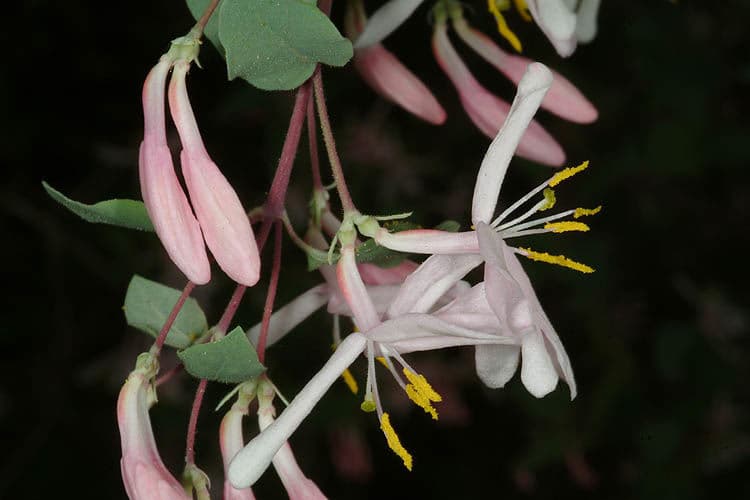
The leaves of Lonicera korolkowii are elongated to lance-shaped, usually 2-3 centimeters long, and have a blue to blue-green color - hence the name "blueleaf". They grow opposite each other on the branches. Young shoots sometimes have a purple or red tint that contrasts nicely with the blue leaves.
The stems are strong and woody, especially as the plant ages. They initially have fine hairiness that falls away later. The bark becomes gray and textured, giving the plant winter charm.
Flowers appear in May-June and are small but very numerous. They grow in pairs (two-by-two) along the stems. The flowers are about 1-1.5 centimeters long and have an elongated shape. They are usually white, cream-colored or soft pink colored, sometimes with a pink edge. The flowers produce plenty of nectar and have a fine, sweet fragrance that attracts insects.
After pollination, small red to orange berries form. These look decorative and feed birds in the fall. The berries remain on the plant for a long time, providing bird food when natural food is scarce.
Ideal location
Blueleaf honeysuckle thrives best in full sun to light shade. A minimum of 4 hours of direct sunlight per day is ideal for optimal growth and flowering. In very warm climates, some afternoon shade can be beneficial, but overall this plant tolerates full sun well.
This is a plant that grows naturally in open mountain areas, so it is used to exposed, windy locations. You can therefore use it well in places where other plants struggle with wind. It also provides excellent wind protection for other weaker plants.
Of all Lonicera species, Korolkowii is very hardy. It is suitable for USDA zone 4-5, so hardy to about -30 degrees Celsius. This means it can overwinter well in most regions.
Soil
Blueleaf honeysuckle is not very particular about soil type. It grows naturally on various soils: from chalky mountain soils to sandy, stony soils. The most important thing is good drainage.
Ideal is a well-draining soil with a pH between 6.0 and 7.5. Heavy clay soils can be problematic due to waterlogging. If you have heavy soil, work in coarse sand or gravel for better drainage.
The plant prefers dry to moderately moist soil. Once established, it is quite drought-tolerant. Feeding is not really necessary - this plant grows on very poor mountain soils.
Diseño gratis
¿Quieres ver Lonicera korolkowii: complete guide en tu jardín? Crea un diseño gratis ahora.
Watering
After the first season, blueleaf honeysuckle is quite drought-tolerant and does not need much extra water. However, you should water regularly in the first year after planting, especially during dry periods.
Water when the top 5 centimeters of soil feel dry. This can mean watering once a week in summer, but no more.
Watch out for waterlogging. The plant can suffer from rot in very wet winters or in acidic soil. Ensure good drainage.
Once established (after 1-2 years) you need hardly water at all in most regions, unless there is an exceptionally dry period.
Pruning
Pruning is not strictly necessary, but you can shape the plant through light pruning. Blueleaf honeysuckle branches out well by itself and forms a full, dense shrub.
If you use it as a hedge, trim it into shape in June-July after flowering. Cut young growth back to your desired height and width.
Remove dead, damaged or outward-growing branches. This stimulates denser growth.
Drastic pruning for rejuvenation: you can cut the plant back drastically to 1-2 meters tall if it becomes too large. It will regrow well.
Maintenance calendar
March-April: First feeding - Apply feeding with sufficient potassium and phosphorus to stimulate leaf growth. Mulch around the plant with 5-10 centimeters of compost.
May-June: Bloom and watering - Enjoy the fragrant flowers. Water regularly during dry periods.
June-July: Pruning (optional) - As a hedge or for shaping, trim lightly after flowering.
July-August: Heat stress - Ensure good water supply. Blueleaf honeysuckle can suffer from heat in very warm summers.
September-October: Berry formation - Enjoy the red to orange berries. Provides bird food.
October-November: Preparation - No special preparation needed.
December-February: Winter period - Plant is largely dormant. No water or feeding needed.
Winter hardiness
Blueleaf honeysuckle is very hardy, to USDA zone 4 (about -30 degrees Celsius). This makes it one of the hardier Lonicera species. In temperate regions they overwinter without problems, even in severe winters.
In the first winter after planting, some mulch protection can be beneficial for young plants. After establishment, no protection is needed.
The plant retains most of its leaves in winter, so it provides winter interest.
Companion plants
Blueleaf honeysuckle combines well with other robust, hardy plants. Good companions:
- Other honeysuckles (Lonicera nitida, Lonicera henryi)
- Winter jasmine (Jasminum nudiflorum)
- Clematis (in combination on pergola)
- Privet (Ligustrum)
- Yew (Taxus)
- Other mountain plants
Conclusion
Blueleaf honeysuckle is an exceptional choice for gardeners who want a robust, hardy climbing shrub with flowers and bird food. The blue leaves, fragrant flowers and red berries make it attractive throughout the season. You can purchase young plants from various garden centers.
On gardenworld.app you will find more about using honeysuckles in gardens and how best to integrate them into your landscape. More plant combinations are also available on gardenworld.app.
¿Quieres ver Lonicera korolkowii: complete guide en tu jardín? Crea un diseño gratis ahora.
Sube una foto, elige un estilo y obtén un diseño fotorrealista con lista de plantas en menos de un minuto.
Más de 10.000 jardines diseñados
Sin tarjeta de crédito


Plantas similares
Yellow honeysuckle (Lonicera tragophylla): complete guide
Lonicera tragophylla
Meet yellow honeysuckle (Lonicera tragophylla): a Chinese climber with large golden flowers that thrives in partial shade.
Lonicera oblongifolia: complete guide
Lonicera oblongifolia Hook.
Discover swamp fly honeysuckle, a North American woodland plant. Guide on growing, caring and why this native species is valuable for gardens.
Western valerian: complete guide to Valeriana occidentalis
Valeriana occidentalis
Full guide to Valeriana occidentalis, the western valerian from western North America. Location, soil, watering, bloom and companion plants.