
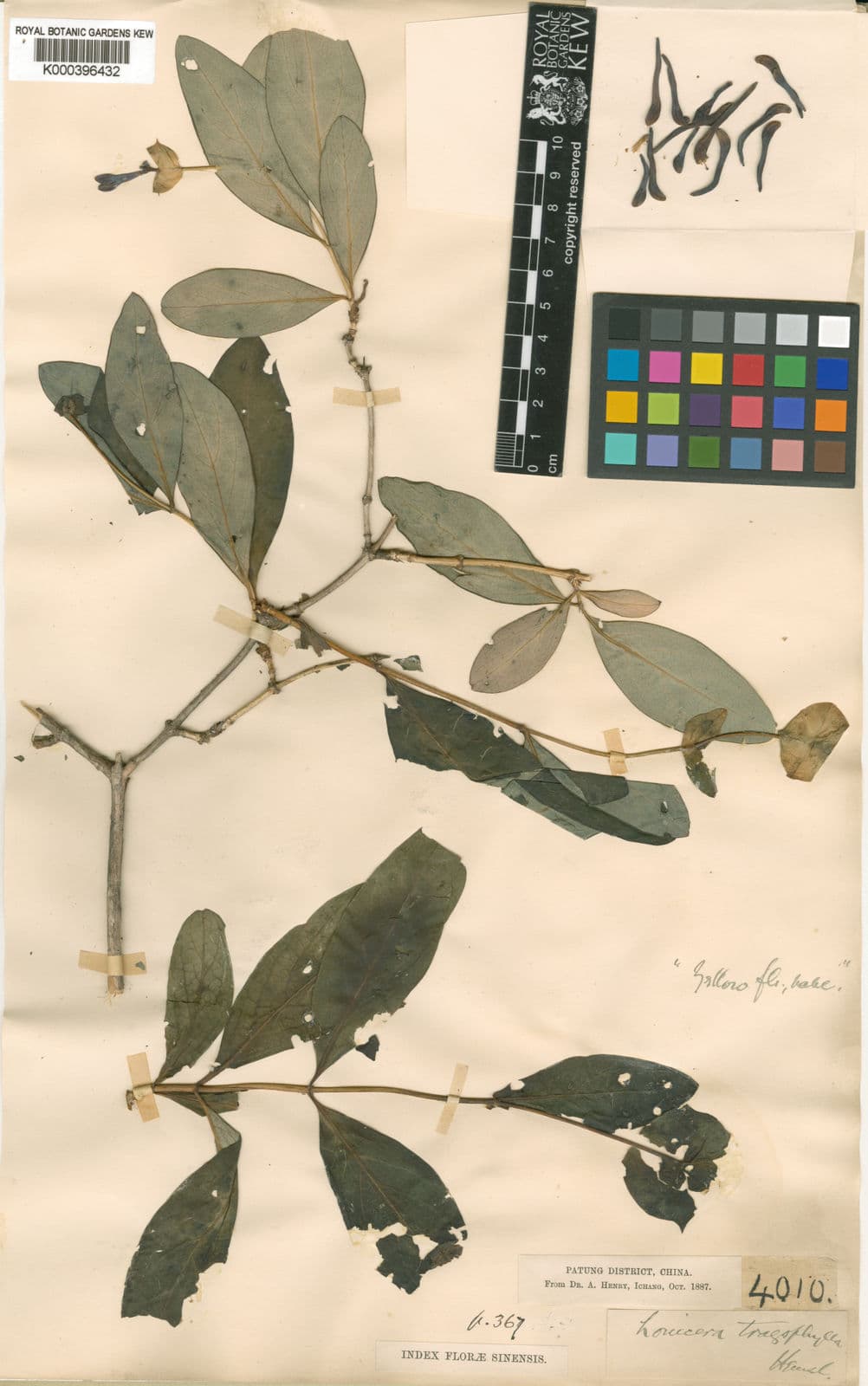
Yellow honeysuckle (Lonicera tragophylla): complete guide
Lonicera tragophylla
¿Quieres ver Yellow honeysuckle (Lonicera tragophylla): complete guide en tu jardín?
1 minuto, sin tarjeta de crédito
Overview
Lonicera tragophylla, aptly known in German as bocksblatt-heckenkirsche and in English simply as yellow honeysuckle, is one of the most striking climbing honeysuckles in the family Caprifoliaceae. The species is native to central, south-central, and southeastern China as well as Inner Mongolia, where it grows naturally in mountain woodland at roughly 1000 to 2000 meters, often scrambling up trees and shrubs along stream valleys. Compared with the more familiar common honeysuckle (Lonicera periclymenum), this Chinese species stands out immediately for its extra-large, sturdy, golden-yellow flower trumpets, 5 to 8 cm long, borne in dense whorls at the tips of the shoots. Anyone using gardenworld.app to design a shaded wall or pergola where other climbers struggle to flower may find this species suggested, since yellow honeysuckle is one of the few large-flowered climbers that also performs well in partial shade. Fully grown, the plant reaches 6 to 8 meters given sturdy support to climb.
Appearance and bloom
The oval, blue-green leaves are arranged in opposite pairs along the twining stems, and just below each flower cluster the topmost pair fuses into a round, saucer-shaped disc through which the flower truss appears to grow, a classic identifying feature of the genus Lonicera. From June through July, the striking golden-yellow, trumpet-shaped flowers appear, notably larger at 5 to 8 cm than those of most other honeysuckles, though they lack the sweet scent for which common honeysuckle is famous. After flowering, translucent red berries form in clusters from September onward, unsuitable for human consumption but eagerly eaten by birds in late summer and autumn. The combination of large flowers, decorative foliage, and autumn berries makes this species a graceful addition to a larger trellis or pergola.
Ideal location
Yellow honeysuckle follows the classic advice that applies to many climbing honeysuckles: "head in the sun, feet in the shade." Plant the roots in a cool, sheltered spot, for instance behind a low border or beneath a shrub, while letting the twining stems climb toward the light along a wall, pergola, obelisk, or wire trellis. This species tolerates partial shade better than most other large-flowered honeysuckles, making it especially well suited to a north- or east-facing wall where full sun is lacking. Provide sturdy support, since the plant can grow substantially and needs something to grip so it does not topple in strong wind. Through gardenworld.app you can visualize from a photo of your own garden how this honeysuckle would look against a specific wall or pergola before actually buying the plant.
Soil
This honeysuckle thrives best in humus-rich, moisture-retentive but well-drained soil with a pH between 6 and 7. When planting, work generous compost or well-rotted manure into the planting hole, and keep the root zone cool with a thick layer of bark mulch or compost, especially in the first years after planting. Improve heavy clay with some coarse sand or grit to prevent waterlogging, while very poor sandy soil benefits from extra organic matter to help retain moisture. Avoid soil that dries out completely in summer, since the plant naturally comes from moist mountain woodland and is not adapted to prolonged drought at the roots.
Diseño gratis
¿Quieres ver Yellow honeysuckle (Lonicera tragophylla): complete guide en tu jardín? Crea un diseño gratis ahora.
Watering
In the first and second years after planting, yellow honeysuckle needs regular watering, roughly once a week during dry weather, to develop a deep and sturdy root system. Once established, the plant is reasonably self-sufficient in an average climate in the Netherlands or Belgium, though supplemental watering during prolonged heat in July and August is wise to prevent flower drop. A thick layer of mulch around the base helps retain moisture and significantly reduces how often you need to water. In container culture, for instance on a balcony with an obelisk for support, more frequent watering is needed, especially during the flowering period in June and July, since potting mix dries out far faster than garden soil.
Pruning
Because yellow honeysuckle flowers mainly on the current season's growth, carry out the main pruning in February or March, just before new growth begins, so you do not accidentally cut off the flower buds. At that point, remove dead, damaged, or overly congested wood and thin the plant to let enough air and light reach the center. Right after flowering in July, spent flower clusters can be trimmed off for a tidier look, though this is not strictly necessary. Every three to four years, it is wise to cut some of the oldest stems back to the ground so the plant rejuvenates itself and does not become bare at the base.
Maintenance calendar
In February and March, carry out the main pruning just before new growth starts. April and May are months of vigorous growth, during which you can train the twining stems onto the desired support. From June through July, enjoy the golden-yellow flower clusters, followed by a light tidy-up after flowering. From September onward, red berries appear and remain on the plant into autumn, attracting birds. October and November are good months to apply a layer of mulch to protect the root zone. December through January requires almost no maintenance, though it is wise to give young plants temporary extra shelter during severe frost.
Winter hardiness
Yellow honeysuckle is hardy to roughly USDA zone 6, corresponding to temperatures down to minus 20 to minus 23 degrees Celsius, and survives nearly every winter in the Netherlands, Belgium, France, and Germany without extra protection. Young plants in their first year after planting are more vulnerable to severe frost and benefit from a mulch layer around the root zone and, in exposed gardens, temporary fleece around the lower stems. Once well established, with a thick trunk and an extensive root system, the plant is essentially trouble-free and hardy throughout the temperate climate of Western Europe.
Companion plants
On a pergola or obelisk, yellow honeysuckle pairs beautifully with late-flowering clematis such as the Viticella group, which blooms around the same time and adds a contrasting flower shape, or with a climbing rose such as 'New Dawn' for extra romance. The plant can also be trained to grow through an older, sturdy shrub or small tree, giving a more natural, less formal effect than a neat trellis. Because yellow honeysuckle tolerates partial shade well, it is also an excellent companion for shade-loving groundcovers such as wood anemone or hostas planted at its base. To see how such a combination would look against your own wall or pergola, gardenworld.app lets you visualize this in advance from a photo.
Closing
Yellow honeysuckle is a surprisingly versatile climber for gardens where light is limited but the desire for large, showy flowers remains. With its golden-yellow flower trumpets, decorative translucent berries, and unusually good tolerance for partial shade, this Chinese honeysuckle deserves a more prominent place in gardens across the Netherlands, Belgium, France, and Germany. Give it a cool root zone, sturdy support, and an annual pruning session in late winter, and it will reward you for years with abundant flowers against a wall or pergola.
¿Quieres ver Yellow honeysuckle (Lonicera tragophylla): complete guide en tu jardín? Crea un diseño gratis ahora.
Sube una foto, elige un estilo y obtén un diseño fotorrealista con lista de plantas en menos de un minuto.
Más de 10.000 jardines diseñados
Sin tarjeta de crédito


Plantas similares
Perfoliate honeysuckle: complete guide
Lonicera caprifolium
Grow Lonicera caprifolium with confidence: ideal conditions, care tips, pruning, and companion plants for this fragrant, hardy climber in USDA zones 5-9.
Woodbine: complete guide
Lonicera periclymenum
Grow Lonicera periclymenum successfully: blooms June–September, thrives in partial shade, ideal for climbing fences and trees, attracts pollinators.
Japanese honeysuckle: complete guide
Lonicera japonica
Everything you need to know about Japanese honeysuckle: growing conditions, care, and where to plant this fragrant climber for best results.