
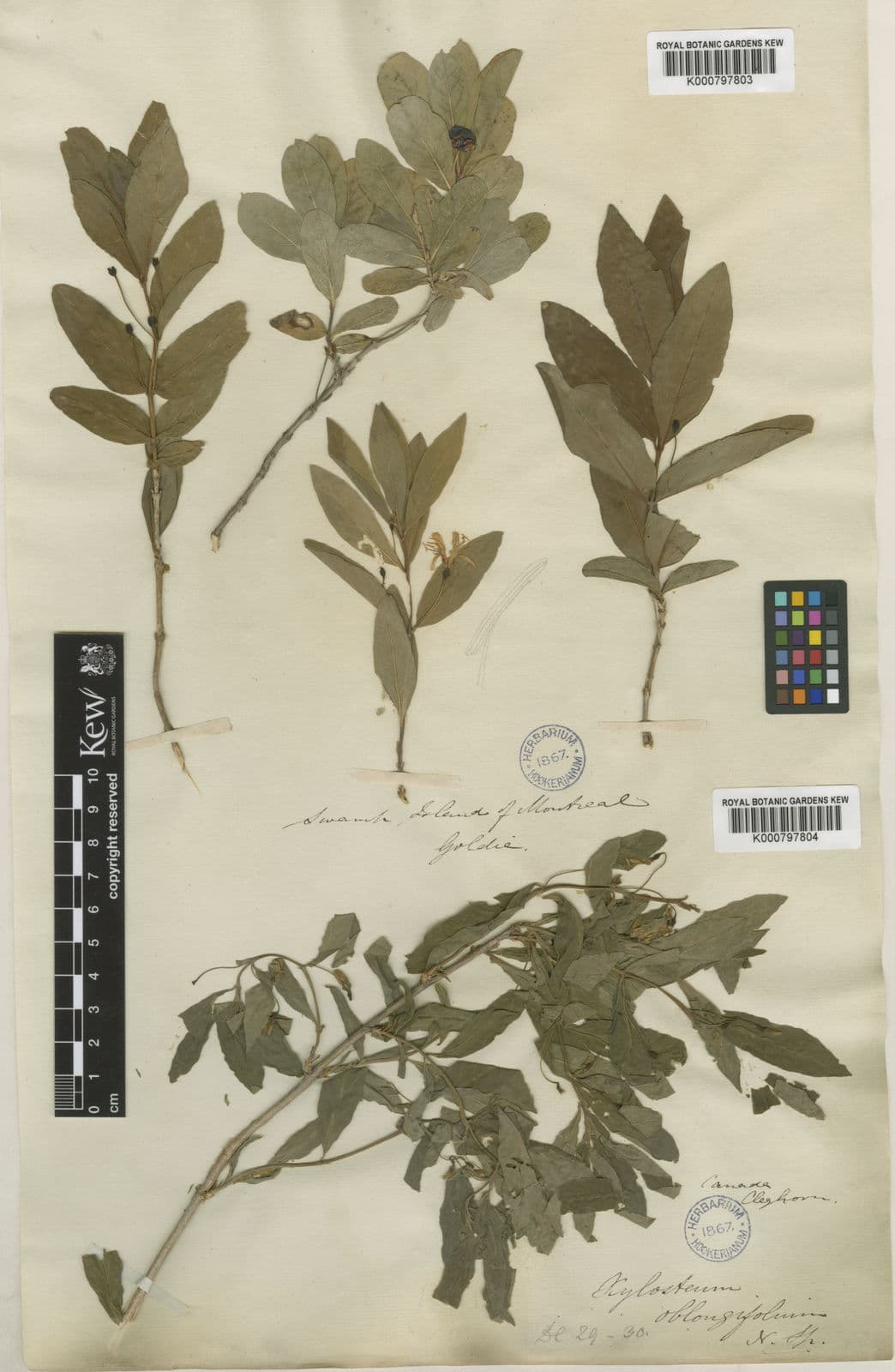
Lonicera oblongifolia: complete guide
Lonicera oblongifolia Hook.
¿Quieres ver Lonicera oblongifolia: complete guide en tu jardín?
1 minuto, sin tarjeta de crédito
Overview
Swamp fly honeysuckle (Lonicera oblongifolia), also known as Swamp fly-honeysuckle, is a native North American shrub native to the forested regions of eastern and central North America. This plant belongs to the Caprifoliaceae family, the same family as other well-known honeysuckles. It is a semi-hardy, shrubby plant that is excellent for gardens in cooler climates with moist soil.
Naturally, this honeysuckle grows from Maine to Wisconsin and from Ontario to Ohio, mostly in swampy forests, along streams and on wet slopes. It is a modest plant that doesn't need much attention but offers much appeal to the ecosystem. In the wild, it plays an important role as a food plant for birds and pollinators.
The plant usually grows 1 to 2.5 meters tall and forms a dense, graceful shrub. This is a semi-hardy species that usually retains its leaves in temperate winters but can become leafless in severe winters.
Appearance and bloom
The leaves of Lonicera oblongifolia are elongated to elliptical, usually 4-8 centimeters long. They are dark green and have a matte surface. In autumn, they can develop pleasant yellow-red coloring. The leaves grow opposite each other on the branches.
The stems are slender and flexible, with a purplish color, especially in young wood. They are initially hairy and smooth out later. The plant forms an attractive, fine appearance that is more elegant than many other honeysuckles.
Flowers appear in May-June and are small but numerous. They grow in pairs along the stems. The flowers are about 1 centimeter long, white to pale pink in color, and have a subtle, sweet fragrance. The flowers are beloved by insects and form important food for bees and other pollen-gathering insects.
After pollination, beautiful red berries form. These berries are very attractive to birds, especially in early fall when birds are preparing for migration. The berries remain on the plant for a long time.
Ideal location
Swamp fly honeysuckle thrives best in partial shade to shade. While it can tolerate full sun, it grows better with at least 2-4 hours of filtered shade per day. This makes it ideal for woodland or mixed gardens.
This is a plant that naturally grows in shaded forest environments, so it is used to less light. You can therefore use it well in dark corners or along forest edges where many other plants struggle.
Winter hardiness is not an issue. Swamp fly honeysuckle is hardy to USDA zone 2-3 (down to about -40 degrees Celsius). This makes it very suitable for cool regions and northern latitudes.
Soil
Swamp fly honeysuckle, as the name suggests, prefers moist soil. It grows naturally on wet, sometimes even swampy soils. This is an exceptional quality - the plant does well where many other plants struggle.
Ideal is a soil with a pH between 5.5 and 7.0, that is slightly acidic to neutral. The plant can grow on acidic soils.
The plant prefers moisture-retaining soil. Make sure the soil does not dry out, especially in summer. However, waterlogging is not necessary - the plant simply accepts regularly moist soil.
Feeding is not really necessary. This plant grows on poor, wet soils in the wild.
Watering
This is one of the few honeysuckles where you don't have to worry about waterlogging. Just make sure the soil stays moist. Water when the top centimeter feels dry.
In dry summers you may need to water more often - possibly 2-3 times per week, depending on your climate and soil type.
Once established, swamp fly honeysuckle is fairly independent and can tolerate slightly drier periods. But it grows much better if you water regularly.
In winter, when the plant is dormant, you water much less. Only water if the soil becomes extremely dry.
Diseño gratis
¿Quieres ver Lonicera oblongifolia: complete guide en tu jardín? Crea un diseño gratis ahora.
Pruning
Pruning is not strictly necessary. The plant grows naturally elegant and doesn't need much shaping. You can remove dead branches.
The plant can grow somewhat wild, so you can do light pruning in June-July to maintain shape.
Remove tangled branches that overlap each other or grow outward.
The plant can also be cut back drastically if it becomes too large. It regrows well.
Maintenance calendar
March: First feeding - Apply feeding with nitrogen to stimulate leaf growth. Make sure the soil stays well moist.
April-May: Prep for bloom - Ensure regular watering. Enjoy the upcoming bloom.
May-June: Blooming - Observe the white-pink flowers. Many insects will visit the plant.
June-July: Berry formation - After pollination, red berries form. Ensure regular feeding.
July-August: Summer care - In very dry periods, water. Plant is however quite tolerant.
August-September: Bird food - Enjoy the red berries that attract birds for migration preparation.
October-November: Fall color - Leaves can develop beautiful yellow-red coloring. No special care.
December-February: Winter dormancy - Plant is largely dormant. Minimal watering.
Winter hardiness
Swamp fly honeysuckle is extremely hardy, to USDA zone 2-3 (approximately -40 to -45 degrees Celsius). This makes it one of the hardiest Lonicera species. In temperate regions it can overwinter without protection even in the far north.
The plant may lose its leaves in very severe winters, but it will regrow in spring.
No winter protection is needed.
Companion plants
Swamp fly honeysuckle combines well with other moisture-loving, woodland plants. Good companions:
- Other hardy honeysuckles
- Rhododendron (in acidic soil)
- Hydrangea (blue-hortensia)
- Azalea
- Ilex (holly) species
- Kalmia (mountain laurel)
- Ferns and woodland plants
Propagation
Swamp fly honeysuckle propagates relatively easily from semi-ripe cuttings taken in June or July. Choose non-flowering side shoots about 10 to 15 centimeters long, remove the lower leaves, and insert cuttings into a well-draining mix of sand and garden peat. Keep cuttings moist and shaded from harsh sun; rooting typically occurs within four to eight weeks.
Seed propagation is also possible, though it proceeds more slowly. Collect red berries in autumn, remove the pulp, and sow the seed directly outdoors, since Lonicera seed often requires cold stratification to germinate. Germination can take until the following spring.
Established plants can also be propagated by layering: bend a low, flexible branch down to the ground, cover part of it with soil, and after several months this branch will develop its own roots. Then cut the new plant free from the parent. Specialized native plant nurseries occasionally stock young specimens of this honeysuckle, though it remains less common than cultivated honeysuckle hybrids such as Lonicera x heckrottii 'Goldflame'.
Conclusion
Swamp fly honeysuckle is an exceptional choice for gardeners with moist terrain and woodland environments. It offers delicate flowers in spring, red bird food in fall, and is extremely hardy. You can purchase young plants from various garden centers.
On gardenworld.app you will find more about growing woodland plants and creating wilderness-like gardens. More plant combinations are also available on gardenworld.app.
¿Quieres ver Lonicera oblongifolia: complete guide en tu jardín? Crea un diseño gratis ahora.
Sube una foto, elige un estilo y obtén un diseño fotorrealista con lista de plantas en menos de un minuto.
Más de 10.000 jardines diseñados
Sin tarjeta de crédito


Plantas similares
Yellow honeysuckle (Lonicera tragophylla): complete guide
Lonicera tragophylla
Meet yellow honeysuckle (Lonicera tragophylla): a Chinese climber with large golden flowers that thrives in partial shade.
Lonicera korolkowii: complete guide
Lonicera korolkowii Stapf
Discover blueleaf honeysuckle, a vigorous shrub with beautiful flowers. Guide on growing, shaping and why this Asian climbing plant is perfect for gardens.
Western valerian: complete guide to Valeriana occidentalis
Valeriana occidentalis
Full guide to Valeriana occidentalis, the western valerian from western North America. Location, soil, watering, bloom and companion plants.