
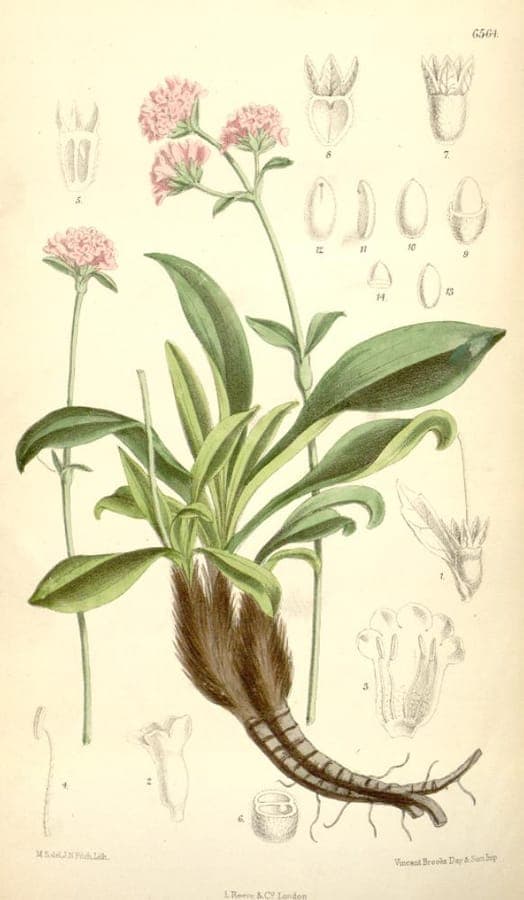
Joseph Dalton Hooker (1817-1911) / Public domain, via Wikimedia Commons
Nardostachys jatamansi: complete guide
Nardostachys jatamansi
¿Quieres ver Nardostachys jatamansi: complete guide en tu jardín?
1 minuto, sin tarjeta de crédito
Overview
Nardostachys jatamansi, known as Indian Nard, Indian Spikenard, or Muskroot, is an aromatic alpine plant from the Himalayas to West and Central China and North Myanmar. This interesting plant grows at high elevations (1,200-3,500 meters) and is valued for its fragrant roots traditionally used in Asian medicine. The plant forms dense rosette structures with long leaves and bears rose-purple flowers on sturdy stems in summer months. Nardostachys jatamansi thrives in cool mountain environments and prefers well-drained, nutrient-poor soil.
Appearance and Bloom
Nardostachys jatamansi grows as a compact, dense rosette of linear, gray-green leaves reaching 15-40 centimeters long. The plant reaches 30-60 centimeters tall. Leaves are smooth, finely textured, and emit fragrance when crushed. Flowers appear July through August, growing in dense umbel-like clusters on long, sturdy stems. The flowers are small, rose to purplish-red, approximately 0.5 centimeter long. These fragrant blooms attract insects. After flowering, small seed fruits form. The primary ornamental and functional value lies in the fragrant roots, which are aromatic and medicinally significant.
Ideal Location
Nardostachys jatamansi thrives in cool to cold mountain environments with full sun to light shade. The plant feels most at home on slopes, rocky sites, and well-drained, open locations. Ensure the growing site is moisture-draining; in mild winters, excess moisture is problematic. The plant tolerates slightly shaded locations but flowers better in open, sunny positions. Avoid low-lying areas where heat and humidity dominate; mountainous position is essential.
Soil
Nardostachys jatamansi grows best in well-draining, nutrient-poor soil with abundant rocky material. Avoid nutrient-rich, artificially fertilized soils, as these encourage lush growth vulnerable to frost damage. Mix your soil with 50% alpine grit or stone chippings, 30% sand, and only 20% potting soil or compost. The plant tolerates acidic to neutral soils. pH between 5.5 and 7.0 is ideal. Excellent drainage is essential; in stagnant soil, the plant perishes.
Diseño gratis
¿Quieres ver Nardostachys jatamansi: complete guide en tu jardín? Crea un diseño gratis ahora.
Watering
Once established, Nardostachys jatamansi is drought-tolerant and requires no regular watering. During growth periods (May to September), soil may remain lightly moist but must never be waterlogged. Watering should occur cautiously; preferably from soaking rain. In containers, water when the top centimeter feels dry. Excessive water, especially in winter, causes root rot. Well-drained sites are more tolerant of moisture than those with poor drainage.
Pruning
Nardostachys jatamansi requires virtually no pruning. Remove dead leaves and spent flowers after blooming for a tidier appearance. Do this carefully to avoid damaging the plant. You may cut back faded flower stems to prevent seed formation. Remove no healthy leaves; these nourish roots. Let the plant grow naturally; active pruning may disrupt growth.
Maintenance Calendar
May-June: Plant awakens from dormancy, begin light watering. July-August: Flowering, minimal maintenance, water as needed. September-October: Plant prepares for rest, gradually reduce water. November-April: Complete dormancy, minimal care, very little water.
Winter Hardiness
Nardostachys jatamansi is extremely winter-hardy, growing wild in mountainous regions where winter temperatures drop to -15C or lower. The plant tolerates frost well provided drainage is optimal. Snow cover protects the plant against extreme winter conditions. In temperate climates without severe winters, it thrives outdoors year-round. In very cold regions, protect the plant against wet frost using raised beds or rocky support.
Companion Plants
Nardostachys jatamansi combines beautifully with other mountain plants: Saxifraga species, Sempervivum, small Sedum varieties, and other alpine plants. Plant alongside bright alpine-flowering specimens like Androsace and Pulsatilla for color contrast. Other aromatic mountain plants such as Thymus and Hebe work well as companions. Avoid large trees and fast-growing plants that would overshadow this delicate specimen.
Conclusion
Nardostachys jatamansi is a unique mountain plant with aromatic roots and interesting summer flowering. With good drainage, cool mountain environment, and minimal care, this plant thrives for years. For medicinal applications, consult your local herbalist or herbal expert. For alpine gardening advice and plant sourcing, consult your local nursery. Visit gardenworld.app for more guides on alpine plants and mountain gardens.
¿Quieres ver Nardostachys jatamansi: complete guide en tu jardín? Crea un diseño gratis ahora.
Sube una foto, elige un estilo y obtén un diseño fotorrealista con lista de plantas en menos de un minuto.
Más de 10.000 jardines diseñados
Sin tarjeta de crédito


Plantas similares
Yellow honeysuckle (Lonicera tragophylla): complete guide
Lonicera tragophylla
Meet yellow honeysuckle (Lonicera tragophylla): a Chinese climber with large golden flowers that thrives in partial shade.
Lonicera korolkowii: complete guide
Lonicera korolkowii Stapf
Discover blueleaf honeysuckle, a vigorous shrub with beautiful flowers. Guide on growing, shaping and why this Asian climbing plant is perfect for gardens.
Lonicera oblongifolia: complete guide
Lonicera oblongifolia Hook.
Discover swamp fly honeysuckle, a North American woodland plant. Guide on growing, caring and why this native species is valuable for gardens.