
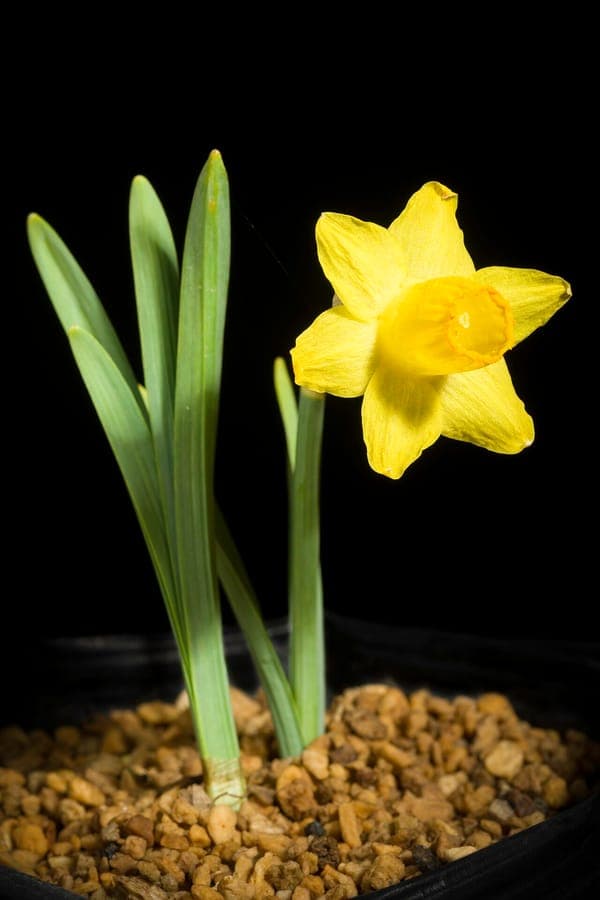
sunoochi from Sapporo, Hokkaido, Japan / CC BY 2.0, via Wikimedia Commons
Lesser daffodil: complete guide
Narcissus minor
¿Quieres ver Lesser daffodil: complete guide en tu jardín?
1 minuto, sin tarjeta de crédito
Overview
Narcissus minor, the lesser daffodil, is a charming early-spring bloomer native to Pyrenean and northern Spanish mountains. This compact, delicate bulb with cheerful yellow flowers is ideal for rock gardens, alpine troughs, border edges, and naturalized woodland plantings. Despite its diminutive stature, it delivers bold early-season color.
Appearance and flowering period
Lesser daffodil reaches merely 15-30 centimeters, making it exceptionally suitable for small gardens and container cultivation. Fine, grass-like foliage emerges in earliest spring. Individual pure yellow flowers feature a small trumpet corona surrounded by larger yellow petals. Each bulb produces one to two flowers. Blooming extends from March through April, depending on location and weather.
Ideal location
Narcissus minor thrives in full sun to light shade. Provide minimum four hours direct sunlight for optimal flowering. The bulb tolerates dry to moderately moist sites equally well. It excels in rock gardens, scree, dry borders, and even naturalized grass meadows. In wilder garden schemes, it creates striking spring accents.
Soil requirements
Lesser daffodil accepts diverse soils from sand to clay. Light, fertile soil suits it well. For maximum bloom, add balanced bulb fertilizer at planting. Drainage is critical: waterlogging causes rot. Slightly acidic to neutral pH (6.5-7.5) is optimal.
Diseño gratis
¿Quieres ver Lesser daffodil: complete guide en tu jardín? Crea un diseño gratis ahora.
Watering
After autumn planting, keep soil lightly moist until shoots emerge. During growth (February-April), water if drought occurs. After flowering (May-June), gradually reduce watering to allow bulb ripening. Extended summer dryness is tolerated and actually promotes dormancy.
Pruning
No pruning is necessary. Leave spent flowers on the plant until naturally shed. Do not cut flowering stems until foliage yellows, as nutrients flow back to the bulb. Remove yellowed foliage after natural senescence.
Maintenance calendar
September-October: Plant bulbs. November-January: Minimal care. February: Protect young shoots from hard frosts. March-April: Monitor moisture, water only if very dry. May-June: Allow foliage yellowing; limit watering. July-August: No care required; bulbs dormant.
Winter hardiness
Narcissus minor is fully hardy to USDA zone 3 (-35degC). This alpine/Pyrenean native tolerates cold, snow, and frost without protection. No winter safeguards needed throughout Netherlands and Belgium.
Companion planting
Plant bulbs in clusters of 10-25 for striking visual impact. Combine with fellow early bloomers like Crocus, Chionodoxa, and Hyacinthus. For naturalistic effects, scatter bulbs randomly in grass meadows or rock garden corners. Perennializing bulbs return reliably for years.
Closing
The lesser daffodil delivers refined yellow beauty in earliest spring. With minimal care, it reliably returns year after year. Available at major garden centers. Discover more design inspiration on gardenworld.app.
¿Quieres ver Lesser daffodil: complete guide en tu jardín? Crea un diseño gratis ahora.
Sube una foto, elige un estilo y obtén un diseño fotorrealista con lista de plantas en menos de un minuto.
Más de 10.000 jardines diseñados
Sin tarjeta de crédito


Plantas similares
Douglas' Onion: complete guide
Allium douglasii
Douglas' onion is a compact ornamental allium with purple flowers, perfect for rock gardens and sunny borders. Learn care, siting and hardiness.
Oblique onion: complete guide
Allium obliquum
The oblique onion is a hardy ornamental allium with chartreuse flower heads and blue-green foliage. Location, soil and care explained.
False hooded garlic: complete guide
Allium pseudocalyptratum
Discover false hooded garlic (Allium pseudocalyptratum): a rare ornamental onion from Lebanon for rock gardens and alpine troughs.