
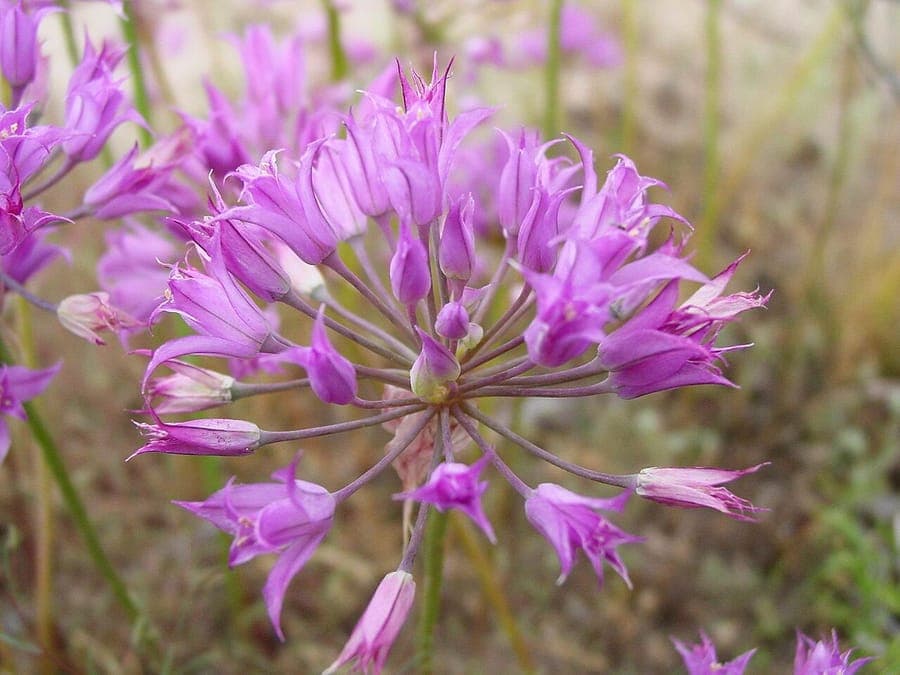
Douglas' Onion: complete guide
Allium douglasii
¿Quieres ver Douglas' Onion: complete guide en tu jardín?
1 minuto, sin tarjeta de crédito
Overview
Douglas' onion (Allium douglasii) is a small, bulb-forming perennial in the amaryllis family, Amaryllidaceae. The species occurs naturally from southeastern Washington State to northeastern Oregon, growing on dry, rocky slopes and open grassland across the Columbia Plateau. That region experiences hot, dry summers and cold winters, which makes Douglas' onion a distinctly drought-adapted bulb.
In gardens, this ornamental onion is prized by rock garden and gravel garden enthusiasts. The plant forms a tidy clump of narrow, blue-green leaves and produces charming spherical flower heads in a vivid purple shade during late spring to early summer. Because the species remains relatively obscure to most gardeners, it lends a refreshing, authentic character to plantings that otherwise rely on familiar ornamental onions such as Allium cristophii or Allium sphaerocephalon.
The botanical name honors the Scottish plant collector David Douglas, who catalogued numerous species across the Pacific Northwest in the early nineteenth century. In the wild, the bulb often grows among basalt outcrops and dry bunchgrasses alongside other characteristic steppe plants of the inland Northwest. For gardeners seeking something beyond the common Allium giganteum or Allium hollandicum, this smaller, wilder-looking species offers a refreshing alternative with an informal, naturalistic feel.
Appearance and bloom
Douglas' onion stays low and compact, typically reaching only 15 to 30 centimetres in height including the flower stem. The leaves are strap-like, grey-green in colour, and emerge from the base of the bulb. Foliage has a medium texture and frequently dies back around bloom time, a trait it shares with many other drought-tolerant ornamental onions.
The flower heads are round to semi-round, composed of dozens of small star-shaped florets in a striking purple hue. Bloom typically occurs in May and June, when most other ornamental onions have either not yet started or have already finished, making Douglas' onion a welcome addition to the flowering calendar. After flowering, brown seed capsules develop, giving the plant an attractive winter silhouette if left standing.
Ideal location
This ornamental onion needs a warm, sunny spot with at least six hours of direct light per day. A sheltered site against a south-facing wall, in a gravel garden, or nestled among rocks closely mirrors the natural growing conditions found in the dry interior of Washington and Oregon.
Avoid shady or damp locations, since Douglas' onion cannot tolerate wet feet, particularly during winter dormancy. In a mixed border, the plant pairs well with other drought-tolerant perennials that share the same sunny, well-drained requirements. It also performs beautifully in containers on a sunny patio, provided drainage is adequate.
Soil
The ideal soil for Douglas' onion is light, free-draining, and rather lean rather than rich. In the wild, the bulb grows in sandy to gravelly soil with a pH between 6.0 and 7.8, ranging from slightly acidic to slightly alkaline. Heavy clay is unsuitable unless substantially amended with coarse sand or grit to improve drainage.
When planting in an ordinary garden border, it helps to add a layer of grit or sharp sand beneath the bulb. This prevents rot during wet spells. Fertilising is rarely necessary; excess nitrogen encourages weak, floppy foliage at the expense of flowering.
Diseño gratis
¿Quieres ver Douglas' Onion: complete guide en tu jardín? Crea un diseño gratis ahora.
Watering
During spring, while actively growing and flowering, Douglas' onion needs moderate moisture, roughly matching natural rainfall. Supplemental watering during prolonged dry spells in April and May encourages a fuller bloom, but overwatering should always be avoided.
Once the foliage begins to yellow after flowering, watering can be reduced significantly or stopped altogether. The bulb then enters a dormancy period typical of drought-adapted summer bulbs. Excess moisture during this rest phase is the most common cause of bulb rot in this species.
Pruning
Maintenance mostly involves removing spent flower stems, unless you wish to leave the ornamental seed capsules for winter interest or seed collection. Remove yellowed foliage only once it has fully died back, allowing the bulb to store reserves for the following season.
An annual tidy-up in late summer, clearing away dead plant material, keeps the border neat and reduces fungal problems. Pruning in the conventional sense, as with shrubs, does not apply to this bulb.
Maintenance calendar
March-April: new shoots emerge; water lightly during dry spells.
May-June: main bloom period with purple flower heads; deadhead spent flowers if desired.
July-August: foliage dies back, bulb enters dormancy; reduce watering substantially.
September-October: dormancy continues; ideal time to plant new bulbs at 8-10 centimetres depth.
November-February: full winter dormancy; no maintenance required.
Winter hardiness
Douglas' onion is hardy to USDA zone 5, corresponding to hardiness zones common across the Netherlands, Belgium, and much of Germany and France. The bulb tolerates frost down to roughly minus twenty degrees Celsius without protective measures.
More important than cold tolerance is drainage: in regions with wet winters, free-draining soil is essential to prevent bulb rot. A layer of grit or a raised bed helps in heavier soils. Once established, the plant requires little attention and returns reliably year after year.
Companion plants
Douglas' onion pairs beautifully with other sun-loving perennials from dry regions, such as Salvia nemorosa, Nepeta, and lavender. In a gravel garden, this ornamental onion creates lovely contrast with ornamental grasses like Stipa tenuissima, whose fine texture highlights the rounded flower heads. Garden centres in the Netherlands and Belgium increasingly stock a range of smaller species alliums alongside these staple perennials, making it easy to source companion plants for a cohesive, drought-tolerant scheme.
Planted alongside other ornamental onions, such as Allium cernuum or Allium stellatum, it creates a varied display with different bloom times and forms. For a naturalistic, prairie-style planting, Douglas' onion combines well with Echinacea and Achillea, plants that appreciate the same sunny, well-drained conditions.
Low-growing rock roses and sedums fill the space around the dying foliage of the onion, preventing bare patches from forming in the border. Planting bulbs in small clusters of five to ten, rather than scattered individually, produces a fuller, more naturalistic bloom that better reflects the species' wild appearance.
Closing
Douglas' onion is an underappreciated ornamental allium that, with its compact form and purple flower heads, offers a surprising addition to any sunny, well-drained border. Once planted in the right soil and location, this bulb requires very little maintenance and returns reliably for years. Visit GardenWorld to see how this ornamental onion fits into a complete garden design, and check the GardenWorld plant database for further care details.
¿Quieres ver Douglas' Onion: complete guide en tu jardín? Crea un diseño gratis ahora.
Sube una foto, elige un estilo y obtén un diseño fotorrealista con lista de plantas en menos de un minuto.
Sin tarjeta de crédito


Plantas similares
Allium cernuum: complete guide
Allium cernuum
Allium cernuum, nodding onion. North American wildflower with elegantly drooping pink flowers. Perfect for natural gardens and dry borders in landscapes.
Autumn Onion (Allium stellatum): complete guide
Allium stellatum
Discover Autumn Onion: rosy-purple star flowers August to October, North American native, full sun, drought-tolerant. Perfect for wild gardens and dry borders.
Allium acuminatum: complete guide
Allium acuminatum
Hooker's onion is a delicate alpine bulb with charming purple flowers and fine grass-like foliage. Perfect for dry gardens and rock gardens.