
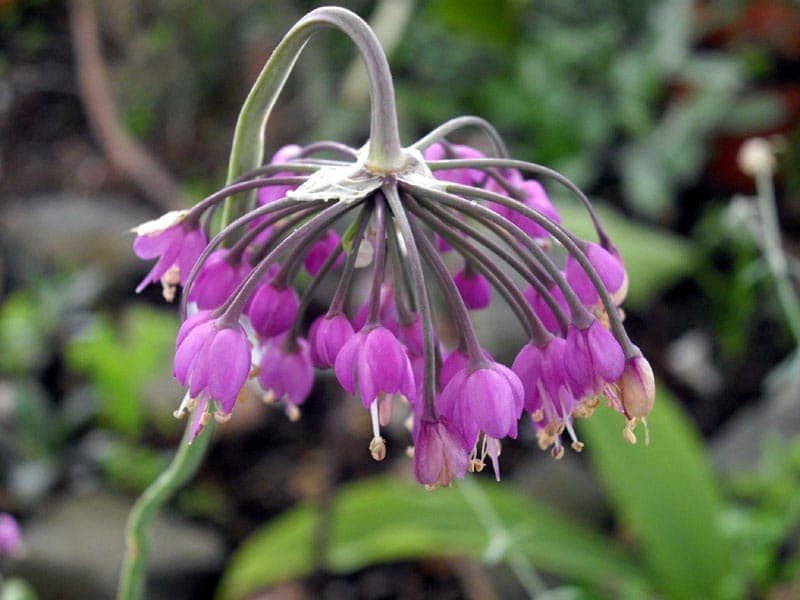
ghislain118 http://www.fleurs-des-montagnes.net / CC BY-SA 3.0, via Wikimedia Commons
Allium cernuum: complete guide
Allium cernuum
¿Quieres ver Allium cernuum: complete guide en tu jardín?
1 minuto, sin tarjeta de crédito
Overview
Allium cernuum, commonly called nodding onion or lady's leek, is a native North American wildflower that combines elegance with simplicity. The wild bloom thrives from Canada through Mexico and establishes itself in diverse ecological environments. Gardeners particularly appreciate it for its nodding flower umbels that resemble tiny ballet dancers.
This hardy bulb plant reaches 30 to 60 centimeters in height, blooming July through August with pink to magenta flowers. The nodding onion is completely winter hardy, simple to cultivate and an excellent choice for natural gardens.
Appearance and bloom
The nodding onion grows from underground bulbs with slender, hollow leaves reaching 20-30 centimeters long. The leaves stand upright and linear, gray-green in color, giving the plant a grass-like appearance when not in bloom.
From July through August appear leafless stems, 30-60 centimeters tall, with a nodding clustered inflorescence at the apex. This inflorescence maintains its drooping posture, hence the common name. The small two-toned flowers range from pink to magenta, sometimes white, roughly 1 centimeter in diameter.
The floral display attracts numerous butterflies and bees, making the nodding onion perfect for insect-friendly gardens. After blooming, seed capsules form and remain ornamentally interesting through late summer.
Ideal location
The nodding onion thrives in full sun to partial shade. Minimum 6 hours of direct sunlight daily ensures optimal blooming. The plant grows in partial shade as well, though fewer flowers are produced.
Plant in front borders, along pathways or within wildflower meadows. The compact growth makes it suitable for small gardens. It combines beautifully with other native wildflowers and ornamental grasses.
Which location provides ample growing opportunities. Plant bulbs minimum 10 centimeters apart.
Soil
The nodding onion is not fussy and accepts various soil types as long as drainage is excellent. Sandy, loamy and even rocky soils are suitable. pH between 5.5 and 7.5 is ideal, though the plant is flexible.
Good drainage is essential - this plant cannot tolerate waterlogging. In heavy clay, add compost and sand. Organic material helps, but do not overdo it - the nodding onion thrives in poor soils.
When planting, place bulbs 7-8 centimeters deep and 10 centimeters apart. This creates impressive cluster groupings after several years.
Diseño gratis
¿Quieres ver Allium cernuum: complete guide en tu jardín? Crea un diseño gratis ahora.
Watering
Once established, the nodding onion is quite drought tolerant. Water regularly the first year to establish strong root systems. Subsequently they perform well without supplemental water, especially in temperate climates.
In hot, dry summers supplemental water may help, especially around blooming period. Avoid waterlogging - this causes bulb rot.
After blooming, no additional water is needed. The bulbs go dormant awaiting next spring.
Pruning
The nodding onion requires minimal pruning. Leave spent flowers standing - these produce seed. If you wish to save seed yourself, allow them to mature until brown, then harvest.
Allow dead leaf material to stand until the plant is completely yellow, which allows nutrient remineralization back into the bulb. In early spring dead material can be removed.
Maintenance calendar
March: Wait for new growth to appear. Remove dead winter material.
April through May: Advancing growth. Light supporting watering helps.
June: Preparation for blooming. Plant continues healthy growth.
July through August: Blooming period! Enjoy the beautiful drooping flowers.
September: Seed ripening if you wish to save seed. Otherwise no action needed.
October through February: Rest period. Bulbs sleep underground.
Winter hardiness
The nodding onion is completely hardy to USDA zone 3 (to -40 degrees C), much colder than necessary in temperate regions. This is an extremely frost-resistant plant.
Once planted no special winter protection is needed. Mulch can help in very harsh climates, but is not essential.
Companion plants
The nodding onion combines beautifully with: Echinacea (purple coneflower), Rudbeckia (black-eyed susan), delicate grasses, and other native wildflowers. Together they create a natural, woodland-floor aesthetic.
Also stunning with lavender, sage and other Mediterranean herbs. The color combination of pink Allium cernuum with blue-purple lavender is remarkable.
Closing thoughts
The nodding onion is a jewel for gardeners seeking simplicity and beauty without much work. With its unique nodding flowers, drought tolerance and butterfly attraction, Allium cernuum is an excellent choice. This should be standard in every natural or ecological garden.
Seek bulbs from specialized bulb retailers, especially around September-October. Plant in groups for maximum effect. You will enjoy them year after year.
¿Quieres ver Allium cernuum: complete guide en tu jardín? Crea un diseño gratis ahora.
Sube una foto, elige un estilo y obtén un diseño fotorrealista con lista de plantas en menos de un minuto.
Más de 10.000 jardines diseñados
Sin tarjeta de crédito


Plantas similares
Douglas' Onion: complete guide
Allium douglasii
Douglas' onion is a compact ornamental allium with purple flowers, perfect for rock gardens and sunny borders. Learn care, siting and hardiness.
Oblique onion: complete guide
Allium obliquum
The oblique onion is a hardy ornamental allium with chartreuse flower heads and blue-green foliage. Location, soil and care explained.
False hooded garlic: complete guide
Allium pseudocalyptratum
Discover false hooded garlic (Allium pseudocalyptratum): a rare ornamental onion from Lebanon for rock gardens and alpine troughs.