
Oblique onion: complete guide
Allium obliquum
¿Quieres ver Oblique onion: complete guide en tu jardín?
1 minuto, sin tarjeta de crédito
Overview
The oblique onion (Allium obliquum) is a striking ornamental onion from the Amaryllidaceae family, native to the steppes and dry grasslands of Central Asia and Eastern Europe: from Romania through southern Russia, Kazakhstan and Kirgizstan to the Altay region and Mongolia. Across this vast continental range the plant grows on rocky slopes and in dry steppe vegetation, where it is used both as an ornamental and, in its home region, as a vegetable.
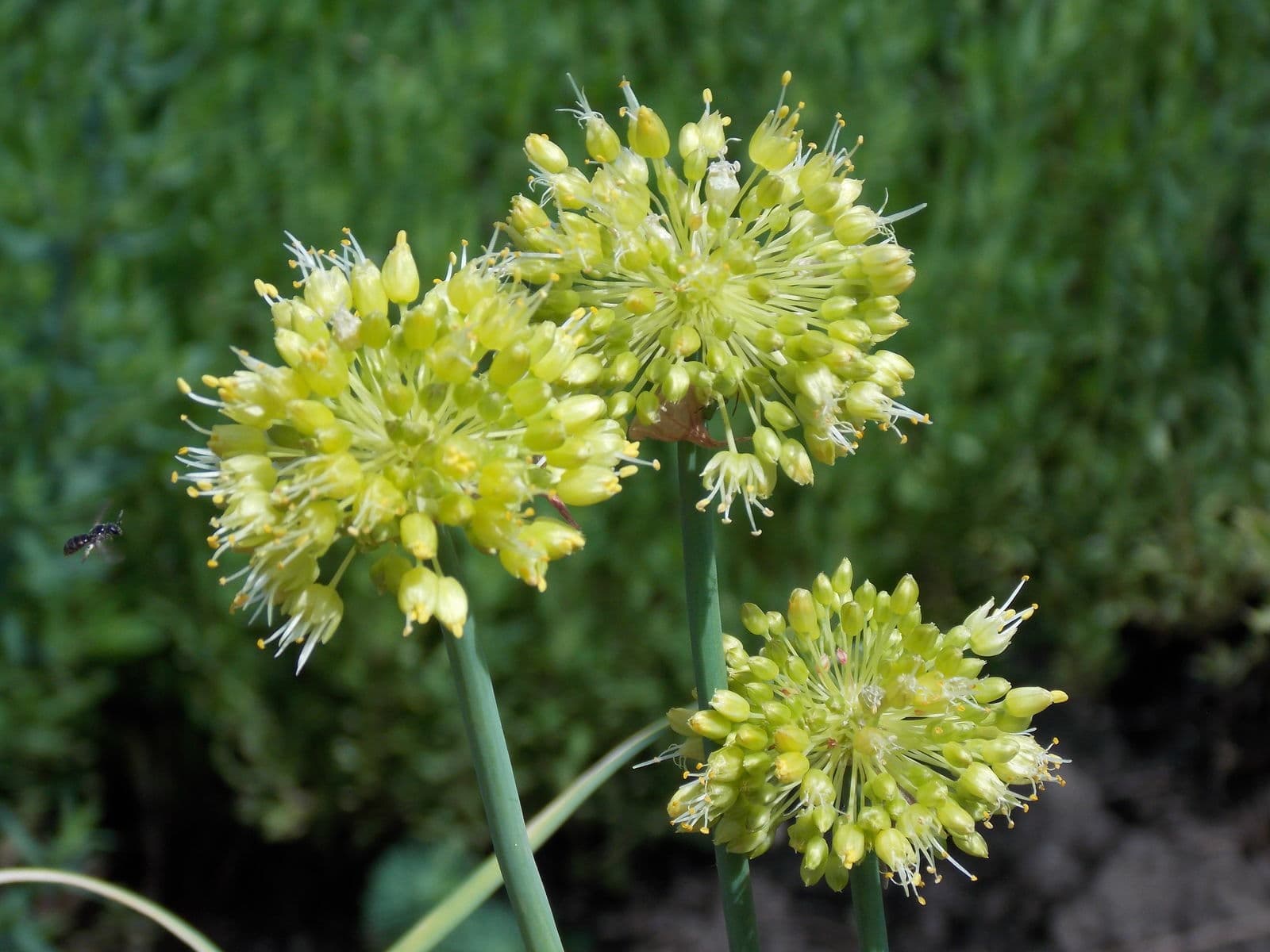
What makes this onion special within the genus Allium is its colour: instead of the usual purple or white flower heads, the oblique onion carries firm, greenish-yellow to chartreuse globes. Combined with the striking blue-green, slightly twisted foliage (hence the species name obliquum, "oblique" or "twisted"), it is an architectural addition to gravel gardens, steppe plantings and borders with ornamental grasses.
Appearance and bloom
The oblique onion forms a low rosette of broad, blue-green leaves with a characteristic slightly twisted or asymmetric arrangement close to the ground. From this foliage a sturdy, bare flower stem shoots up in early summer, reaching 50 to 80 cm, ending in a dense, round flower head 4 to 5 cm across.
The individual flowers are small, star-shaped and greenish-yellow to chartreuse, an unusual shade among ornamental onions that pairs beautifully with silver-grey foliage and purple neighbours. Bloom falls in June and July and attracts large numbers of bees and other pollinating insects. After flowering, the seed heads remain decorative, drying into round brown structures that keep ornamental value well into late summer.
Ideal location
Plant the oblique onion in full sun, with at least 6 to 8 hours of direct sunlight a day. Its continental steppe origin makes it especially suited to gravel gardens, rocky borders, prairie-style plantings and sunny, dry edges where many other bulbs struggle.
The plant combines beautifully with ornamental grasses such as Stipa and Festuca, which help disguise the bare lower stem. In moist, shady gardens the oblique onion blooms considerably less and the risk of bulb rot increases.
Soil
The oblique onion is undemanding about soil as long as drainage is good. A moderately fertile, free-draining soil with a pH between 6.0 and 7.5 is ideal; the plant also tolerates lime-rich, slightly alkaline soil without issue, fitting its steppe origins.
Plant the bulbs 8 to 10 cm deep and 15 cm apart (matching the recommended row spacing for this crop), in September or October, well ahead of the first frost. On heavy clay, it is wise to work coarse sand or grit into the planting hole to prevent bulb rot. Compost at planting time is sufficient; extra feeding is rarely needed.
Watering
During emergence and bloom in spring and early summer, water the oblique onion occasionally during prolonged dry spells, roughly once a week. As soon as the foliage begins to yellow after flowering, cut back watering quickly.
After blooming, when the bulb enters rest, the oblique onion is markedly drought-tolerant and needs almost no water during its summer dormancy; too much moisture during this period is actually harmful and can cause bulb rot. In winter, supplemental watering is never needed.
Diseño gratis
¿Quieres ver Oblique onion: complete guide en tu jardín? Crea un diseño gratis ahora.
Pruning
Pruning is limited to removing spent flower stems, although many gardeners leave the dried flower heads standing for their ornamental value in late summer and for dried arrangements. Always let the foliage yellow and die back completely after flowering before removing it: this is essential to give the bulb enough stored energy for next year's bloom.
Remove dead foliage only once it is brown and dry, usually in August.
Maintenance calendar
March-April: new foliage emerges; check the soil for excess moisture after winter.
May-June: flower stem shoots up; full bloom with chartreuse heads begins.
July: flowering ends; seed heads form and slowly dry.
August: foliage yellows and dies back; reduce watering.
September-October: the best time to plant new bulbs or divide existing clumps.
November-February: bulbs rest underground; no maintenance needed beyond a winter check on drainage.
Winter hardiness
Thanks to its origin in the cold, continental steppes of Mongolia, the Altay and Siberia, the oblique onion is exceptionally winter-hardy: USDA zone 3 to 8, tolerating temperatures well below -30°C. For gardens in the Netherlands, Belgium and Germany (typically zone 7-8), this is more than sufficient.
The bulbs overwinter without any protection as long as drainage is adequate. Only in extremely wet, heavy clay soil can winter freeze-thaw combined with moisture lead to bulb rot.
Companion plants
The unusual chartreuse flower colour of the oblique onion pairs surprisingly well with silver-grey plants such as Perovskia, Artemisia and Eryngium, and with ornamental grasses like Stipa tenuissima, Festuca glauca and Panicum. For a lively colour contrast, plant it near purple-flowering species such as Allium sphaerocephalon, Salvia nemorosa or Nepeta.
In a steppe or prairie-style garden, the oblique onion combines with Echinacea, Achillea and Sedum species to form a tough, low-maintenance planting that holds structure all season.
Propagation
Propagation is by seed or by dividing bulb clusters. Sow freshly harvested seed outdoors right after harvest in autumn in a free-draining seed mix; germination usually follows in spring after a natural cold period. Seedlings typically flower only after two to three years.
Dividing bulb clusters is the fastest route to flowering plants. Dig up the bulbs in late summer, once the foliage has fully died back, separate the offset bulbs from the parent and replant immediately at 8 to 10 cm depth. Bulbs are available from specialist bulb growers who focus on rare and botanical Allium species.
Pests and diseases
Like many onion relatives, the oblique onion suffers little from pests and diseases thanks to its natural sulphurous scent, which deters many insects and even deer and rabbits. In wet soil, bulb rot can occur, recognisable by a soft, discoloured bulb; improve drainage if this happens.
Onion fly and aphids appear occasionally but rarely cause serious damage. When buying bulbs from a garden centre, choose firm, dry specimens without soft spots or mould.
Closing
The oblique onion is a rewarding, winter-hardy ornamental onion whose unique chartreuse flower colour gives any gravel garden or steppe planting a surprising accent. With minimal care and a well-drained, sunny spot, this Asian steppe native blooms abundantly year after year. GardenWorld can help you design a drought-tolerant border featuring unusual bulbs. Visit GardenWorld for garden design and the GardenWorld plant database for more species.
¿Quieres ver Oblique onion: complete guide en tu jardín? Crea un diseño gratis ahora.
Sube una foto, elige un estilo y obtén un diseño fotorrealista con lista de plantas en menos de un minuto.
Sin tarjeta de crédito


Plantas similares
Douglas' Onion: complete guide
Allium douglasii
Douglas' onion is a compact ornamental allium with purple flowers, perfect for rock gardens and sunny borders. Learn care, siting and hardiness.
False hooded garlic: complete guide
Allium pseudocalyptratum
Discover false hooded garlic (Allium pseudocalyptratum): a rare ornamental onion from Lebanon for rock gardens and alpine troughs.
White-margined daffodil (Narcissus albimarginatus): complete guide
Narcissus albimarginatus
Meet the white-margined daffodil (Narcissus albimarginatus): a rare Moroccan dwarf daffodil for alpine troughs and bulb frames.