
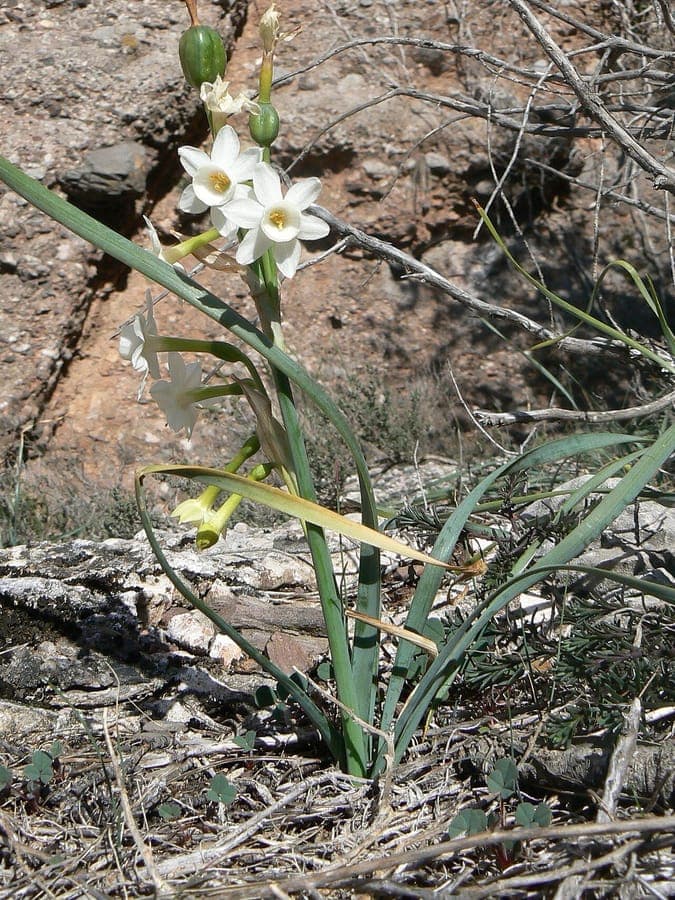
No machine-readable author provided. CavallBernat assumed (based on copyright claims). / Public domain, via Wikimedia Commons
Narcissus dubius: complete guide
Narcissus dubius
¿Quieres ver Narcissus dubius: complete guide en tu jardín?
1 minuto, sin tarjeta de crédito
Overview
Narcissus dubius, known as Doubtful Daffodil or Narcisse douteux, is an elegant and graceful daffodil native to southern France and Spain. This member of the Amaryllidaceae family flowers in spring, bringing refined white blooms with delicate tones to any garden.
This plant grows from a bulb and forms grass-like foliage and slender, elegant flower stems. It's not invasive and thrives in Mediterranean and temperate climates. Narcissus dubius requires minimal maintenance once planted and returns reliably each spring.
Its principal value lies in its elegant, white flowers with yellow or cream-colored trumpet-shaped coronas. Many gardeners treasure it for its naturalization potential in wild grass and borders.
Appearance and Bloom
Narcissus dubius typically grows 15-30 centimeters tall, with narrow, grass-like foliage that remains green after flowering. Flowers are small to medium-sized, white with yellow or cream trumpet-corona.
Each bulb produces one to several flowers per spring. The flowers have a subtle, pleasant fragrance that attracts numerous pollinators.
Blooming extends February through April, earlier than many other daffodils. In frost regions, flowers may emerge cautiously.
Ideal Location
Narcissus dubius grows best in full sun to partial shade. Position it where it receives at least three to four hours of direct sun daily. It also grows in lightly partial shade situations.
The plant suits borders, groupings under trees (especially in late-blooming woodland), rock gardens and meadows. It naturalizes beautifully in wild grass.
Locations with good drainage are preferred to avoid root rot.
Soil
Narcissus dubius prefers well-draining soils. It grows in diverse soil types but performs best in neutral to slightly alkaline soil (pH 6.5-8.0). It's undemanding about nutrients.
Ensure adequate drainage; waterlogging, especially in winter, can be fatal to bulbs. If you have heavy clay soils, add coarse sand and compost.
Once planted and established, the plant requires no special nutrients.
Diseño gratis
¿Quieres ver Narcissus dubius: complete guide en tu jardín? Crea un diseño gratis ahora.
Watering
Narcissus dubius requires minimal artificial watering. During growth and bloom periods (winter-spring), regular rainfall is usually sufficient. Avoid waterlogging, especially in winter.
Once bloomed and foliage yellows, you can reduce watering. In summer you can withdraw water altogether if letting bulbs rest.
The plant is reasonably drought-tolerant once established.
Pruning
Narcissus dubius requires minimal pruning. Remove spent flowers for neatness, but leave foliage until it yellows naturally. This allows the bulb to rebuild reserves for next season.
Remove dead foliage only when fully dried.
Maintenance Calendar
October-November: Bulb planting. Plant bulbs 10-15 centimeters deep in well-drained soil.
February-April: Bloom period. Enjoy white flowers. Minimal maintenance needed.
April-May: Bloom ends. Foliage yellows. Leave foliage standing.
May-August: Summer rest. Minimal water. Bulbs ripen and gain energy.
August-October: Bulb preparation. No special care required.
Winter Hardiness
Narcissus dubius is very cold-hardy to about -15 degrees Celsius. It grows permanently in USDA zones 4-9, though it thrives best in zones 7-9. In cold areas, bulbs can be planted deeper for extra protection.
In Mediterranean and temperate regions it grows without issue outdoors.
Companion Plants
Narcissus dubius pairs well with:
- Other spring bulbs (tulips, hyacinths, crocuses)
- Helleborus (Christmas rose)
- Brunnera (Siberian bugloss)
- Violets and primulas
- Grass and wildflowers for naturalization
Closing Thoughts
Narcissus dubius is an elegant and reliable spring flower for diverse garden situations. With its refined white flowers and light fragrance, it brings grace and spring hope. Plant bulbs in autumn, and enjoy years of reliable return bloom.
For UK and Irish gardeners, check bulb suppliers for stock in September-October. Narcissus dubius is modest in price and very rewarding to grow.
Also explore naturalizing in wild grass or woodland edges for a more natural, wild appearance.
¿Quieres ver Narcissus dubius: complete guide en tu jardín? Crea un diseño gratis ahora.
Sube una foto, elige un estilo y obtén un diseño fotorrealista con lista de plantas en menos de un minuto.
Más de 10.000 jardines diseñados
Sin tarjeta de crédito


Plantas similares
Douglas' Onion: complete guide
Allium douglasii
Douglas' onion is a compact ornamental allium with purple flowers, perfect for rock gardens and sunny borders. Learn care, siting and hardiness.
Oblique onion: complete guide
Allium obliquum
The oblique onion is a hardy ornamental allium with chartreuse flower heads and blue-green foliage. Location, soil and care explained.
False hooded garlic: complete guide
Allium pseudocalyptratum
Discover false hooded garlic (Allium pseudocalyptratum): a rare ornamental onion from Lebanon for rock gardens and alpine troughs.