
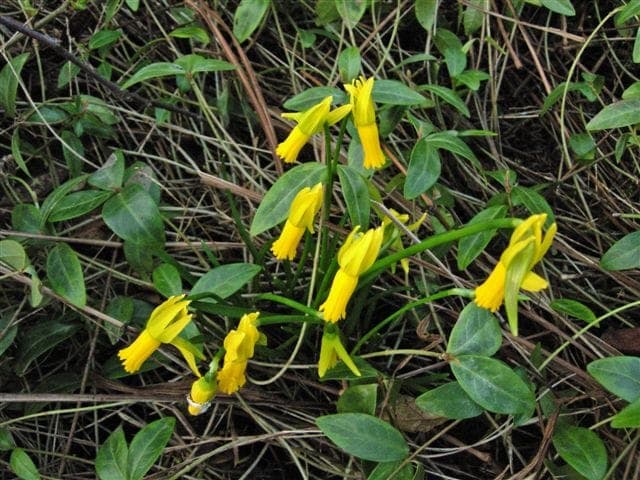
Francine Riez / CC BY-SA 3.0, via Wikimedia Commons
Narcissus cyclamineus: complete guide
Narcissus cyclamineus
¿Quieres ver Narcissus cyclamineus: complete guide en tu jardín?
1 minuto, sin tarjeta de crédito
Overview
Narcissus cyclamineus is an exceptional and rare daffodil from the Amaryllidaceae family. This elegant spring bloomer originates from northwestern Spain and Portugal and is renowned for its unique flowers with strongly recurved petals. The plant forms a stunning accent in spring garden designs, attracting more attention than many conventional daffodils.
Despite its exotic appearance, Narcissus cyclamineus proves surprisingly easy to cultivate and extremely hardy. This special bulb deserves a place in every serious gardener's collection.
Appearance and Bloom
Narcissus cyclamineus grows to approximately 20-25 centimetres in height and blooms in early spring (March-April). The characteristic flowers are golden yellow with longer, back-curved petals that strongly reflex backward, giving the plant its name from its resemblance to cyclamen flowers.
Each bulb typically produces a single, elegant flower with an elongated crown. The leaves are narrow and blue-green, forming a compact rosette growth. The plant reaches full height only weeks before blooming.
Ideal Location
Narcissus cyclamineus thrives best in sunny to partially shaded locations with well-drained soil. For most colourful blooms, gardenworld.app recommends locations with at least four hours of direct sunlight daily. The plant tolerates more shade than many other narcissi.
Use rock gardens, small gardens and borders where the delicate flowers remain fully visible. Under deciduous trees, plant this daffodil in early spring before leaves unfold.
Soil
The plant grows optimally in well-drained, not overly fertile soil. Improve heavy clay soils with sand and gravel to prevent waterlogging. For container growing, use a well-drained bulb growing mix.
Narcissus cyclamineus thrives in slightly acidic to neutral soil (pH 6.0-7.5). Add some sand or peat moss during planting to improve drainage, especially in wet areas.
Watering
During growth and bloom periods, maintain consistently moist but never waterlogged soil. After flowering, allow foliage to persist until it naturally dies back, which returns nutrients to the bulb. Summer months require less water as the plant rests.
In containers, drain regularly and let the top soil layer dry between waterings. Prevent standing-water diseases through good drainage and air circulation.
Diseño gratis
¿Quieres ver Narcissus cyclamineus: complete guide en tu jardín? Crea un diseño gratis ahora.
Pruning
Remove faded flowers to prevent seed setting, but leave green foliage intact until natural senescence. This repeated nutrition returns to the bulb. Only cut foliage after it completely withers.
With container plants, carefully pluck dead flower stems. Do not damage the bulb during removal.
Maintenance Calendar
October: Plant bulbs 10-15 cm deep with spacing between November-February: Winter dormancy; minimal watering March: Growth begins; start regular watering April: Bloom reaches peak; single fertiliser application May-August: Foliage fully green; reduce watering August-September: Prepare dormancy; reduce watering
Winter Hardiness
Narcissus cyclamineus proves exceptionally hardy, suitable for all European hardiness zones. Bulbs tolerate winter temperatures from -15 to -20 degrees Celsius without damage. No winter protection needed except in exceptionally severe winters with minimal snow cover.
The plant successfully grows in naturalized plantings across many world regions.
Companion Plants
Cyclamen daffodil combines beautifully with other early bulbs like snowdrops, crocuses and other narcissus varieties. Plant them together in clusters for maximum effect. Low-growing ground covers like ivy-leaved creeping plants create good background.
In permanent green areas, dark yellow conifers and silver-foliaged deciduous trees provide elegant contrast to the delicate yellow flowers.
Conclusion
Narcissus cyclamineus offers gardeners a rare chance for elegance and distinction in early spring. With its unique flowers, robust growth and absolute hardiness, this daffodil variety merits inclusion in every collector's garden. Enjoy this stunning spring bloomer in rock gardens, borders or naturalized settings.
Available at leading garden centres. Order bulbs now in autumn for best results. For more inspiration, visit gardenworld.app/en and discover how to incorporate Narcissus cyclamineus into your garden plan.
¿Quieres ver Narcissus cyclamineus: complete guide en tu jardín? Crea un diseño gratis ahora.
Sube una foto, elige un estilo y obtén un diseño fotorrealista con lista de plantas en menos de un minuto.
Más de 10.000 jardines diseñados
Sin tarjeta de crédito


Plantas similares
Douglas' Onion: complete guide
Allium douglasii
Douglas' onion is a compact ornamental allium with purple flowers, perfect for rock gardens and sunny borders. Learn care, siting and hardiness.
Oblique onion: complete guide
Allium obliquum
The oblique onion is a hardy ornamental allium with chartreuse flower heads and blue-green foliage. Location, soil and care explained.
False hooded garlic: complete guide
Allium pseudocalyptratum
Discover false hooded garlic (Allium pseudocalyptratum): a rare ornamental onion from Lebanon for rock gardens and alpine troughs.