
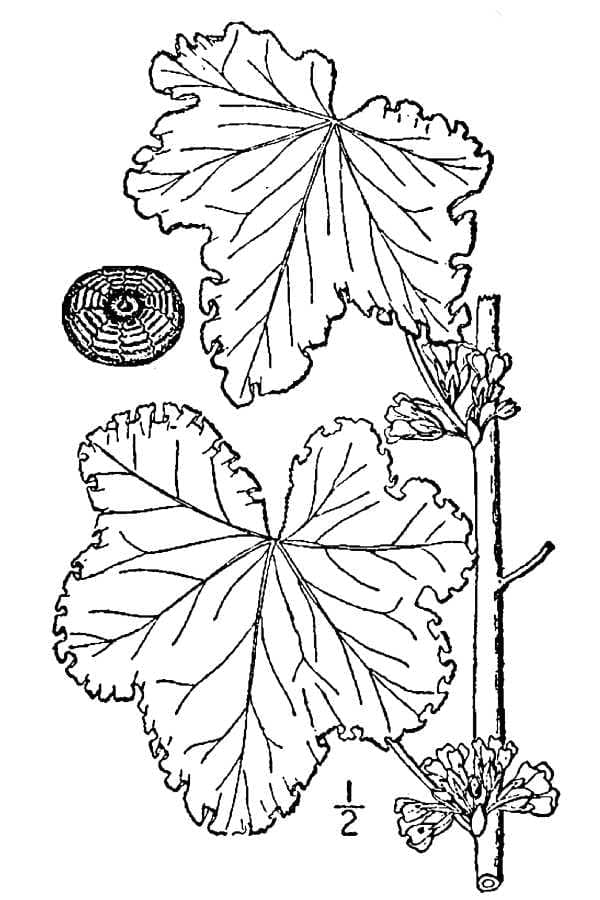
Nathaniel Lord Britton (1859-1934), and A. Brown / Public domain, via Wikimedia Commons
Malva verticillata: complete guide
Malva verticillata
¿Quieres ver Malva verticillata: complete guide en tu jardín?
1 minuto, sin tarjeta de crédito
Overview
Malva verticillata, known as Whorled mallow or Asian mallow, is a fascinating species within the Malva genus with a large distribution range across Northeast Tropical Africa, temperate to tropical Asia and North Myanmar. The botanical name 'verticillata' refers to the characteristic whorled arrangement of flowers along the stem, creating a distinctive pagoda-like silhouette. Unlike many other mallow species, Malva verticillata is also edible: young leaves and fruits can be eaten and are used in traditional Asian cuisine. This makes it a unique 'play fruit' plant that offers both ornamental and nutritional value. Available at garden centers, Malva verticillata offers considerable benefits for Dutch gardeners seeking experimental gardening and looking for both beauty and function on gardenworld.app.
Appearance and Bloom
Malva verticillata reaches heights of 40 to 120 centimeters, variable depending on growing conditions. The plant grows upright with moderately branched stems. The most characteristic feature is the flower arrangement: they grow in whorls (circles) along the stem, resulting in a distinctive pagoda-like or stacked silhouette. This is botanically unique and very ornamental. The leaves are round to heart-shaped, 3 to 8 centimeters large, with softly serrated edges. The foliage is light to medium green and lightly hairy. The flowers are small to medium-sized (approximately 2 to 3 centimeters diameter) in pale lilac to pink tints, sometimes whitish. The blooming period is 8 to 12 weeks from May through September. After bloom, characteristic disc-shaped fruits (seed capsules) form, remaining in the whorled pattern, very decorative.
Ideal Location
Malva verticillata thrives in full sun to light shade. Minimum 5 to 7 hours of direct daily sunlight is ideal. The plant tolerates more shade than many other mallow species and grows reasonably well in partial shade conditions. This makes it suitable for borders where variation in light levels is desirable. Plant in locations with good moisture-retaining soil. The plant is suited for garden edges, herb-combined borders, and mixed flower beds. In gardenworld.app designs, Malva verticillata fits excellently in educational or experimental garden layouts where both ornamental value and functionality are desired.
Soil and Feeding
Malva verticillata accepts virtually all soils from moderately acidic to neutral (pH 5.5 to 7.5). The plant prefers moderately moist, well-draining soils without waterlogging. Poor soils are fine; excessive feeding is detrimental. At planting, work in 3 to 4 centimeters compost. For container culture: 60 percent potting soil with 40 percent garden peat or composted material. Once per season very light feeding (half normal dose) in May/June. Avoid nitrogen after September. This plant accepts somewhat moister soils than many other mallows, which is convenient for less dry garden locations.
Diseño gratis
¿Quieres ver Malva verticillata: complete guide en tu jardín? Crea un diseño gratis ahora.
Watering
Malva verticillata requires more regular water than drought-resistant mallow species, but far less than true hydrophytes. Water regularly so the soil remains evenly moist (but not waterlogged), especially during growth and bloom season (May through September). Weekly 1.5 to 2 centimeters water in normal summers. During prolonged drought: 2 to 3 centimeters monthly. The plant tolerates slightly moister conditions better than its relatives. For containers: water when the top 2 centimeters feel dry. Good drainage is essential. In autumn and winter: less water, but don't allow to dry completely.
Pruning
Malva verticillata responds well to regular deadheading. From June through August: remove spent flowers regularly, which extends the blooming period. Cut just below spent flower. This maintenance can provide weeks of extra bloom. For edible purposes: pinch young leaves regularly (when 4 to 6 leaf pairs are present) for kitchen applications; this also promotes bushier growth. In October, light shaping if plant has become too sprawling. Avoid heavy autumn pruning. For potted plants: regular pinching promotes more compact appearance.
Maintenance Calendar
May: Plant, establish watering in dry periods. June-August: Bloom at full height; remove spent flowers, water regularly, harvest leaves for kitchen. September-October: Bloom diminishes, reduce watering, cease feeding. October-November: Plant largely dies back or enters dormancy. November-February: Winter dormancy; seed can overwinter in soil. March-April: New seedlings may appear. This species is equally a 'cut-and-eat' plant very versatile.
Winter Hardiness
Malva verticillata is classified as USDA zones 7 to 10, thus frost-sensitive. In the Netherlands, this plant must be treated as annual in most winters. In very mild southern Dutch winters, some plants may overwinter with protection. Seeds can survive winters (5 to 10 year soil longevity) and provide self-seeding in spring. For overwintering living plants: move containers to unheated greenhouse or conservatory (5 to 10 degrees). Store seeds cool (12-15 degrees) in dry condition for seeding next season. This plant is better suited to southerly warm zones or for annual cultivation in much of the Netherlands.
Companion Plants
Malva verticillata combines nicely in gardens with culinary and functional focus. In herb gardens: plant alongside Ocimum (basil), Petroselinum (parsley), and Lactuca (lettuce) for mixed salad gardens. For ornamental effects: fine grasses like Pennisetum in yellow-green add movement around the pagoda-like silhouette. Small flowers like Calendula (calendula) in orange form color accents. Nasturtium (nasturtium) grows well in the same moisture conditions. For structure: Heuchera (coral bells) with colored foliage contrasts well. Such mixed border plant combinations create very educational gardenworld.app designs where beauty and function converge.
Conclusion
Malva verticillata is a unique, experimental choice for gardeners seeking both ornamental value and culinary function. With its characteristic pagoda-shaped flower arrangement, edible leaves and fruits, and adequate hardiness in mild regions, this plant offers considerable value. Particularly suited for gardenworld.app users in southern Dutch regions who wish to combine gardening as hobby food production with attractive ornamental value.
¿Quieres ver Malva verticillata: complete guide en tu jardín? Crea un diseño gratis ahora.
Sube una foto, elige un estilo y obtén un diseño fotorrealista con lista de plantas en menos de un minuto.
Más de 10.000 jardines diseñados
Sin tarjeta de crédito


Plantas similares
Malva sylvestris: complete guide
Malva sylvestris
Malva sylvestris: Common mallow with magenta blooms and dark purple veins. Versatile, hardy, easy-growing. European classic.
Malva nicaeensis: complete guide
Malva nicaeensis
Malva nicaeensis: Mediterranean mallow with lilac blooms and decorative foliage. Ideal for dry gardens. Grows 60-100cm tall. Flowers for months.
Egyptian mallow: complete guide
Malva parviflora
Explore Malva parviflora, the Egyptian mallow with delicate pink flowers. Drought-tolerant Mediterranean charmer.