
Alvesgaspar / CC BY-SA 3.0, via Wikimedia Commons
Malva sylvestris: complete guide
Malva sylvestris
¿Quieres ver Malva sylvestris: complete guide en tu jardín?
1 minuto, sin tarjeta de crédito
Overview
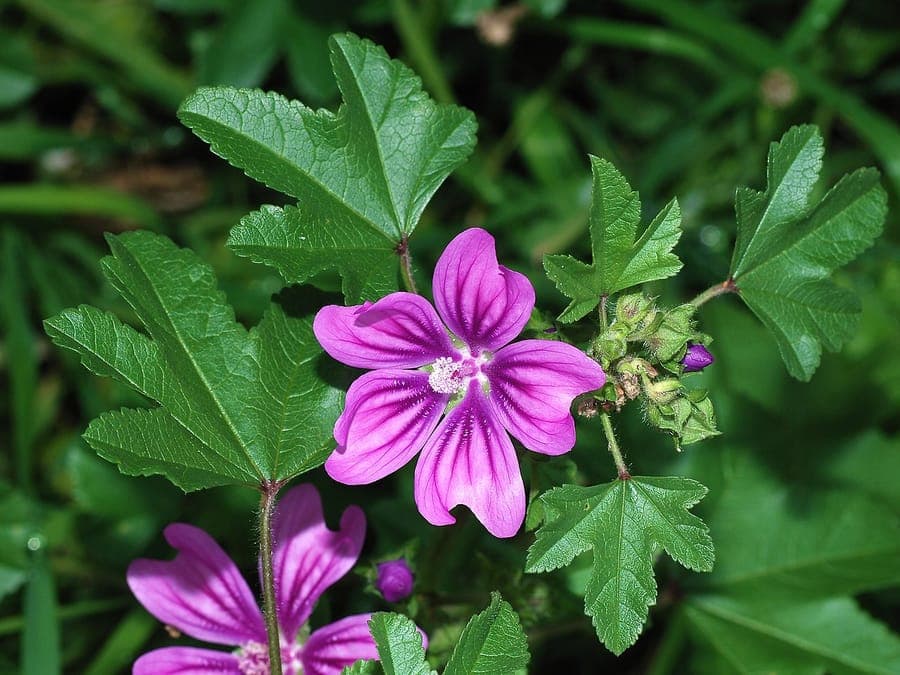
Malva sylvestris, known as Common mallow or Wild mallow, is the most distinctive species in the Malva genus and a classic in European gardens. This annual to perennial herb from the Malvaceae family is widely distributed from Europe to Central Asia and the Western Himalayas. The botanical name 'sylvestris' literally means 'of the forest,' indicating original wild growing sites. This mallow is celebrated for its spectacular dark magenta flowers with characteristic dark purple veins, and above all for its hardiness and minimal maintenance requirements. Malva sylvestris is available at garden centers in seed form. This plant makes an excellent choice for Dutch gardens and fits perfectly in garden designs on gardenworld.app thanks to its versatility and flower abundance.
Appearance and Bloom
Malva sylvestris grows to 80 to 150 centimeters height, considerably larger than many related species. The plant forms a strongly upright, branched shrub with robust, hairy stems. The foliage is strikingly heart-shaped to almost round with deeply serrated edges, 5 to 10 centimeters large. The leaf surface is lightly hairy, giving a fine texture. The flowers are the absolute highlight: large (3 to 4 centimeters diameter), dark magenta to plum-purple with 5 petals, each bearing characteristic dark purple veins radiating from the center. These vein patterns form a botanical art gallery. The blooming period is exceptionally long: 12 to 14 weeks from May through September, sometimes extending to October in warm years. The seed capsules are characteristically disc-shaped with radial segmentation.
Ideal Location
Malva sylvestris thrives best in full sun exposure: at least 6 to 8 hours of direct daily sunlight. While the plant grows in light shade, this results in weaker flowering. Place this mallow in south-facing or west-facing locations for optimal results. The plant is suited for borders, flower garden backgrounds, and against south walls. Due to its height, it's ideal for vertical accenting in garden designs. In gardenworld.app planting schemes, Malva sylvestris lends itself excellently as background elements in borders or as structural plants in mixed flower beds.
Soil and Feeding
Malva sylvestris is remarkably adaptable and grows in virtually any well-draining soil with pH 5.5 to 7.5. This plant accepts poor to fertile soils, sandy grounds, clay soils with improvements, and everything in between. Heavy clay soils should be improved with 25 to 35 percent coarse sand, perlite or garden compost to prevent waterlogging. Actually, excessive feeding is detrimental: it promotes foliage at the expense of flowers. At planting, minimal organic matter suffices (2 to 3 centimeters compost). For container culture: 60 percent potting soil with 40 percent sand. This plant requires virtually no annual feeding; once very lightly in May with half-dose slow-release fertilizer.
Diseño gratis
¿Quieres ver Malva sylvestris: complete guide en tu jardín? Crea un diseño gratis ahora.
Watering
Malva sylvestris is remarkably drought-resistant once established. During the first growing year, water more regularly: 2 to 3 centimeters weekly in dry periods. Thereafter, only supplement during prolonged drought: 2 to 4 centimeters monthly. This mallow tolerates even absolutely dry European summers without damage. Excessive water is detrimental and can cause root rot. The plant is perfectly suited for dry borders, gravel gardens and xeriscape designs. In containers: water when the top 3 centimeters feel dry. Winter requires minimal water.
Pruning
Malva sylvestris responds well to regular deadheading (removal of spent flowers). From June through September: remove spent flowers regularly, which considerably extends the blooming period. Cut just below the spent flower. This simple maintenance can literally provide weeks of extra flowering. In October, pruning to 50 centimeters height promotes more compact growth and recovery for the next season. Avoid drastic autumn pruning. For potted plants: regular pinching of young shoots (when 4 to 6 leaf pairs are present) stimulates bushiness and more flowering.
Maintenance Calendar
May: Plant, grow seedlings, establish watering in dry periods. June-September: Bloom at full height; remove spent flowers, water in dry weeks. October: Reduce watering, light shape pruning, seed capsules can remain for self-seeding. November-February: Plant largely dies back; seed overwinters in soil. March-April: Young seedlings emerge in warm weather. This mallow readily propagates itself via seed.
Winter Hardiness
Malva sylvestris is classified as USDA zones 4 to 9, very winter-hardy. This means this plant overwinters almost everywhere in the Netherlands, even in severe winters to -30 degrees. In established gardens, hardiness ensures continuity. Self-seeders are common: seeds that fall in autumn and winter germinate spontaneously in spring. This provides a natural renewal cycle. For extra security: leave seed capsules in autumn. Seeds can remain viable in soil for many years (5-15 years) and germinate as needed.
Companion Plants
Malva sylvestris combines beautifully with other classic border plants. Delphiniums in blue tints form classic color contrasts with magenta Malva. Lavender (Lavandula) and rosemary (Rosmarinus) create harmonious Mediterranean combinations. White or yellow Gaura lindheimeri provide lighter contrast. For structure: grasses like Miscanthus in fine gold tones add movement. Sage (Salvia) in purple and blue species shares the same growing needs. White Alchemilla mollis adds softer texture. Low groundcovers like Geranium in pink tones beneath mallow height. Such plant compositions are classic English border combinations, perfect for gardenworld.app designs.
Conclusion
Malva sylvestris is an unparalleled classic for any Dutch garden. With its spectacular flowers, extended blooming period, remarkable hardiness and virtually zero maintenance requirements, this mallow arguably offers the most benefits of all garden plants. Perfectly suited for gardenworld.app users seeking reliable, voluptuous flowers for structural planting in modern, classical and informal gardens.
¿Quieres ver Malva sylvestris: complete guide en tu jardín? Crea un diseño gratis ahora.
Sube una foto, elige un estilo y obtén un diseño fotorrealista con lista de plantas en menos de un minuto.
Más de 10.000 jardines diseñados
Sin tarjeta de crédito


Plantas similares
Malva nicaeensis: complete guide
Malva nicaeensis
Malva nicaeensis: Mediterranean mallow with lilac blooms and decorative foliage. Ideal for dry gardens. Grows 60-100cm tall. Flowers for months.
Egyptian mallow: complete guide
Malva parviflora
Explore Malva parviflora, the Egyptian mallow with delicate pink flowers. Drought-tolerant Mediterranean charmer.
Malva pusilla: complete guide
Malva pusilla
Malva pusilla: Dwarf mallow, compact form, purple flowers. Temperate Eurasia, slightly acid to neutral. Ideal for pergolas, borders.