
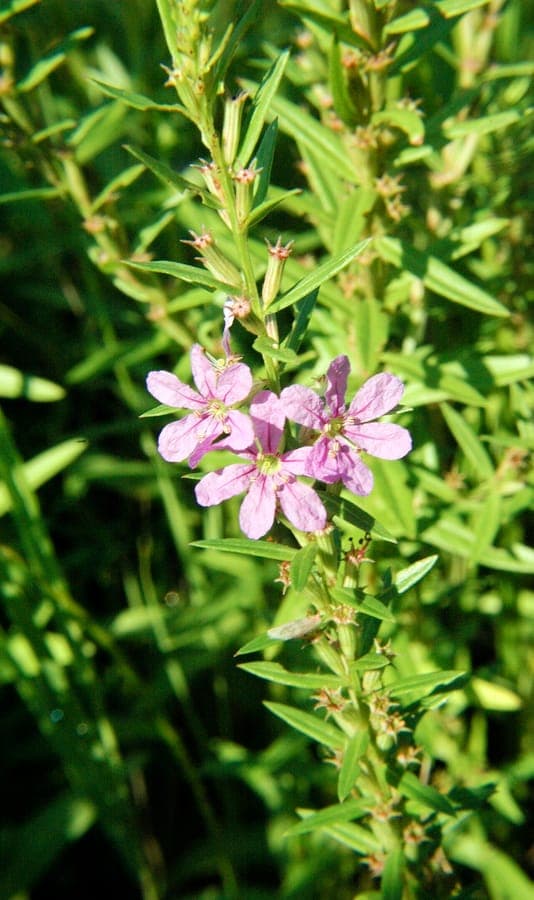
gmayfield10 / CC BY-SA 2.0, via Wikimedia Commons
Winged loosestrife: complete guide
Lythrum alatum
¿Quieres ver Winged loosestrife: complete guide en tu jardín?
1 minuto, sin tarjeta de crédito
Lythrum alatum, known in English as winged loosestrife, wing-angle loosestrife or angled purple loosestrife, is a native North American perennial belonging to the family Lythraceae - the same family as the familiar purple loosestrife Lythrum salicaria. In German it is called Gefluegelter Blutweiderich, in French salicaire ailee. The species name 'alatum' is Latin for 'winged' and refers to the narrow ridges or wings that run along the four angles of the square stem - the distinctive feature that sets this plant apart from its close relatives.
Overview
Lythrum alatum grows naturally in wet meadows, along streambanks, in marshes and on moist open ground across a wide swath of central, eastern and southern North America - from Ontario and Quebec south to Florida and Texas, and across the Gulf Coast to Mexico, Cuba and Hispaniola. Despite its American origin, it adapts well to Northern European gardens and is a valuable perennial for wet corners, pond edges and rain gardens.
As a herbaceous perennial, winged loosestrife reaches 60 to 120 cm in height depending on soil moisture. The upright stems are distinctively square in cross-section, with four slightly ridged angles - the wings of the common name. The plant forms dense clumps that spread slowly by underground rhizomes but is non-invasive, unlike its European relative Lythrum salicaria, which has become a significant wetland weed in North America.
For bees, bumblebees and butterflies, Lythrum alatum is an exceptionally valuable nectar source across its long flowering season from June through September. The small but abundantly produced purple-pink flowers attract a wide range of pollinators and contribute substantially to garden biodiversity. If you want to incorporate this plant into a wetland-themed planting scheme for your front or back garden, gardenworld.app offers design tools to help you plan moisture-loving plant combinations.
Appearance and bloom cycle
The leaves are narrow, lance-shaped to ovate, dark glossy green and stalkless - they clasp the stem directly at the base. On the stem the leaves are arranged alternately or partly in opposite pairs in the upper portion. The plant forms an upright, somewhat bushy clump of multiple stems that gives a well-structured appearance from spring through autumn.
The flowering season extends from June through September, making winged loosestrife one of the longest-blooming perennials available for wet sites. Individual flowers are small - just 1 to 1.5 cm across - but they are produced in such great numbers in the leaf axils along the upper portion of each stem that the whole upper half of the plant glows purple-pink. Flower colour ranges from lilac-pink to deep purple-red.
After flowering, small seed capsules form. The plant self-seeds modestly but does not spread aggressively. The dry seed heads are attractive through autumn and winter, providing food for seed-eating birds. The stems turn reddish-brown in autumn, adding a warm colour to the late-season garden.
Ideal location
Lythrum alatum is a sun-loving wetland plant. Full sun - at least 6 hours of direct sunlight daily - produces the richest flowering. The plant tolerates 3 to 4 hours of partial shade without losing too much of its display, but heavy shade leads to weak, flopping stems and sparse flowers.
In terms of site, this is a plant for wet to consistently moist locations: pond margins, streambanks, low-lying garden areas that stay wet after rain, bog gardens and rain gardens. It can be grown in standard garden borders provided the soil is kept consistently moist, but it is happiest with permanently wet conditions. It tolerates waterlogging and brief flooding with ease.
Avoid dry, sandy or very free-draining soils - these are entirely unsuitable. Unlike most garden perennials, winged loosestrife actively prefers heavy, moisture-retaining clay or loam soils.
Soil
Winged loosestrife thrives in consistently moist to wet, clay or loam soils with a neutral to slightly acidic pH of 5.5 to 7.0. It also grows in peaty soils, silty streambank soils and heavy loam. The single most important soil requirement is that it should never dry out.
At planting time, work generous amounts of well-rotted compost into the planting area to improve moisture retention and fertility. In gardens with standard free-draining soil, an annual top-dressing of compost or leaf mould in autumn is strongly recommended to simulate the moist organic conditions the plant inhabits naturally.
At a pond or bog garden margin, Lythrum alatum can tolerate having its roots in standing water up to 10 to 15 cm deep. Deeper water is less suitable - this is a marsh plant, not a true aquatic. The soil does not need to be particularly fertile; the plant grows well in nutrient-poor marshy conditions. Excessive fertilising produces lush but floppy growth and reduces stem strength.
Diseño gratis
¿Quieres ver Winged loosestrife: complete guide en tu jardín? Crea un diseño gratis ahora.
Watering
Watering is the most critical care factor for Lythrum alatum. In its ideal situation - the edge of a pond or stream, or a permanently wet patch - no irrigation is needed at all. In a standard garden border, however, the plant must be kept consistently moist throughout the entire growing season.
During dry spells, water thoroughly every 2 to 3 days, or better still install a drip line or soaker hose to maintain consistent soil moisture. A 10 cm mulch layer of leaf compost or straw around the plant is very helpful in reducing evaporation and keeping the root zone cool and moist.
In winter the plant needs no supplementary watering - natural rainfall is sufficient. Ensure that even in the coldest weather the ground is not left frozen and bone dry; a protective mulch layer keeps the soil somewhat more pliable around the dormant root system.
Unlike most garden perennials, Lythrum alatum can survive periods of waterlogging and even brief submersion. This makes it particularly suited to low-lying garden areas that periodically flood after heavy rain - conditions that would kill most other ornamental plants. Visit gardenworld.app if you want help planning a rain garden or wet border that makes the most of moisture-tolerant plants like this one.
Pruning
Winged loosestrife requires minimal pruning. The plant self-seeds modestly; if you want to limit spread, remove the seed capsules as they ripen in August and September. This also redirects the plant's energy and can encourage a second flush of flowers.
In autumn, leave the stems standing: they provide food for seed-eating birds and create attractive winter structure, particularly when frosted or snow-dusted. Cut the stems back to just above ground level in early spring, before new growth emerges in February or March. The dry winter stems are genuinely decorative.
When the clump becomes too large, divide the plant in early spring. Dig up a section of the root clump, cut it into pieces with a sharp spade and replant at a new location. This is also the main method of propagation.
No chemical treatments are needed - the plant has no significant pests or diseases. Aphids may appear on young shoots in spring but the problem usually resolves itself without intervention.
Maintenance calendar
February-March: Cut back dry stems to ground level. Remove old mulch. Apply fresh compost around the base.
April-May: New shoots emerge. Begin watering consistently if the spring is dry. Apply mulch to retain moisture.
June: First flowers open. Ensure adequate water. Monitor for aphids on young shoot tips.
July-August: Full flowering season. Maximum pollinator activity. Water regularly in dry weather. Remove early ripening seed capsules if spread is not desired.
September: Flowering tapers off. Stems begin to colour reddish-brown. Leave standing for winter structure and bird feeding.
October-November: Apply a mulch layer. No further pruning needed. Enjoy the autumn and winter silhouette.
December-January: Dormancy. No maintenance required.
Winter hardiness
Lythrum alatum is reliably hardy to USDA zone 4, tolerating minimum temperatures of -29 degrees Celsius. In the Netherlands, Belgium, the United Kingdom and most of Northern and Central Europe no winter protection is needed. The plant dies back completely to ground level in winter and re-emerges reliably from the rootstock each spring.
Young plants in their first winter can benefit from a layer of straw or compost over the dormant rootstock, but this is rarely strictly necessary - even first-year plants are surprisingly cold-hardy. In wet soils or at pond margins, the presence of water prevents the ground from freezing solid around the roots, providing additional protection in cold snaps.
Companion plants
Lythrum alatum combines beautifully with other moisture-loving plants. Some particularly successful combinations:
- Iris pseudacorus (yellow flag iris): the bright yellow blooms in May to June create a striking colour contrast with the purple of the later-blooming loosestrife.
- Filipendula rubra or Filipendula ulmaria (meadowsweet): the fluffy white plumes of meadowsweet and the neat purple spires of winged loosestrife are a classic wetland pairing.
- Lobelia cardinalis (cardinal flower): the intense red of the lobelia combined with the purple-pink of the loosestrife creates a vibrant, jewel-like colour palette in a moist border.
- Veronicastrum virginicum (Culver's root): the tall, slender white or lavender flower spikes of Veronicastrum provide an elegant contrast to the denser, more colourful loosestrife.
- Caltha palustris (kingcup or marsh marigold): the early yellow blooms in April to May combine timelessly with the later loosestrife flowering.
- Pontederia cordata (pickerelweed) at the pond edge: the blue-purple flowers of pickerelweed blend harmoniously with the pink-purple of winged loosestrife.
Closing
Lythrum alatum is an indispensable plant for wet garden corners, pond and stream margins and bog gardens. Its long flowering season from June to September, its outstanding value for pollinators and its robust cold hardiness make it an excellent choice for any garden with a consistently moist or wet spot. Once the moisture conditions are right, it asks for almost no maintenance and returns faithfully each year with its vibrant purple-pink flowers. Its quiet winter beauty - russet stems catching frost and light - extends its garden contribution well beyond the flowering season.
¿Quieres ver Winged loosestrife: complete guide en tu jardín? Crea un diseño gratis ahora.
Sube una foto, elige un estilo y obtén un diseño fotorrealista con lista de plantas en menos de un minuto.
Más de 10.000 jardines diseñados
Sin tarjeta de crédito


Plantas similares
Purple loosestrife: complete guide
Lythrum salicaria
Discover Lythrum salicaria, a vigorous waterside plant with dramatic purple-pink flowers. Essential for water gardens, marsh edges, and landscape design on gardenworld.app.
Lythrum virgatum: complete guide
Lythrum virgatum
Lythrum virgatum brings elegant purple flower spikes to your garden. Discover everything about this European perennial.
Lythrum hyssopifolia: complete guide
Lythrum hyssopifolia
Delicate pink flowers adorning grasslike plants for wet margins. Lythrum hyssopifolia loves moisture and thrives in mud and silt. Compact alternative for smaller water gardens.