
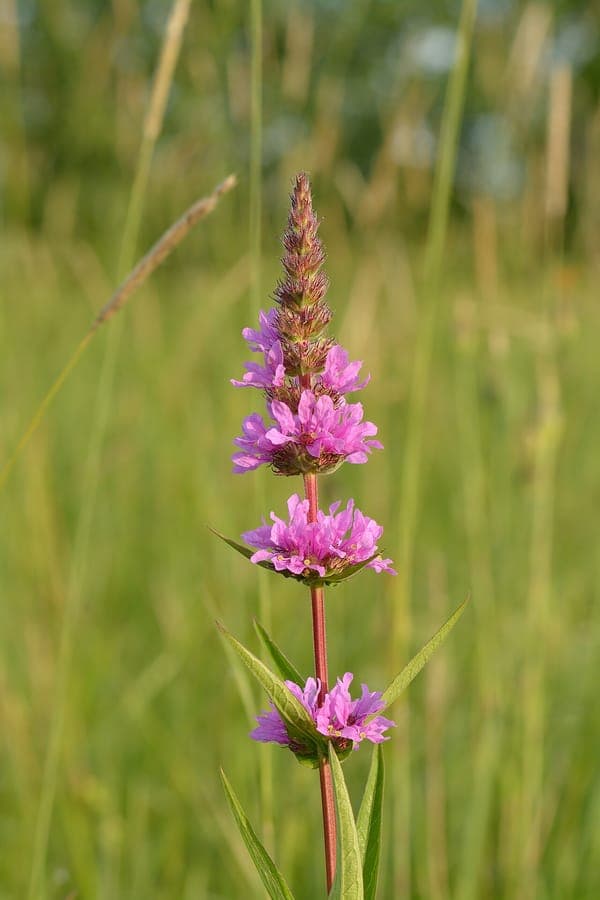
Ivar Leidus / CC BY-SA 3.0, via Wikimedia Commons
Purple loosestrife: complete guide
Lythrum salicaria
¿Quieres ver Purple loosestrife: complete guide en tu jardín?
1 minuto, sin tarjeta de crédito
Overview
Lythrum salicaria, commonly known as purple loosestrife or spiked loosestrife, is a robust and prolific flowering plant native to Eurasia, North Africa, and Ethiopia. This vigorous grower forms dense vertical compositions reaching 120-150 centimeters in height and characterizes natural waterside landscapes throughout Europe and northern regions globally. For contemporary garden designers seeking dramatic floral displays in wetland areas, pond margins, and constructed wetland systems, Lythrum salicaria presents an nearly indispensable choice plant combining ecological value with unparalleled visual impact.
The distinguishing characteristic of Lythrum salicaria centers on its powerful exponential growth pattern, massive purple-pink flower production, and extreme resilience against water stress factors. While smaller species maintain modest expansion, Lythrum salicaria creates impressive hedgerows and flowering screens visible across substantial landscape expanses. Along modern water gardens, it establishes architectural framing, boundary definition, and dynamic color accents fundamentally transforming waterside composition.
Blooming period extends June through October - four full months of continuous violet-purple flowers. This extended display provides unmatched seasonal-long color contribution to water garden compositions.
Appearance and Bloom
Lythrum salicaria's physical architecture distinguishes itself markedly from miniature plant variants. Specimens typically reach 100-150 centimeters in height, with vigorous cultivars achieving 180 centimeters under optimal conditions. Stems display square-like cross-section with reddish-purple coloration (particularly in young growth), branching extensively in the upper third, creating broad, regularly ovoid forms.
Foliage consists of narrowly lanceolate leaves approximately 4-8 centimeters in length, arranged in opposite or three-part patterns along stems. In full sun exposure, foliage acquires greenish-brown tints with reddish-purple undertones. Shade-grown leaves remain brighter green.
Flowers constitute the spectacular display. Plants produce densely-packed upright flower spikes (panicles) reaching 30-40 centimeters in length, consisting of hundreds of minuscule pink to deep-purple six-petaled flowers. These inflorescences appear simultaneously along the upper half of the plant, resulting in massive floral displays. Flowering proceeds in successive waves June through October, with dark-red seed-heads from previous flowers providing textural background for newly emerging flower spikes.
Ideal Location
Optimal locations demand full-sun exposure (6-8 hours direct daily sunlight) along waterside margins, low-lying swampy zones, and seepage areas where water stagnates or flows very slowly. The plant tolerates partial shade (3-4 hours sun) but flowers sparsely and grows less vigorously.
Water levels prove less critical than commonly assumed. The plant flourishes in pure water-edge conditions (inundation to 10-15 centimeters) while equally thriving in periodically moist ground experiencing wet periods only weekly. This expands horticultural applicability substantially.
Wind exposure poses no problems - thick, rigid stems provide excellent self-support even in storm-exposed terrain.
Diseño gratis
¿Quieres ver Purple loosestrife: complete guide en tu jardín? Crea un diseño gratis ahora.
Soil Quality
Soils for Lythrum salicaria must guarantee moisture retention but are not dependent on extreme nutrient richness. The plant establishes in virtually all water-landscape soil types: clay-silt combinations (optimal), pure clay, even sand-silt mixtures provided moisture content remains consistently high.
The plant tolerates extremely broad pH range (4.5-8.0) without performance reduction. Nitrogen-rich soils do not cause overgrowth problems as in some wetland plants - Lythrum salicaria simply grows vigorously under all nutrient availability levels.
Watering and Moisture Management
Following transplantation during the initial 3-4 weeks, add 2-3 centimeters water daily. Established plants require baseline rainfall and soil moisture reserves in most climates. During dry summers supplement with 30-40 millimeters water weekly.
Pruning and Formation
During early spring (March-April) remove dead stems from the previous season, cutting back to 10-15 centimeters height. This ensures dense, multi-branched growth and massive flower production. Late May pinching (removal of terminal 10-15 centimeters) results in more, shorter flower spikes with wider, more compact form.
Deadheading extends bloom: remove spent flower spikes as they grey, through late July. Allow seed-setting after late July (seed-heads prove decorative in autumn).
Maintenance Calendar
March-April: Early spring pruning to 10-15 cm. Inspect for winter damage.
April-May: Growth accelerates. Stabilize water level.
May-June: Pre-bloom extension (optional). Begin deadheading as flowers emerge.
June-September: Massive blooming. Continuous deadheading for extended display through late July. Water supplementation 30-40 mm weekly in dry periods.
October-November: Bloom ends. Allow seed-heads to dry. Plant material senesces.
December-February: Dormant period. Minimal maintenance. Water level may decline.
Winter Hardiness
Lythrum salicaria is completely hardy through USDA zone 3 (-40°C). In Netherlands, Belgium, and Germany, the plant survives all natural winter temperatures. Aboveground material seneses October-November; subterranean rhizomes regenerate March-April.
Companion Plant Selection
Iris sibirica: Blooms May-June with blue-purple flowers positioned above Lythrum height.
Trollius europaeus (Globeflower): Yellow May blooms; lower stature, excellent foreground.
Filipendula ulmaria (Meadowsweet): Large, cream-white, July-August; good height variation adjacent to purple Lythrum.
Valeriana officinalis: Compact pink-white flowers, July; delicate texture contrasting Lythrum's coarse growth patterns.
Concluding Remarks
Lythrum salicaria provides unparalleled visual impact for water landscapes at scale - a strong, hardworking flower specialist delivering spectacular performance for years with minimal intervention. For garden designs centering on waterside margins and wetlands, Lythrum salicaria proves nearly indispensable. Discover additional inspiration on www.gardenworld.app where professional water garden designs synthesize ecological principles with aesthetic excellence. With proper site selection and water-level management, this plant offers decades of flowering glory in your garden composition.
¿Quieres ver Purple loosestrife: complete guide en tu jardín? Crea un diseño gratis ahora.
Sube una foto, elige un estilo y obtén un diseño fotorrealista con lista de plantas en menos de un minuto.
Más de 10.000 jardines diseñados
Sin tarjeta de crédito


Plantas similares
Spatulaleaf loosestrife: complete guide
Lythrum portula
Discover Lythrum portula, a delicate miniature wetland plant with rosy-purple flowers. Thrives in moist soils, perfect for water gardens and marshy areas in garden design.
Two-leaved Solomon's seal: complete guide
Maianthemum bifolium
Discover Maianthemum bifolium, a delicate woodland floor plant with tiny white flowers. Perfect for shade gardens, forest understory, and groundcover on gardenworld.app.