
Wikimedia Commons / CC BY-SA 3.0, via Wikimedia Commons
Two-leaved Solomon's seal: complete guide
Maianthemum bifolium
¿Quieres ver Two-leaved Solomon's seal: complete guide en tu jardín?
1 minuto, sin tarjeta de crédito
Overview
Maianthemum bifolium, commonly known as two-leaved Solomon's seal or May-lily, is a delicate, low-growing forest floor plant native to temperate Eurasia. This diminutive plant reaches only 10-20 centimeters in height and is distinguished by its two opposite leaves and small pure white flowers appearing May-June. For garden designers recreating natural forest-floor aspects or greening shade-dominated terrain, Maianthemum bifolium serves as an essential groundcover plant providing subtle beauty and ecological integration to garden compositions.
The distinguishing characteristic of Maianthemum bifolium centers on its role as transition plant between forest floor and open zones. While much groundcover material proves aggressive, Maianthemum bifolium behaves modestly, integrating gracefully into natural compositions. The plant spreads slowly via subterranean rhizomes, forming over decades continuous carpets of green punctuated by annual white-flower highlights.
In temperate gardens where shade predominates, Maianthemum bifolium proves nearly indispensable. The plant functions as connective tissue, linking larger shrubs and understory elements, weaving continuity through otherwise fragmented floor zones.
Appearance and Bloom
Maianthemum bifolium develops extremely compact, low-spreading habit. Individual plantlets reach merely 10-20 centimeters in height, although established colonies spread much more broadly (30-50 centimeter diameters across years). Stems are thin, flexible, green-red tinted.
The most characteristic feature comprises two opposite leaves, each approximately 3-5 centimeters long, elliptic with acute apices. Leaves spread flatly across the soil surface, optimally capturing light in shallow shade-zones.
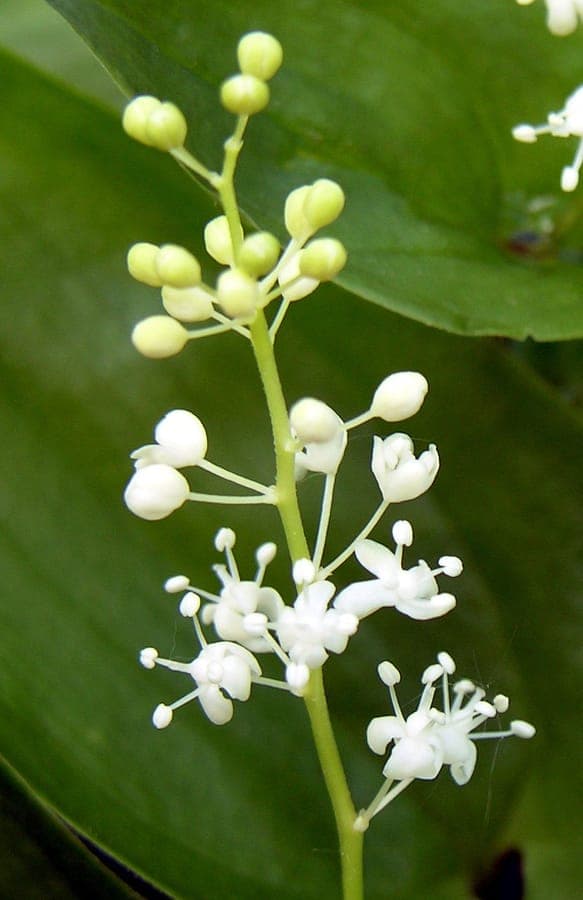
Flowers are minuscule and delicate: pure white, approximately 3-4 millimeters across, grouped into dense small panicles (5-10 centimeter long clusters) at the stem apex. These flowers appear May-June, ethereal against dark-green foliage. Fragrance proves extremely subtle, nearly imperceptible.
Following flowers, small red berries (8-10 millimeters) develop, ripening July-August to glossy purple-red. These berries prove non-avian forage in these regions; they persist through autumn-winter, lending botanical interest to dormant-season displays.
Ideal Location
Optimal locations comprise completely shaded to half-shade zones (0-2 hours direct sun). The plant thrives beneath leafy trees, along woodland edges, and in shady forest-floor zones. Preference for terrain with organic-rich ground (abundant leaf mold, rotting wood) matching natural forest soils.
The plant tolerates extremely minimal full light. In full-light situations Maianthemum bifolium performs poorly and becomes pale in color.
Diseño gratis
¿Quieres ver Two-leaved Solomon's seal: complete guide en tu jardín? Crea un diseño gratis ahora.
Soil Quality
Soils must be humus-rich, acidic to neutral (pH 5.0-7.0), and consistently moist. Ideal soil mimics forest soils: organic-rich sand-silt-clay combination with 20-30% decomposed leaf mold and rotting log material.
Moisture retention proves crucial. Maianthemum bifolium tolerates dry summers poorly and may disappear entirely in dry, full-sun zones. In well-mulched shade-zones it survives winter droughts without problems.
Watering and Moisture Management
Immediately following transplantation for the initial 4-6 weeks, maintain daily moisture (soil must never dry). Once established (after 1 season) rainfall and natural soil moisture suffice. During dry periods (hot, dry weather) light supplementation (10-15 millimeters weekly) prevents disappearance.
Pruning and Formation
Pruning proves completely unnecessary. The plant self-regulates. Invasive growth gradually becomes controlled through forest-floor ecological balance.
Maintenance Calendar
April-May: Growth activates. Moisture management critical (soil never dry).
May-June: Flowering. Enjoy subtle white flower displays.
July-August: Seed-setting. Red to purple berries ornamental.
August-October: Autumn dormancy. Gradual foliage coloration and senescence.
November-March: Dormant period. Subterranean rhizomes remain active.
Winter Hardiness
Maianthemum bifolium is completely hardy through USDA zone 2 (-40°C). In Netherlands, Belgium, Germany, and Scandinavia, the plant survives all winter conditions. Aboveground foliage senesces in October; subterranean rhizomes regenerate April.
Companion Plant Selection
Helleborus niger (Christmas rose): January flowering, white-green; low-growing, matching Maianthemum bifolium stature.
Pulmonaria officinalis (Lungwort): Pink-blue, April-May; somewhat taller (20-30 cm), supplementary color accent.
Anemone nemorosa (Windflower): White, March-April; extremely low (10-15 cm); perfect companion plantlet integration.
Polygonatum odoratum (Solomon's seal): White, May-June; much taller (60-80 cm) creating vertical layering above Maianthemum bifolium.
Concluding Remarks
Maianthemum bifolium represents the quiet voice of forest-floor plants: subtle, elegant, and absolutely essential for authentic shade gardens. This plant offers what few other groundcover materials provide: genuine forest-floor characterization in cultivated gardens. For designers valuing natural beauty and seeking to green shade-complexes, Maianthemum bifolium proves irreplaceable. Discover additional inspiration on www.gardenworld.app. With proper shade, moisture management, and patience, you'll enjoy decades of this delicate yet persistent forest-floor growth.
¿Quieres ver Two-leaved Solomon's seal: complete guide en tu jardín? Crea un diseño gratis ahora.
Sube una foto, elige un estilo y obtén un diseño fotorrealista con lista de plantas en menos de un minuto.
Más de 10.000 jardines diseñados
Sin tarjeta de crédito


Plantas similares
Spatulaleaf loosestrife: complete guide
Lythrum portula
Discover Lythrum portula, a delicate miniature wetland plant with rosy-purple flowers. Thrives in moist soils, perfect for water gardens and marshy areas in garden design.
Purple loosestrife: complete guide
Lythrum salicaria
Discover Lythrum salicaria, a vigorous waterside plant with dramatic purple-pink flowers. Essential for water gardens, marsh edges, and landscape design on gardenworld.app.