
Christian Fischer / CC BY-SA 3.0, via Wikimedia Commons
Spatulaleaf loosestrife: complete guide
Lythrum portula
¿Quieres ver Spatulaleaf loosestrife: complete guide en tu jardín?
1 minuto, sin tarjeta de crédito
Overview
Lythrum portula, commonly known as spatulaleaf loosestrife or lesser loosestrife, is a delicate miniature member of the Lythrum genus native to temperate regions of Europe, Northwest Africa, and northwestern Turkey. This understated yet charming plant naturally establishes itself in wet, marshy terrain where groundwater tables remain consistently elevated. For garden enthusiasts designing water features or expanding wetland zones, Lythrum portula presents an excellent candidate due to its modest stature and exceptional tolerance for moisture-saturated conditions. Unlike its larger cousin Lythrum salicaria, which can dominate compositions through vigorous horizontal expansion, this species maintains restraint and integrates harmoniously into carefully curated aquatic plantings.
The distinguishing characteristics separate Lythrum portula from other loosestrife varieties in several meaningful ways. The plant reaches maximum heights of 15-30 centimeters, while its foliage displays narrow, spatulate morphology - the distinctive feature lending the common name. Rather than forming dense thickets, Lythrum portula spreads gradually through subterranean rhizomatous expansion, creating diffuse colonies across waterlogged substrates. The soft pink to reddish-purple flowers generate a miniature composition ideally suited for the foreground of wetland plantings or naturalistic pond margins. Although easily overlooked in large-scale landscape installations, botanically inclined gardeners and ecology-conscious designers will appreciate the refined details of morphology and ecological specialization.
The flowering period extends 8 to 10 weeks between June and September, guaranteeing an extended palette of subtle color accents throughout the summer landscape. In optimally moist environments receiving adequate sunlight, individual plants consistently produce dense floral displays that elevate the visual composition without overwhelming neighboring vegetation.
Appearance and Bloom
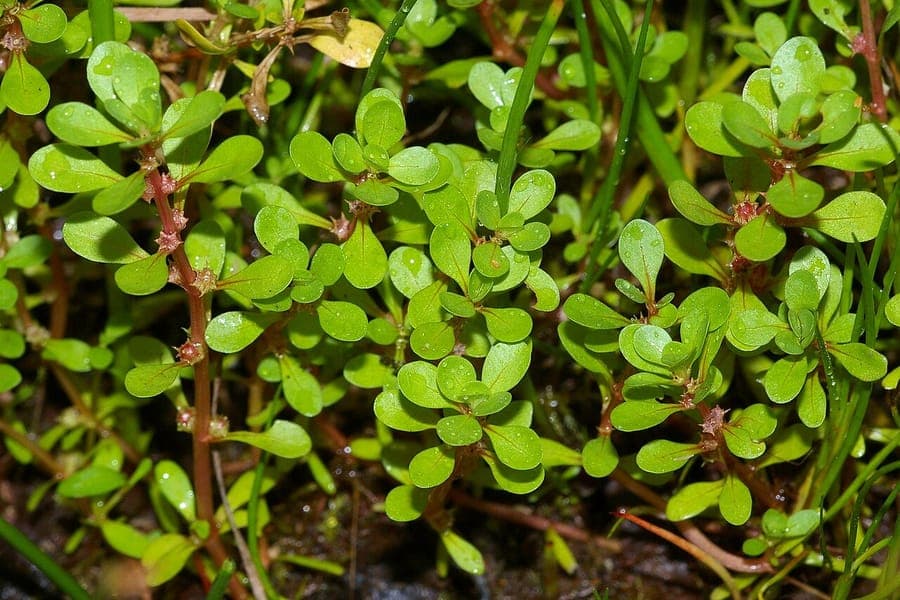
Lythrum portula displays botanical characteristics distinctly different from larger loosestrife species in the Lythraceae family. Growth reaches only 15-30 centimeters in height, with thin, flexible stems often displaying reddish pigmentation under strong sunlight exposure. Foliage consists of diminutive leaves measuring 5-8 millimeters in length, with narrowly spatulate morphologies arranged in opposite pairs along each stem. This foliar arrangement imparts an elegant, delicate character particularly striking when viewed against water surfaces in naturalistic settings.
Flowers emerge in June and achieve maximum blooming intensity during July and August, extending into September as late-summer displays. The inflorescence comprises minuscule pink to reddish-purple flowers approximately 3-4 millimeters in diameter, densely grouped within racemose arrangements along the upper third of each stem. Floral progression occurs in successive waves throughout the growing season. Under optimal conditions - consistently moist soil, 6-8 hours direct sunlight - individual plants sustain flowering for 8-10 continuous weeks, significantly extending visual impact compared to competing species.
Following floral senescence, the plant develops diminutive fruit capsules measuring 1-2 millimeters, ripening during August and September. Seed production is exceptionally prolific, dispersing via water transport and avian consumption. This reproductive strategy has historically contributed to the species' establishment throughout temperate Eurasia, demonstrating evolutionary adaptation to periodic flooding and drainage cycles inherent to wetland ecosystems.
Ideal Location
Optimal growing conditions require locations maintaining sustained high soil moisture and direct sun exposure for minimum 6-8 hours daily throughout the growing season. Within northern European contexts, such conditions naturally occur along water margins, in low-lying peatland regions, and surrounding freshwater marsh habitats. For garden designers implementing water features, this species integrates ideally within riparian zones experiencing seasonal water-level fluctuations of 5-10 centimeters.
Water-level stability during the growing season (March through October) proves critical. Maintenance of 2-5 centimeters submerged conditions promotes vigorous expansion and abundant flowering. Conversely, completely emergent (above-water) placement or perpetually saturated without any submersion reduces flowering intensity substantially. Seasonal water-level decline during winter months (October-February) poses minimal concern provided soil moisture remains adequate through deepening into December.
Partial shade conditions prove suboptimal. Plants receiving 3-4 hours sunlight exhibit substantially reduced growth rates and minimal flowering output. Complete shade conditions preserve plant survival, but blooming becomes negligible and the species functions as background foliage rather than ornamental contributor to seasonal color composition.
Wind exposure requires limited consideration due to the plant's compact structural architecture. However, in severely wind-exposed coastal locations experiencing salt spray, saline aerosol deposition may damage sensitive foliage. Lythrum portula tolerates slightly brackish conditions but cannot endure full marine salt concentrations experienced in salt-marsh environments.
Soil Quality
Soil composition constitutes a critical success factor for Lythrum portula cultivation. Contrary to conventional wisdom favoring nutrient-rich garden substrates, this species thrives in nutrient-poor to moderately fertile alluvial silts and marsh deposits. Superior performance results from substrates combining clay or clay-silt matrices with decomposed organic matter from riparian sources - submersed vegetation remains, reed fragments, and wetland humus.
Soil pH accommodates a broad range, from 4.5 (acidic, peatland conditions) through 7.5 (neutral) without performance reduction. The critical limitation involves excessive nitrogen availability. In nutrient-enriched garden soils, Lythrum portula experiences competitive displacement by aggressive wetland species preferring eutrophic conditions. Consequently, fertilization proves counterproductive, actually reducing establishment success. Nutrient-poor matrices paradoxically favor Lythrum portula through limitation of competing vegetation.
Water quality significantly influences long-term vigor. Clean, oxygen-rich water sustains robust root development and healthy foliage color. Stagnant water heavily laden with organic silt (anoxic mud) impairs root respiration and accelerates root rot incidence. Slow-flowing conditions or periodic water exchange cycles promote optimal plant health.
The optimal substrate preparation involves incorporating 30-40% decomposed plant material with 60-70% clay-dominant mineral soil, maintaining pH between 5.5 and 7.0 through mineral component selection. Avoid peat-based commercial composts - the managed drainage and nutrient profile prove incompatible with Lythrum portula's ecological specialization.
Diseño gratis
¿Quieres ver Spatulaleaf loosestrife: complete guide en tu jardín? Crea un diseño gratis ahora.
Watering and Moisture Management
Supplementary watering becomes unnecessary for established Lythrum portula plants in properly designed water gardens where water tables remain controlled through drainage and precipitation inputs. However, for young plantlets recently transplanted into non-permanently inundated garden locations, the initial 3-4 weeks demand meticulous moisture management.
Immediately following transplantation, soil must maintain continuous moisture for 10-14 days to facilitate root establishment. Achieve this through daily 2-3 centimeter water additions via irrigation or morning/evening overhead sprinkling. Once root integration becomes evident (gentle pulling resistance indicates anchored root systems), transition toward intermittent moisture cycling: dry-moist-dry sequences throughout the first growing season.
Following the initial establishment season (May through October), rainfall and soil moisture reserves typically sustain complete growth cycles without supplementary irrigation in northern European climates. During abnormally dry periods (less than 40 millimeters monthly precipitation May-September), occasional watering interventions - 20-30 millimeters weekly - enhance flower production and prevent premature senescence.
For gardeners in drier continental regions, situate Lythrum portula in natural depressions or swale locations where rainwater concentration creates microhabitat moisture conditions matching the species' hydrological preferences. Salinity tolerance proves minimal; avoid saltwater irrigation or saline soil amendments.
Pruning and Formation
Maintenance pruning requirements remain minimal due to Lythrum portula's naturally compact growth architecture. However, selective interventions enhance form and flowering abundance substantially.
During early spring (March-April), remove dead stems from the preceding growing season, cutting approximately 5-8 centimeters above soil surface. This promotes vigorous basal branching, resulting in denser architectural form and increased floral density. Always use sterile, sharp pruning implements, cutting immediately above leaf nodes to minimize damage risk.
Throughout the flowering period (June-September), the primary objective involves deadheading - removal of spent floral displays as they fade and become desiccated. This intervention redirects energy from seed production toward continuous flower initiation, extending the blooming period from typical 4-6 weeks to 8-10 weeks of sustained color display.
In established plantings persisting for four or more years without division or renovation, selective stem thinning during May improves light penetration and air circulation throughout the canopy, reducing fungal disease incidence during humid summer conditions.
Maintenance Calendar
March-April: Early spring pruning. Remove dead stems from previous season. Inspect for overwintering fungal conditions affecting emerging foliage.
April-May: Active growth initiates. Maintain stable water table at 2-5 centimeters submersion. Avoid fertilization.
June-July: Flowering commences. Begin deadheading regimen for extended blooming. Supplementary watering if rainfall is below 20 millimeters weekly.
August-September: Peak flowering period. Continue deadheading protocol. In unusually dry conditions, provide 25-30 millimeters weekly water.
October-November: Flowering wanes. Allow seedhead development for self-seeding or remove spent material depending on design preferences. Water table may gradually decline through November.
December-February: Dormant winter period. Minimal maintenance required. No pruning or fertilization. Water table may remain low provided soil retains adequate moisture depth.
Winter Hardiness
Lythrum portula demonstrates complete winter hardiness throughout northern and central European climates (USDA hardiness zones 4-10). The plant tolerates sustained temperatures reaching -25°C without protective measures. In Netherlands and Belgian garden contexts, even severe winter conditions (-15°C) present no survival risk.
Aboveground foliage naturally senesces during October-November. Subterranean rhizomatous systems remain metabolically active and regenerate new stems during March-April. This natural dormancy pattern proves ideal for water gardens: the species disappears from visual composition during winter months, reappearing in spring growth cycles.
Alternating freeze-thaw cycles (particularly January-February) may create challenges for recently established plantlets. Soil heave (expansion due to ice formation) can displace young plants vertically from appropriate planting depth. Solution: establish plantings during autumn months (September) rather than spring to ensure firm root integration prior to winter soil disturbance.
Companion Plant Selections
Lythrum portula achieves optimal visual and ecological integration alongside complementary wetland species:
Mentha aquatica (Watermint): A vigorous grower that avoids overshadowing through distinct height differentiation. Mentha flowers during July-August with purple inflorescences harmonizing beautifully with Lythrum portula's reddish tones and extended bloom period.
Scirpus sylvaticus (Wood clubrush): An emergent species reaching 60-80 centimeters, ideally positioned behind Lythrum portula in layered compositions. Brown inflorescences appear in June, providing textural contrast.
Iris pseudacorus var. bastardii (Compact yellow iris): A dwarf cultivar achieving similar heights to Lythrum portula (25-35 cm). Yellow flowers bloom May-June, establishing color progression preceding red loosestrife displays.
Veronica beccabunga (Brooklime): An extremely compact aquatic speedwell (15-30 cm) producing bright blue flower spikes during May-July. Excellent foreground planting when combined with Lythrum portula as mid-layer element.
Avoid planting adjacent to aggressive, densely-expanding species such as Phragmites australis (Common reed), which can literallyoutcompete and strangle Lythrum portula within 2-3 growing seasons.
Concluding Remarks
Lythrum portula represents a genuine botanical treasure for water gardeners valuing refined, scientifically interesting plantings over broad-spectrum color blocks. This species combines delicate aesthetic character with robust hardiness, minimal maintenance demands, and 8-10 weeks of sophisticated rosy-purple flowering. For garden designs emphasizing subtlety and naturalism - particularly naturalistic water margins and ecologically-informed wetland plantings - Lythrum portula achieves an irreplaceable role within the planting palette. Discover additional wetland design inspiration on www.gardenworld.app, where professional garden designers synthesize ecological principles with aesthetic refinement. With appropriate site selection, consistent moisture management, and thoughtful companion plantings, Lythrum portula will provide multi-year enjoyment as an elegant miniature centerpiece within your garden's aquatic composition.
¿Quieres ver Spatulaleaf loosestrife: complete guide en tu jardín? Crea un diseño gratis ahora.
Sube una foto, elige un estilo y obtén un diseño fotorrealista con lista de plantas en menos de un minuto.
Más de 10.000 jardines diseñados
Sin tarjeta de crédito


Plantas similares
Purple loosestrife: complete guide
Lythrum salicaria
Discover Lythrum salicaria, a vigorous waterside plant with dramatic purple-pink flowers. Essential for water gardens, marsh edges, and landscape design on gardenworld.app.
Two-leaved Solomon's seal: complete guide
Maianthemum bifolium
Discover Maianthemum bifolium, a delicate woodland floor plant with tiny white flowers. Perfect for shade gardens, forest understory, and groundcover on gardenworld.app.