
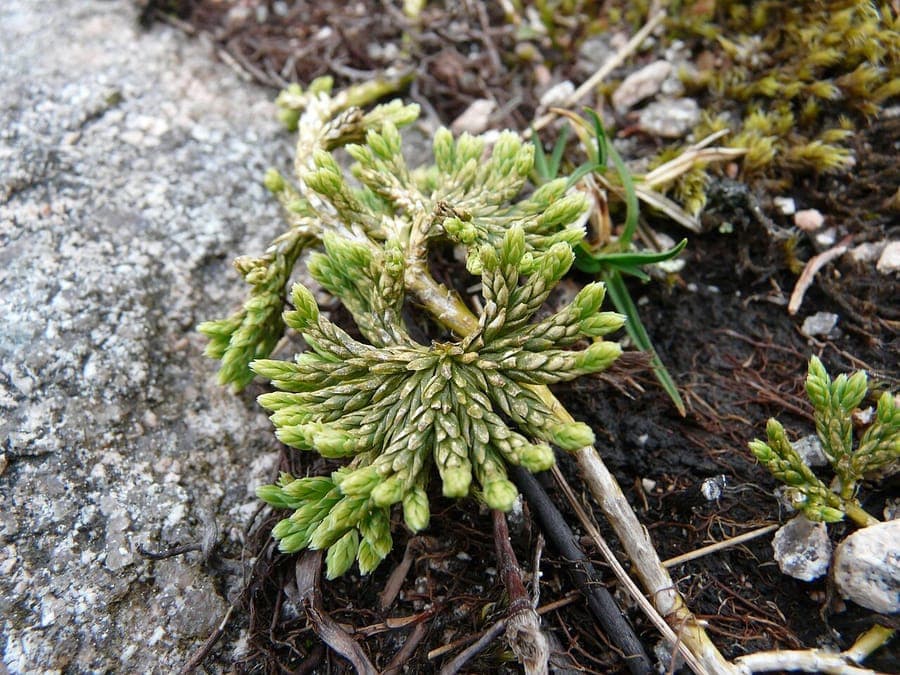
Alastair Rae / CC BY-SA 2.0, via Wikimedia Commons
Alpine clubmoss: complete guide
Lycopodium alpinum
¿Quieres ver Alpine clubmoss: complete guide en tu jardín?
1 minuto, sin tarjeta de crédito
Alpine clubmoss (Lycopodium alpinum) is a remarkable and rare plant from the family Lycopodiaceae, adapted for the world's harshest mountain environments. This evergreen dwarf spreads across subarctic and temperate regions of the northern hemisphere, from Alaska and Greenland to the Alps and Siberia, thriving where few other plants can survive.
The plant displays characteristic features of clubmosses with divided, fork-like stems that grow horizontally and branch extensively. Leaves are extremely tiny and scale-like, a crucial adaptation that minimizes water loss in extreme conditions. Alpine clubmoss reaches only a few centimeters in height but forms dense mats that blanket exposed mountain slopes.
Growth and reproduction: Growth rates are extraordinarily slow, advancing mere millimeters each year. Alpine clubmoss reproduces through spores contained in small cone-like structures at the branch tips. Spore dispersal relies on wind currents, a reproductive strategy unchanged for millions of years.
Habitat requirements: Alpine clubmoss thrives in highly acidic soils with pH between 4.0 and 4.5, typical of mountain peaks and heath lands. Light requirements are high - scoring 8 out of 10 - despite frequent alpine cloud cover. The plant has adapted to exploit intense light during short mountain summers followed by extended darkness.
Cultivation and care: This challenging plant is nearly impossible to cultivate successfully in gardens. Soil must be extremely acidic, exceptionally well-drained, and permanently moisture-poor. Alpine clubmoss cannot tolerate competition from other plants and occurs only on barren, rocky slopes.
Winter hardiness: Alpine clubmoss is extraordinarily cold-hardy, surviving in USDA zones 0 to 5. The plant withstands temperatures to minus 40 degrees Celsius without damage. Unlike many evergreens, it remains actively green throughout winter beneath snow cover.
Ecological significance: Alpine clubmoss plays important roles in alpine ecosystems. It helps break down rock and contributes to soil formation on barren slopes. Dense mats prevent erosion on steep terrain and provide shelter for microscopic organisms.
Companion species: Alpine clubmoss usually grows in pure stands without other vascular plants, sharing space only with mosses and lichens. This ecosystem has remained largely unchanged for thousands of years.
Carefulness and ethics: Be cautious regarding wild populations. Alpine clubmoss is protected in many regions due to its rarity. Never collect this plant from the wild without permission from local authorities.
We recommend experiencing alpine clubmoss in its native habitat during mountain expeditions rather than attempting cultivation. The plant stands as a living testament to evolution's power to adapt life to Earth's most extreme conditions. Explore more plant guides at gardenworld.app.
¿Quieres ver Alpine clubmoss: complete guide en tu jardín? Crea un diseño gratis ahora.
Sube una foto, elige un estilo y obtén un diseño fotorrealista con lista de plantas en menos de un minuto.
Más de 10.000 jardines diseñados
Sin tarjeta de crédito


Plantas similares
Christmas green: complete guide
Lycopodium complanatum
Christmas green is a frost-hardy moss-like plant perfect for shady gardens and woodland edges. Growing and care guide for northern temperate climates.
Huperzia selago: complete guide
Huperzia selago
Discover the mountain clubmoss: a truly unique arctic fern-like plant for moist shaded gardens. Growing guide with soil, moisture and specialized care.
Marsh clubmoss: complete guide
Lycopodiella inundata
Discover Lycopodiella inundata, the rare Marsh clubmoss. A unique wetland plant for specialized bog gardens.