
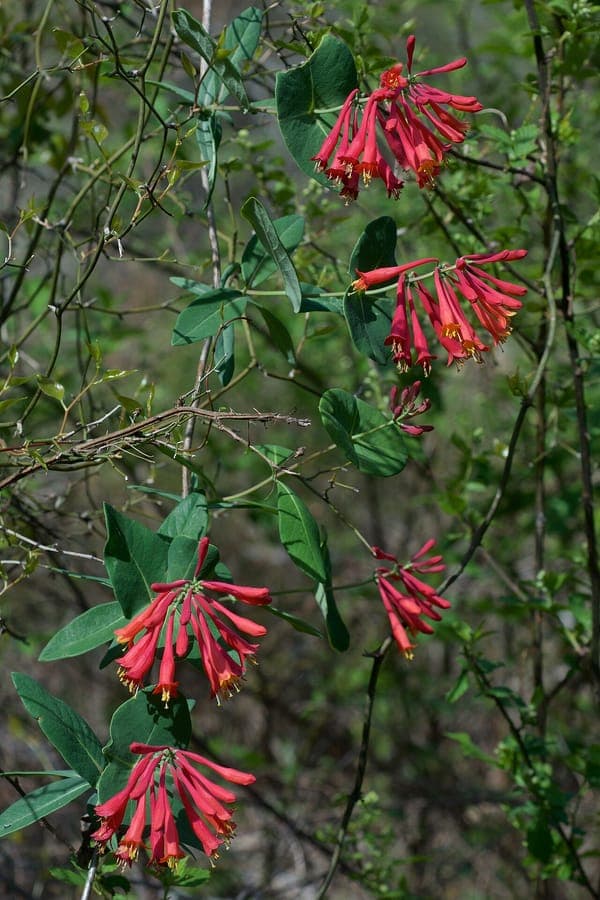
Eric Hunt / CC BY-SA 4.0, via Wikimedia Commons
Coral honeysuckle: complete guide to this vibrant evergreen climber
Lonicera sempervirens
¿Quieres ver Coral honeysuckle: complete guide to this vibrant evergreen climber en tu jardín?
1 minuto, sin tarjeta de crédito
Overview
Coral honeysuckle (Lonicera sempervirens), also called scarlet honeysuckle, is a stunning evergreen vine from the eastern United States. This frost-hardy climber produces spectacular, bright red, tubular flowers that attract hummingbirds and songbirds. With its vigorous growth habit and glossy foliage, it makes an ideal covering for trellises, pergolas, and garden walls. This is a true garden workhorse offering years of minimal-care enjoyment.
Appearance and bloom cycle
Coral honeysuckle grows as a strong, twining vine reaching 3-5 meters tall. Stems are reddish-brown to green, firm and durable. Opposite, elliptical to oblong leaves measure 3-6 cm long, bright green, glossy, and crucially, evergreen – the plant retains foliage throughout winter.
The flowers steal the show: tubular, about 4-5 cm long, intense red to orange-red, scentless but irresistible to hummingbirds. Blooming begins in May and continues until September, with peak display in May-June. Small red berries follow, valuable for birds.
Ideal location
Coral honeysuckle thrives in full sun to light shade. Position it where it receives at least 5-6 hours of direct sunlight. Against south- or southwest-facing walls, it grows explosively. North-facing aspects work too, though flowering is lighter. The plant tolerates wind well and even succeeds in windswept coastal gardens.
Always provide sturdy support: trellis, mesh, pergola, or rope. Without support, it becomes a dense ground cover.
Soil requirements
Coral honeysuckle is remarkably unfussy about soil. Nearly any normal garden soil suffices. Heavy clay, sandy soil, poor soil – it grows everywhere. Slight preference for neutral to slightly acidic (pH 6-7.5), but tolerance is vast. Drainage doesn't need to be perfect; this plant tolerates wet feet better than most climbers.
At planting, add compost for structure; thereafter, supplemental feeding is rarely necessary.
Watering
Once established, coral honeysuckle needs minimal water. In the first year, water regularly until roots take hold. After establishment, rainfall suffices. Only during severe drought (more than 3 weeks without rain) add supplemental water.
In containers, more frequent watering is needed – approximately weekly in summer. In wet winters, omit supplemental water; rain provides ample moisture.
Diseño gratis
¿Quieres ver Coral honeysuckle: complete guide to this vibrant evergreen climber en tu jardín? Crea un diseño gratis ahora.
Pruning
Pruning keeps the plant neat and promotes flowering. In early spring (February-March), remove old, dead, or poorly branched stems. Remove stems that outgrow the support structure. Mild pruning after flowering (July) may encourage next year's bloom.
This plant flowers on young wood, making hard pruning safe. Moderate pruning (removing 10-20% of growth) suffices; excessive cutting is unnecessary.
Maintenance calendar
Spring (March-May): Prune as needed. Check support structure security. Light feeding (general-purpose bloom fertiliser, half strength) may boost flowering. Young plants need regular watering until established (6-8 weeks).
Summer (June-September): Enjoy red flowers and visiting hummingbirds. Water only in extreme drought. Remove dead stems. Monitor for pests (especially spider mites during hot summers).
Autumn (October-November): Reduce watering. Plant prepares for winter. Colour remains vibrant. Check support structure for winter stability.
Winter (December-February): Plant is frost-hardy and evergreen. No supplemental watering (rain suffices). Check support after storms. Pruning can occur in late February.
Frost hardiness
Coral honeysuckle is very frost-hardy, tolerating temperatures to at least -20°C. In temperate zones, the plant suffers no winter damage; even in severe winters, it remains green and healthy. No protection or mulching is needed. This is a perfect plant for gardeners seeking reliable, evergreen coverage.
Companion plants
Coral honeysuckle forms stunning combinations with:
- Clematis (white varieties): Beautiful colour contrast and differing bloom times.
- Hedera helix (Ivy): Another evergreen with subtler foliage.
- Hydrangea petiolaris: Frost-hardy climber with white flowers.
- Rosa (Climbing roses): For dual flowering and fragrant seasons.
Together they create richly clothed trellises with extended seasonal interest.
Final thoughts
Coral honeysuckle is a tireless workhorse. Don't plant in shaded corners – good light prevents disease. Birds and insects will thank you for the flowers and berries. Summer cuttings root easily for propagation.
Wondering how to integrate this vibrant climber into your garden design? Visit gardenworld.app – upload a garden photo and receive personalised plant recommendations. Explore more climbing plants on gardenworld.app's plant blog.
¿Quieres ver Coral honeysuckle: complete guide to this vibrant evergreen climber en tu jardín? Crea un diseño gratis ahora.
Sube una foto, elige un estilo y obtén un diseño fotorrealista con lista de plantas en menos de un minuto.
Más de 10.000 jardines diseñados
Sin tarjeta de crédito


Plantas similares
Yellow honeysuckle (Lonicera tragophylla): complete guide
Lonicera tragophylla
Meet yellow honeysuckle (Lonicera tragophylla): a Chinese climber with large golden flowers that thrives in partial shade.
Lonicera korolkowii: complete guide
Lonicera korolkowii Stapf
Discover blueleaf honeysuckle, a vigorous shrub with beautiful flowers. Guide on growing, shaping and why this Asian climbing plant is perfect for gardens.
Lonicera oblongifolia: complete guide
Lonicera oblongifolia Hook.
Discover swamp fly honeysuckle, a North American woodland plant. Guide on growing, caring and why this native species is valuable for gardens.