
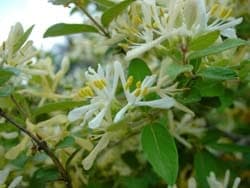
Easai at English Wikipedia / CC BY-SA 3.0, via Wikimedia Commons
Morrow's honeysuckle: complete guide
Lonicera morrowii
¿Quieres ver Morrow's honeysuckle: complete guide en tu jardín?
1 minuto, sin tarjeta de crédito
Overview
Morrow's honeysuckle (Lonicera morrowii) is an exceptionally hardy and versatile shrub from the Caprifoliaceae family. Native to East Asia, particularly Japan, Korea, and Manchuria, it thrives across European gardens. This semi-evergreen to deciduous shrub is celebrated for its sweetly scented white flowers that gradually turn deep red, followed by vibrant berries that birds adore.
The honeysuckle is a classic choice for hedges, screens, and mixed borders. Its dense growth habit makes it ideal for privacy and shelter. Gardeners across the region rely on this species for its robustness and minimal maintenance requirements.
Appearance and bloom
Morrow's honeysuckle grows into a shrub reaching 2-3 meters in height and spread. The branches are slender and well-branched, with a gently arching habit. Leaves are oval to lance-shaped, glossy, and semi-evergreen. Spring brings abundant, remarkably fragrant flowers in creamy white tones.
The tubular flowers are intensely scented and attract numerous pollinators. The remarkable feature is the colour transformation: blooms begin pure white, gradually shift through pink tones, and finish in deep crimson. This colour play remains visible for several weeks. Post-flowering, glossy red berries develop, persisting from August through October. These fruits provide essential food for thrushes, blackbirds, and other garden birds.
Ideal location
Morrow's honeysuckle performs best in full sun to semi-shade positions. In deeper shade, the plant grows but produces fewer flowers. Position it where it receives protection from strong, drying winds. The shrub is excellent for hedging, as a specimen plant, or in groups of three to five for greater volume and flowering impact.
Avoid heavily trafficked areas, though the plant tolerates varied conditions well. Use honeysuckle along garden paths, between properties as living boundaries, or in front of larger shrub arrangements. Growth is rapid, filling spaces quickly and effectively.
Soil requirements
Lonicera morrowii grows in virtually any soil type, from sandy to clay-based. Ideally, select well-draining soil that retains moderate moisture without becoming waterlogged. Optimal pH ranges from 5.5 to 7.5. Enrich poor soils with compost or peat to improve water retention.
Ensure proper drainage, especially on heavy clay soils or in high-rainfall regions. Root rot risks increase with prolonged waterlogging. Mix sand or perlite into the planting hole if soil is extremely compacted. Post-planting organic mulching around the base suppresses weeds and conserves soil moisture.
Diseño gratis
¿Quieres ver Morrow's honeysuckle: complete guide en tu jardín? Crea un diseño gratis ahora.
Watering
During the establishment year following planting, water honeysuckle regularly until the root system develops fully. Water deeply during dry periods throughout the growing season (April to September). Deeper, less frequent watering outperforms shallow, frequent sprinkles.
Mature plants are quite drought-tolerant once established, yet thrive with consistently moderate soil moisture. Apply 5-7 cm of organic mulch (leaf matter or bark) to retain moisture and keep soil cooler during hot summers. Avoid waterlogging, particularly in winter when evaporation is minimal.
Pruning
Morrow's honeysuckle requires minimal pruning yet responds exceptionally well to shaping. Perform initial pruning in early spring (February to March) before new growth emerges. Remove dead, damaged, or crossing branches. For hedge cultivation, annual pruning maintains a dense, full form.
Post-flowering (June to July), trim any wayward shoots. More substantial pruning can occur every three years in early spring to rejuvenate growth. If the plant becomes leggy after years, significant pruning in March stimulates renewed vigour.
Maintenance calendar
March-April: Spring pruning, remove dead wood, refresh mulch, apply fertiliser May-June: Monitor growth, water during dry spells July-August: Observe flower colour changes, watch bird activity, summer pruning September-October: Enjoy berry display, observe seed dispersal by birds, tidy surroundings November-February: Winter monitoring, minimal work required
Winter hardiness
Morrow's honeysuckle is exceptionally winter-hardy, rated to USDA zone 4 (-30°C to -25°C). Throughout the region, this plant thrives without winter protection. Only young, newly planted specimens might benefit from a light mulch layer over roots during exceptionally severe winters.
The plant may shed some leaves during harsh winters or in areas with strong, drying winds, but recovers rapidly in spring. In southern regions, winter hardiness presents no concerns whatsoever.
Companion planting
Morrow's honeysuckle pairs exceptionally well with:
- Mahonia aquifolium: For spring yellow flowers and foliage contrast
- Euonymus europaeus: For red autumn fruits
- Viburnum opulus: For similar bird-friendly characteristics
- Cornus alba: For red winter stems
- Philadelphus: For fragrant spring blooms
- Berberis: For colour and structural variation
Closing thoughts
Morrow's honeysuckle is one of the most versatile and distinctive shrubs for European gardens. Its hardiness, fragrance, bird-friendly berries, and extended seasonal interest make it a timeless classic. Whether building a bird sanctuary, requiring a secure hedge, or simply desiring fragrant flowers, this honeysuckle always fits perfectly.
Found at major garden centres across the region. Invest in this plant and enjoy years of minimal-maintenance pleasure. Visit gardenworld.app for design inspiration and further guidance.
¿Quieres ver Morrow's honeysuckle: complete guide en tu jardín? Crea un diseño gratis ahora.
Sube una foto, elige un estilo y obtén un diseño fotorrealista con lista de plantas en menos de un minuto.
Más de 10.000 jardines diseñados
Sin tarjeta de crédito


Plantas similares
Yellow honeysuckle (Lonicera tragophylla): complete guide
Lonicera tragophylla
Meet yellow honeysuckle (Lonicera tragophylla): a Chinese climber with large golden flowers that thrives in partial shade.
Lonicera korolkowii: complete guide
Lonicera korolkowii Stapf
Discover blueleaf honeysuckle, a vigorous shrub with beautiful flowers. Guide on growing, shaping and why this Asian climbing plant is perfect for gardens.
Lonicera oblongifolia: complete guide
Lonicera oblongifolia Hook.
Discover swamp fly honeysuckle, a North American woodland plant. Guide on growing, caring and why this native species is valuable for gardens.