
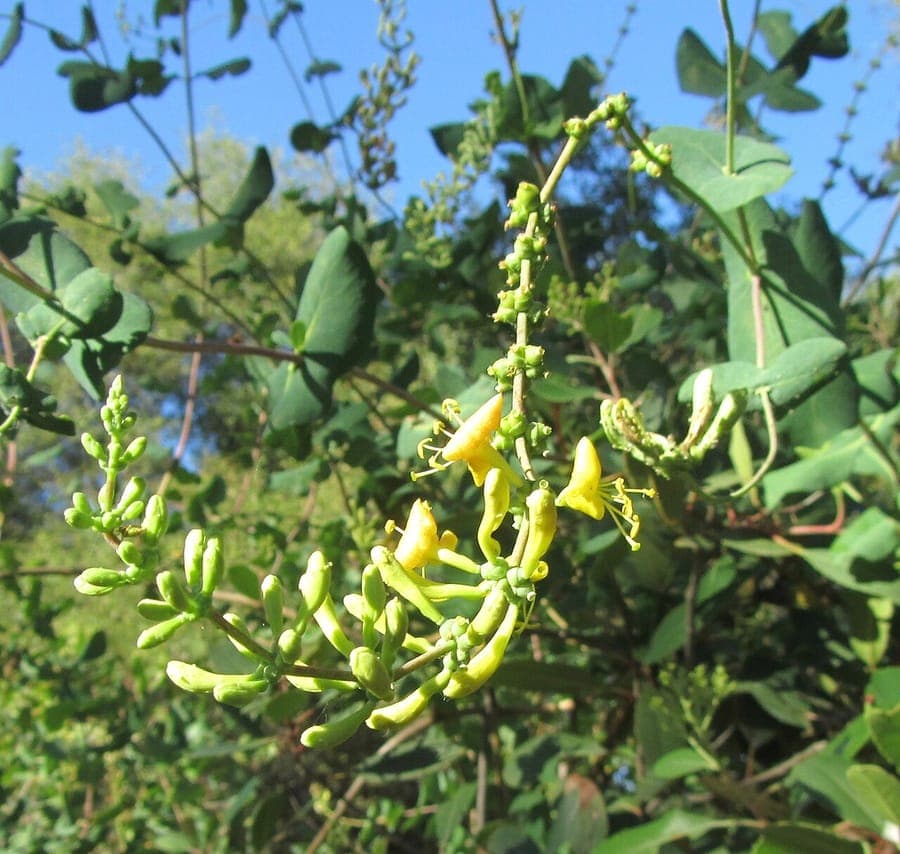
David Fischer / CC BY 4.0, via Wikimedia Commons
Chaparral honeysuckle: complete guide
Lonicera interrupta
¿Quieres ver Chaparral honeysuckle: complete guide en tu jardín?
1 minuto, sin tarjeta de crédito
Overview
Chaparral honeysuckle (Lonicera interrupta) is a native American climbing plant found from southwestern Oregon to Arizona. This flexible plant thrives in dry, mountainous terrain and is perfect for xeriscaping and rock gardens. Chaparral honeysuckle grows both as a climbing specimen and as an upright shrub.
This species is adapted to the warm, dry climate of western chaparral ecosystems and requires minimal water once established. The plant attracts bird species that enjoy the nutritious berries.
Appearance and Bloom
Chaparral honeysuckle grows as a flexible shrub or climbing vine. The flowers are tube- to funnel-shaped, typically yellow with sometimes a red or orange tint. The flowers appear in spring and early summer in clusters.
The leaves are lance-shaped to oval and bright green. Following bloom, red to dark red berries form. The plant undergoes natural growth decline during drought periods and regrows when rainfall increases.
Ideal Location
Chaparral honeysuckle grows best in full sun to very lightly shaded locations. In very warm southern climates, some morning sun can help.
The plant prefers wind-sheltered, well-draining sloped or mountainous situations. As a climber, train it along rocks, stone walls, or other sturdy structures.
Soil
Chaparral honeysuckle thrives in well-draining, typically only lightly fertile soil. Sand, gravel, and rocky material are well tolerated. The plant can grow in very poor soils and is ideal for compacted soils and mountainous conditions.
The plant tolerates no heavy clay or water-retaining soils.
Diseño gratis
¿Quieres ver Chaparral honeysuckle: complete guide en tu jardín? Crea un diseño gratis ahora.
Watering
Once established, chaparral honeysuckle is extremely drought-tolerant. Regular water in the first growing season helps the plant develop deep roots.
After establishment, mature plants need very little supplemental water. The plant can survive for years without supplemental rainfall, though it grows at a minimal level.
Pruning
Minimal pruning is needed. After blooming, damaged branches can be removed. The plant can be trained and thinned as desired to accommodate growth.
Heavy pruning can be performed in late spring or early summer if the plant becomes too large. Avoid pruning that removes more than one-third of the plant at once.
Maintenance Calendar
Spring: Begin watering carefully. Remove dead wood from winter damage. Summer: Minimal watering except during drought spells. Fall: Water can be stopped. Winter: Protection is not needed in its native range.
Winter Hardiness
Chaparral honeysuckle is winter-hardy in zones with cold winters and dry summers. This plant is very sensitive to wet winters and may die in areas with very wet winters.
In deep southern areas, this plant grows, though it does not like very hot, wet summers.
Companion Plants
Chaparral honeysuckle grows well with other drought-tolerant western native plants:
Ceanothus species provide blue flowers in early spring. Manzanita offers interesting red bark. Buckwheat and other native wildflowers feed pollinators. Native grasses like blue fescue add texture.
Closing Thoughts
Chaparral honeysuckle is a dream for dry-climate gardeners. With its flexibility, drought expectations, and extended bloom, this is a valuable complement to xeriscaped and rock gardens. Find this western beauty at California-specialized plant nurseries or ask via gardenworld.app.
For design advice in dry climates, visit gardenworld.app for professional design help.
¿Quieres ver Chaparral honeysuckle: complete guide en tu jardín? Crea un diseño gratis ahora.
Sube una foto, elige un estilo y obtén un diseño fotorrealista con lista de plantas en menos de un minuto.
Más de 10.000 jardines diseñados
Sin tarjeta de crédito


Plantas similares
Yellow honeysuckle (Lonicera tragophylla): complete guide
Lonicera tragophylla
Meet yellow honeysuckle (Lonicera tragophylla): a Chinese climber with large golden flowers that thrives in partial shade.
Lonicera korolkowii: complete guide
Lonicera korolkowii Stapf
Discover blueleaf honeysuckle, a vigorous shrub with beautiful flowers. Guide on growing, shaping and why this Asian climbing plant is perfect for gardens.
Lonicera oblongifolia: complete guide
Lonicera oblongifolia Hook.
Discover swamp fly honeysuckle, a North American woodland plant. Guide on growing, caring and why this native species is valuable for gardens.