
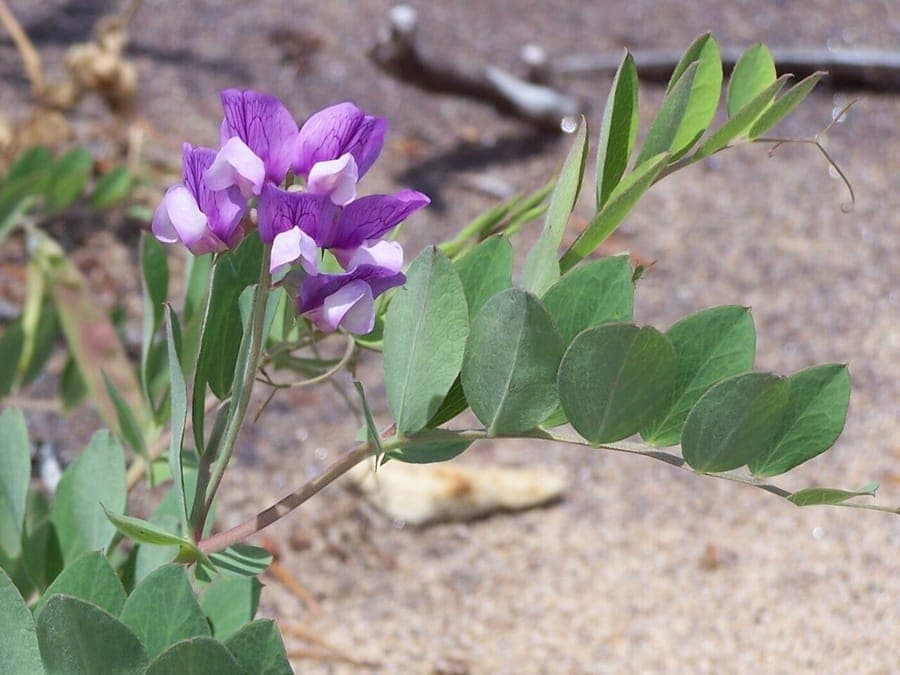
(c) Louis Imbeau, some rights reserved (CC BY) / CC BY 4.0, via Wikimedia Commons
Japanese pea (Lathyrus japonicus): complete guide
Lathyrus japonicus
¿Quieres ver Japanese pea (Lathyrus japonicus): complete guide en tu jardín?
1 minuto, sin tarjeta de crédito
Overview
The Japanese pea (Lathyrus japonicus), also known as beach vetchling or seaside vetch, is a remarkable garden plant that finds its way from the rocky coasts of East Asia into European gardens. This robust, creeping or climbing species takes its name from its range from northern Europe and northern Asia through China and Japan, even wild along the beaches from Alaska to western North America. It is a member of the pea family (Fabaceae) that distinguishes itself through striking deep purple to violet flower clusters, grey-green foliage, and an almost unparalleled ability to thrive in challenging conditions.
For gardeners seeking a vigorous vine that can tolerate more than most other climbers, Lathyrus japonicus is a hidden gem. The plant reaches 30-60 cm in height and can climb to 1.5 metres when supported. On gardenworld.app you can create a garden design where this hardy pea integrates as ground cover in difficult rock gardens, along banks or against walls. Combined with other tough species such as alpine pinks (Dianthus) and sea kale (Crambe), it creates an incomparable coastal garden atmosphere.
Appearance and bloom period
The Japanese pea flowers from May to August with attractive, densely packed flower clusters in deep purple to dark violet. The blooms stand on loose flower stems, aided by tendrils that assist in climbing. The foliage is grey-green to blue-green and consists of several pairs of oval leaflets whose terminal leaflets have transformed into climbing tendrils. The entire plant exudes coastal garden elegance.
After flowering, long, flat seed pods appear, releasing brown seeds in late summer weeks. The seed remains viable for several years and the plant sometimes self-seeds spontaneously. The plant has a deep, powerful root system that protects it against drought and sends out tendrils as soon as they have unfolded.
Ideal location
The Japanese pea originally thrived on cliff faces, sandy coasts, and rocky slopes where rough weather posed no problem. Choose therefore a sunny to partially shaded spot in your garden, with at least 5 hours of direct sun daily. The plant tolerates wind better than most garden plants - even sea spray, if you live near the coast.
Ensure the location is well-drained and avoid water pooling in winter months. Along paving, along walls, on steep slopes and in underground basins this is an ideal vetch. Mixed with other hardy species and creeping rock plants, it forms an authentic seaside garden.
Soil requirements
Where many other vetches have delicate soil needs, Lathyrus japonicus is a true champion of adaptability. The plant thrives in lean soils, sandy soils, humus-rich soils, and even in dry, clayey soils - as long as they are well-drained. Overwintering problems arise primarily from waterlogged conditions in winter. Work sand or gravel through heavy clay to improve drainage.
The plant's preference lies in soils with pH 6.0 to 8.0 - it thrives in both neutral and very weakly acidic to alkaline soils. Heavy feeding is not necessary; on the contrary, Fabaceae species fix their own nitrogen from the air via root nodules. A thin mulch of gravel or dry leaves helps retain moisture in sandy soils.
Diseño gratis
¿Quieres ver Japanese pea (Lathyrus japonicus): complete guide en tu jardín? Crea un diseño gratis ahora.
Watering
Thanks to its deep root system, the Japanese pea is particularly drought-tolerant after the first growing season. In the first year after planting, water weekly - approximately 10 litres per plant weekly - until roots are well established. Water at the base of the plant and avoid wet foliage.
From the second year onward, supplementary water is only necessary during extreme drought exceeding four weeks. In winter, the plant must remain absolutely dry - wet roots combined with frost are lethal, especially for young plants. The plant is particularly suited to dry, sunny corners of the garden.
Pruning and support
During the first two years, Japanese pea grows better if you pinch back flowering shoots and build up the plant into a thick, robust climber. This promotes branching and ensures fuller growth. Cut back regrown stems in early spring and remove any frost damage. Heavy pruning is not needed - let the plant develop naturally.
Give the plant a light support structure: low wire along a wall, a small trellis, or wooden latticework. The tendrils cling but appreciate some help. Find handy climbing support structures at most garden centres.
Maintenance calendar
March-April: Check for frost damage, remove dead twigs. Plant new specimens; ensure well-drained soil.
May-June: Peak growth period, especially in sunny locations. Provide support where needed, monitor for drought.
July-August: Peak flowering. Harvest seed if desired; seed ripens between August-September.
September-October: Plant for autumn; this provides better overwintering establishment. Check drainage around root zone.
November-February: Quiet period. Protect young plants against severe frost with a layer of pine branches.
Winter hardiness
Lathyrus japonicus is very winter-hardy and tolerates temperatures down to approximately -20°C (USDA zones 4-9), which means it can overwinter outdoors virtually anywhere in the UK and temperate Europe. Provided feet remain dry, winter loss is rare. Young plants may benefit from some protection during their first winter season.
Companion plants
The Japanese pea forms beautiful combinations with other hardy species. Group it with sea kale (Crambe maritima), alpine pinks (Dianthus), sea yarrow (Achillea maritima) and artemisia. For rock gardens, combine it happily with alpine asters, alpine phlox and creeping stonecrop. On gardenworld.app you can integrate these plant combinations into a rock garden that truly has character. Plant three to five specimens in groups for visual impact.
Final thoughts
Lathyrus japonicus is a plant for gardeners seeking robustness without conventional choices. It offers seaside garden character, lively purple flowering, and unparalleled hardiness. Whoever includes this beach vetch in their garden once discovers quickly why this species is highly valued among connoisseurs. On gardenworld.app create a coastal garden where this fascinating pea takes centre stage.
¿Quieres ver Japanese pea (Lathyrus japonicus): complete guide en tu jardín? Crea un diseño gratis ahora.
Sube una foto, elige un estilo y obtén un diseño fotorrealista con lista de plantas en menos de un minuto.
Más de 10.000 jardines diseñados
Sin tarjeta de crédito


Plantas similares
Everlasting pea (Lathyrus latifolius): complete guide
Lathyrus latifolius
Learn all about everlasting pea (Lathyrus latifolius), a strong climber with pink and purple flowers. Ideal for pergolas, garden walls and borders. Sowing, planting and care.
Black pea (Lathyrus niger): complete garden guide
Lathyrus niger
Discover black pea, an elegant wild-growing climbing plant. Growing tips, bloom period, ideal location, and uses in natural garden designs.
Grass vetchling (Lathyrus nissolia): complete guide
Lathyrus nissolia
Discover grass vetchling, an elegant wild plant with grass-like leaves. Growing tips, May-June bloom, and suitability for natural garden design.