
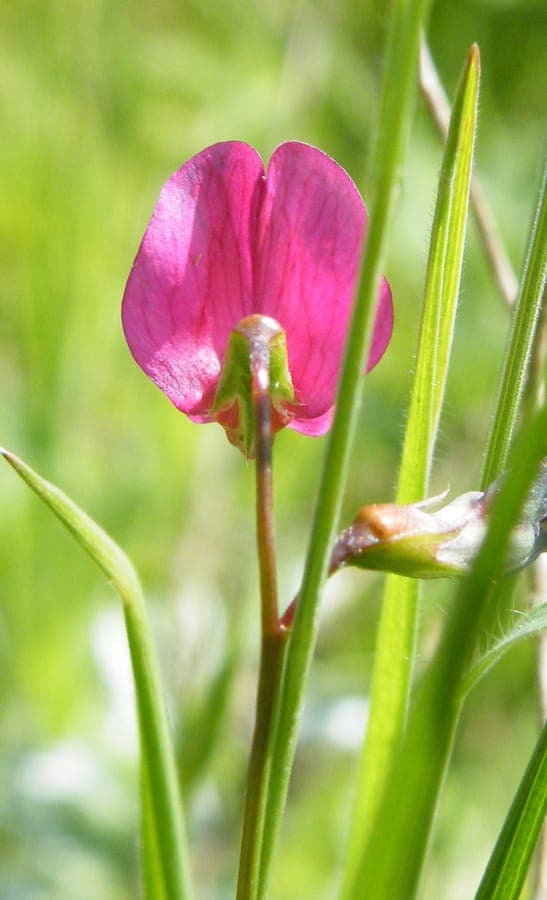
Phil Sellens from East Sussex / CC BY 2.0, via Wikimedia Commons
Grass vetchling (Lathyrus nissolia): complete guide
Lathyrus nissolia
¿Quieres ver Grass vetchling (Lathyrus nissolia): complete guide en tu jardín?
1 minuto, sin tarjeta de crédito
Overview
Grass vetchling (Lathyrus nissolia), also called Grass pea, is a charming annual plant from the legume family (Fabaceae). Native to Europe, the Mediterranean region, and Iran, it grows wild in herb-rich meadows and damp grasslands.
This plant is remarkable for its characteristic grass-like foliage, distinguishing it from most other Lathyrus species that have winged stem-leaves. Grass vetchling is an underappreciated gem for wild gardens and wildflower meadow projects, where it attracts butterflies and provides ecological value.
Appearance and Bloom
Grass vetchling grows as a compact (30-50 cm tall) upright to semi-trailing plant with delicate, narrow, grass-like leaves (linear-lanceolate). This unusual leaf form gives the plant its name. Leaves are 4-8 cm long and only 2-4 mm wide - a striking characteristic.
Bloom period: May to June. Flowers are small (1-1.5 cm), pink to reddish-purple, borne singly or in pairs along the stem. This delicate coloring suggests wild, natural beauty.
Fruit: After flowering, long, slender seed pods (3-4 cm) develop containing black seeds.
Ideal Location
Grass vetchling thrives in:
- Light: Full sun to half-shade (4-6 hours direct light)
- Microclimate: Moderately moist, not drought-stressed
- Position: Meadow margins, herb-rich grassland, wildflower borders
- Soil: Pasture-like conditions, not intensively cultivated
Less suited to:
- Very dry sandy locations
- Deep shade
- Very wet, boggy soils
Tip: Grass vetchling pairs beautifully in herb-rich meadow strips with other low wildflowers.
Soil
Grass vetchling makes modest demands:
- Soil type: Sandy to loamy; suited to species-rich grassland
- Drainage: Moderate to good
- pH: Neutral to slightly acidic (6.0-7.2)
- Fertility: Very low; the plant thrives on nutrient-poor soil where little else competes
- Organic matter: Minimal; species-rich meadows actually benefit from low fertility
Preparation: For wildflower meadow: light soil scarification, weed removal, direct sowing. No feeding.
Watering
Grass vetchling is drought-tolerant:
Establishment (first year):
- Regular watering only during very dry spells (>3 weeks without rain)
- After 4-6 weeks: minimal supplementation
- Water only if soil dries completely
Mature plants:
- Virtually no watering needed
- During extreme drought: water occasionally
- Grass vetchling is made for dry summers; excess water harms
Diseño gratis
¿Quieres ver Grass vetchling (Lathyrus nissolia): complete guide en tu jardín? Crea un diseño gratis ahora.
Pruning and Maintenance
Grass vetchling requires minimal work:
Growing season:
- No pruning
- Deadheading (removing spent flowers) slightly extends bloom
- Allow natural seed-set
After seed production:
- Plant exhausts itself (annual)
- Leave seeds on ground for self-sowing next year
- Remove unwanted seedlings
Disease management:
- Practically disease-free
- Very rarely: spider mite under extreme heat; no control needed
Maintenance Calendar
April: Direct sow or transplant seedlings May-June: Full bloom, insect visitation peak July: Seed pod development August-September: Seeds mature, plant energy depletes October-November: Plant dies back; seeds overwinter in soil May (following year): Volunteer seedlings bloom
Winter Hardiness
Grass vetchling is an annual plant (non-winter hardy in typical cultivation). Seed, however, can overwinter in soil.
Winter care:
- Plant dies back October-November
- Seed persists in soil until spring
- No frost damage possible (plant already dead)
Companion Planting
Grass vetchling suits herb-rich meadow schemes:
Good companions:
- Other host plants: Wild chervil (Chaerophyllum), eryngo (Eryngium)
- Low wildflowers: Veronica (Veronica), sheep sorrel (Rumex)
- Grasses: Sweet vernal grass (Anthoxanthum), quaking grass (Briza)
- Butterfly-nectar plants: Bupleurum (Bupleurum), dill (Anethum)
Poor companions:
- Vigorous competitors: Choose low plants to avoid competition
- Very fertile soils: Grass vetchling disappears under competitive pressure
Closing Remarks
Grass vetchling is a delicate beauty for species-rich, wildflower meadow-edge designs. The plant provides nectar for bees and hummingbirds; seed feeds birds and small mammals. It is critical support for farmland ecosystems where biodiversity is central.
Self-sowing and seed persistence make grass vetchling self-sustaining once established. This plant supports 'species-rich meadow' initiatives and grassland conservation at garden scale.
Plan your wildflower meadow via gardenworld.app for optimal insect support. With grass vetchling and companions, you create a living ecosystem.
For more wildflower gardening tips and meadow advice: visit gardenworld.app.
¿Quieres ver Grass vetchling (Lathyrus nissolia): complete guide en tu jardín? Crea un diseño gratis ahora.
Sube una foto, elige un estilo y obtén un diseño fotorrealista con lista de plantas en menos de un minuto.
Más de 10.000 jardines diseñados
Sin tarjeta de crédito


Plantas similares
Tall Silky Lupine: complete guide
Lupinus elatus
Tall silky lupine is a fast-growing Californian perennial with silvery foliage and blue-purple flower spikes, ideal for a prairie-style garden.
Garfield Lupine: complete guide
Lupinus garfieldensis
The Garfield lupine is a rare, fast-growing American perennial for alkaline, dry grassland gardens, with striking blue flower spikes.
Lupinus elegans: complete guide
Lupinus elegans
Lupinus elegans, the elegant lupine, is a spectacular blooming plant from Mexico with blue flower spikes. Care, cultivation and garden use.