
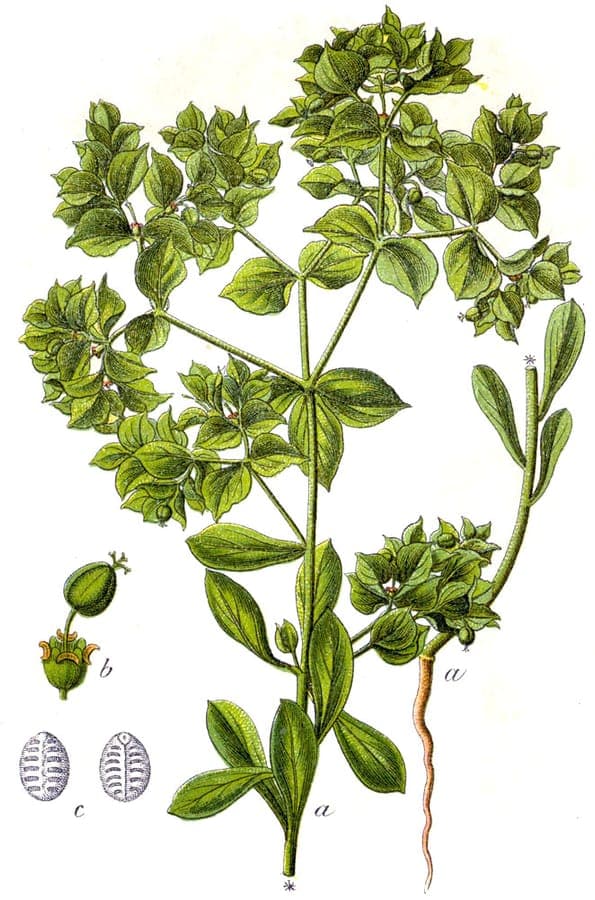
Johann Georg Sturm (Painter: Jacob Sturm) / Public domain, via Wikimedia Commons
Sickle spurge: complete guide
Euphorbia falcata
¿Quieres ver Sickle spurge: complete guide en tu jardín?
1 minuto, sin tarjeta de crédito
Overview
Sickle spurge (Euphorbia falcata) is an elegant, moderate-growing plant from the Euphorbiaceae family. Native range extends from Macaronesia through the Mediterranean, Western Himalaya, Europe, and Mongolia, indicating broad geographic distribution. The species is celebrated for architectural form and impressive drought tolerance.
Appearance & Bloom Cycle
Sickle spurge distinguishes itself through characteristic sickle-shaped (falcate) leaves, from which its common name derives. The plant grows upright, typically achieving 30-50 cm height with narrow, dense branching. Foliage displays attractive blue-green coloration with subtle gray waxy coating.
Blooming extends from April through June. Cyathia flowers are minute yet elegant, featuring yellow nectaries providing striking contrast against gray-green plant material. Spent flower clusters turn yellow-orange before abscission, offering additional visual interest.
Ideal Location
Sickle spurge excels in full sun to light shade. Provide minimum 5-6 hours direct sunlight daily for optimal flowering. The plant tolerates halophytic (salt-laden) conditions, making it suitable for coastal regions.
This species thrives in open gardens, rock gardens, and pergola positions. Upright form makes it excellent for mid-height borders. All south and west-facing exposures prove ideal.
Soil Requirements
Sickle spurge demonstrates remarkable soil type tolerance. The plant performs on sandy, calcareous, and nutrient-poor substrates. Preference for well-drained soils; waterlogging causes root rot.
The plant accepts both acidic (pH 5.5) and neutral to alkaline soils (pH 8.0). In heavy clay: add sand and compost for improved structure. Organic matter content of 2-5% proves ideal.
Watering
Extremely drought-tolerant once established. Water regularly during the first 6-8 weeks after planting. Subsequently, water only during extreme drought (exceeding 4 weeks without rainfall).
For container plants, water when top 2-3 cm feels dry. Prevent waterlogging. During extended summer heat, regular watering may become necessary in very sandy substrates, though the plant survives without supplemental irrigation.
Diseño gratis
¿Quieres ver Sickle spurge: complete guide en tu jardín? Crea un diseño gratis ahora.
Pruning & Maintenance
Sickle spurge requires minimal pruning. In early spring (February-March), remove dead or frost-damaged stems. Also deadhead spent flower clusters for neat appearance.
If the plant becomes overly wild, gentle top pruning in June encourages bushier, more compact form. Use caution with excessive cutting; the plant grows rather slowly.
Maintenance Calendar
January-February: Inspect for winter damage; remove frost-damaged sections.
March-May: Growth period; flowering commences. Light shaping as needed.
June-August: Bloom passes. Deadhead spent flowers. Minimal water during intense heat.
September-October: Growth slows. Harden plants in full sun for winter resilience.
November-December: Dormancy; no special care required.
Winter Hardiness
Sickle spurge demonstrates reasonable cold-hardiness to approximately -7°C in well-drained soil. In cold climates (USDA zone 6 or colder), provide winter protection. In temperate regions (USDA zones 7-9), no protection needed.
Container plants are less hardy; relocate to protected positions in November. In very cold areas: cultivate as annual or overwinter indoors.
Companion Plants
Sickle spurge pairs beautifully with:
- Salvia species for blue tones
- Agapanthus for blue-purple blooms
- Helianthemum for summer color
- Santolina for silvery foliage
- Catmint (Nepeta) for pastel accents
Suitable for Mediterranean borders, dry rock gardens, and heat-loving plant combinations.
Practical Tips
Source quality nursery plants from Intratuin or Gamma. Space 45-60 cm apart depending on desired mature size. The plant does not spread significantly.
Seed propagation is viable in spring. Harvest fresh seed, sow in seed compost at 15-18°C, and maintain moderate moisture. Germination occurs within 2-3 weeks. Seedlings grow rapidly; pot-on after 8-10 weeks.
For container cultivation: blend standard potting soil with 40% sand for excellent drainage. Repot every 3 years. Containers struggle in wet winter weather; protect from persistent rainfall.
The plant has few pest issues in European climates, though watch for scale insects under warm, dry conditions. Treat with insecticide if necessary.
Milky sap irritates sensitive skin; wash hands thoroughly after handling.
Visit gardenworld.app for additional plant guidance and design inspiration. Discover how other gardeners employ this Mediterranean accent.
¿Quieres ver Sickle spurge: complete guide en tu jardín? Crea un diseño gratis ahora.
Sube una foto, elige un estilo y obtén un diseño fotorrealista con lista de plantas en menos de un minuto.
Más de 10.000 jardines diseñados
Sin tarjeta de crédito


Plantas similares
Spurge: complete guide
Euphorbia chamaesyce
Discover Spurge (Euphorbia chamaesyce): cultivation techniques, care requirements, ideal locations, and practical tips for a thriving plant.
Variegated spurge: complete guide
Euphorbia marginata
Explore Variegated spurge (Euphorbia marginata): cultivation, care, ideal locations, and practical tips for this striking ornamental.
Eyebane: complete guide
Euphorbia nutans
Understand Eyebane (Euphorbia nutans): cultivation, care, characteristics, and management tips for this aggressive spreading plant.