
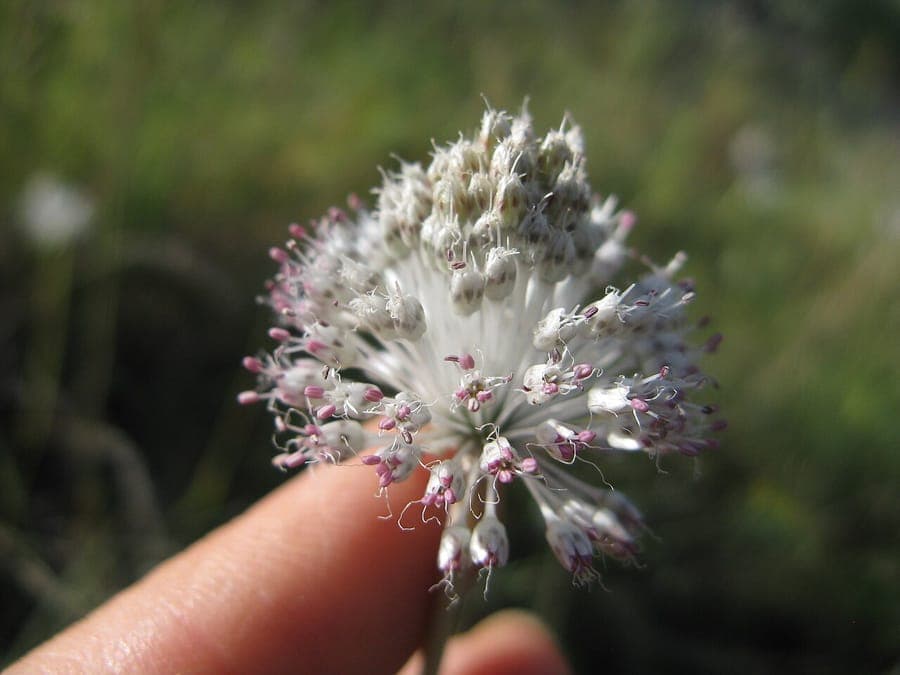
Вікторія Тротнер(Приймачук) / CC BY-SA 4.0, via Wikimedia Commons
Spotted onion: complete guide
Allium guttatum
¿Quieres ver Spotted onion: complete guide en tu jardín?
1 minuto, sin tarjeta de crédito
Allium guttatum, known as Spotted onion, is an elegant wild onion from Southeast Europe: Balkan Peninsula, Ukraine, Turkey, and surrounding regions. This hardy perennial grows on rocky slopes, dry grasslands, and alpine zones. With extremely fine leaves, compact form, and elegant white to pink flowers, it brings Mediterranean elegance to temperate gardens.
Overview
Allium guttatum distinguishes itself with very compact growth (10-25 cm), fine grey-green leaves, and characteristic, pointed white or pale pink flowers. This is a true mountain dweller, frost-hardy to USDA zone 5 (-29 C), and therefore reliable throughout Europe. The plant blooms in April-May. This is clearly not an edible onion, but purely ornamental and ecologically valuable.
Appearance and Bloom
The plant grows in dense rosettes with extremely fine, grey-green leaves (0.5-1 mm wide). In April-May, very elegant, pointed flower clusters (umbels) appear with 10-20 small, white to pink florets. The flowers have a very delicate, hair-like appearance. The botanical epithet "guttatum" (speckled) refers to subtle spots on the petals. Seed setting is very good.
Ideal Location
Use a very sunny, well-drained microclimate in rock gardens. Front borders, alpine troughs, dry hilltops. Cannot tolerate shade. Very attractive to bees and butterflies. Plant in groups of 5-7 for maximum effect.
Soil
Well-drained, lean soil with pH 6.0-7.5. No compost or rich feeding. Use 1 part garden soil + 1 part coarse sand + 1 part perlite. As potted plant: cactus/alpine mix (70%) + garden soil (30%). Add some slow-release fertilizer (3-5 g/m2 nitrogen annually).
Diseño gratis
¿Quieres ver Spotted onion: complete guide en tu jardín? Crea un diseño gratis ahora.
Watering
Minimal water needed. During growth period (March-April), light misting 1-2 times weekly. After bloom, withdraw water. In summer/autumn keep nearly dry. Rain and snowmelt water suffices. Very frost-tolerant; snow protects.
Pruning
Remove flowers after blooming (May) unless seed is desired. Leave dead stems until March for bird food. No winter pruning needed. Remove dead leaves spontaneously.
Maintenance Calendar
- January-March: Frost protection not needed; check drainage
- April-May: Bloom; minimal watering
- June-July: Dormancy; stop watering
- August-October: Resting period; keep almost dry
- November-December: Minimal watering; no winter care needed
Winter Hardiness
Very hardy to USDA zone 5 (-29 C). No protection needed anywhere in Europe. Snow cover helps and protects. Ideal for alpine gardens and rock gardens.
Companion Planting
In rock gardens: Sedum, Sempervivum, Saponaria, Silene. With wildflowers: Dianthus, Lychnis, Phlox subulata. Low grasses: Festuca glauca. Avoid tall, moisture-loving companions. For bird food: place near observation points.
Closing Remarks
Spotted onion is a quiet beauty for alpine and dry gardens. With minimal maintenance it grows 8-12 years. This is the onion for plant enthusiasts with rock gardens or alpine troughs. Seed suppliers regularly stock seeds; sow in autumn on stratification (October) for best results. Mature plants cost 3-6 euros each. For optimal success: ensure very well-drained, lean soil.
¿Quieres ver Spotted onion: complete guide en tu jardín? Crea un diseño gratis ahora.
Sube una foto, elige un estilo y obtén un diseño fotorrealista con lista de plantas en menos de un minuto.
Más de 10.000 jardines diseñados
Sin tarjeta de crédito


Plantas similares
Douglas' Onion: complete guide
Allium douglasii
Douglas' onion is a compact ornamental allium with purple flowers, perfect for rock gardens and sunny borders. Learn care, siting and hardiness.
Oblique onion: complete guide
Allium obliquum
The oblique onion is a hardy ornamental allium with chartreuse flower heads and blue-green foliage. Location, soil and care explained.
False hooded garlic: complete guide
Allium pseudocalyptratum
Discover false hooded garlic (Allium pseudocalyptratum): a rare ornamental onion from Lebanon for rock gardens and alpine troughs.