
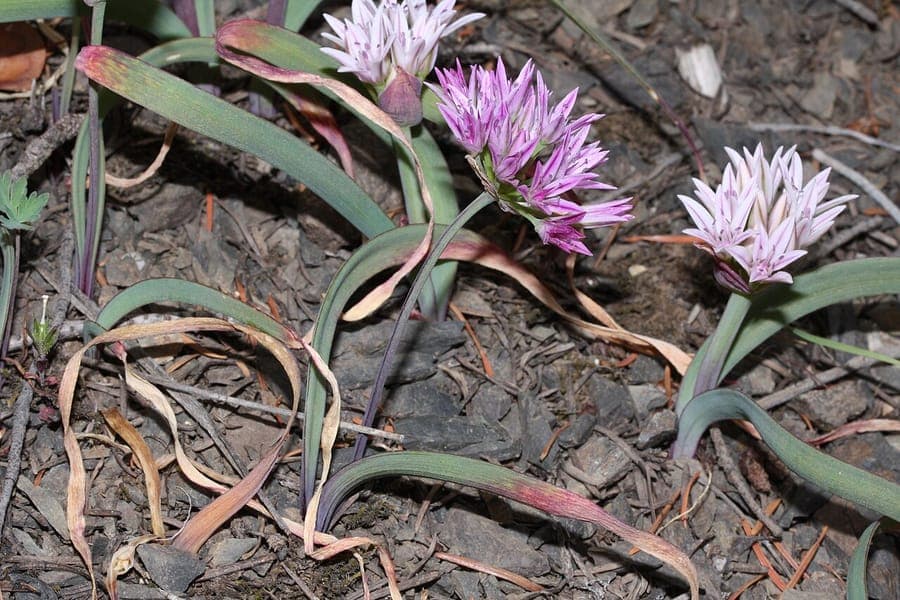
Walter Siegmund (talk) / CC BY-SA 3.0, via Wikimedia Commons
Allium crenulatum: complete guide
Allium crenulatum
¿Quieres ver Allium crenulatum: complete guide en tu jardín?
1 minuto, sin tarjeta de crédito
Overview
Allium crenulatum, commonly known as the Olympic onion, is an elegant compact alpine plant from the Amaryllidaceae family (onion family), native to mountain regions of the Pacific Northwest, specifically the Cascade Mountains and Olympic Mountains in Oregon and Washington. This hardy alpine bulb grows only 15 to 30 centimetres tall and forms attractive clusters of pink to purple flowers in May to June. The plant is renowned for extreme drought tolerance and ability to thrive in lean, stone-rich soils where many plants barely survive.
Appearance and bloom
The Olympic onion has slender, grass-like foliage growing close to ground level, forming compact clumps. Flowers grow in spherical clusters (umbels) on slender, upright stems reaching about 20 to 25 centimetres tall. Each individual flower is small, pink to purple with characteristic crenulated (scalloped) edges, giving this species its scientific name. Flowering occurs from May to June, attracting butterflies and honeybees. The plant disappears underground after blooming and re-emerges the following season.
Ideal location
The Olympic onion thrives in full sun to partial shade on well-drained sites. Alpine rockeries and mountain borders are ideal. The plant creates beautiful drifts along gravel paths, in wall crevices, or on green roofs where water drains rapidly. This proves perfect for talus slopes, scree gardens, and shale areas where many plants fail. Container cultivation is also successful, particularly in alpine troughs and raised alpine beds where drainage is superior.
Soil
The Olympic onion requires excellent drainage and grows best in poor, stone-rich, lean soil. It thrives on acidic to neutral soils with pH around 6.5 to 7.0. For containers, use alpine plant compost with additional grit or sand. In garden settings, plant on talus slopes or raised beds with significant grit incorporation. Adding abundant organic matter is unnecessary - indeed, richer soils promote excessive vegetative growth at the expense of flowering. The plant actually benefits from harsh growing conditions.
Diseño gratis
¿Quieres ver Allium crenulatum: complete guide en tu jardín? Crea un diseño gratis ahora.
Watering
The Olympic onion is drought tolerant once well established. During the growing season (March to May), water moderate amounts while ensuring excellent drainage and no waterlogging. After flowering (June to August), water can be reduced substantially. In autumn and winter, supplemental water is unnecessary - indeed, if rain is abundant, extra watering remains pointless. This plant thrives better under dry conditions than excessive moisture.
Pruning
The Olympic onion requires minimal maintenance. The plant naturally dies back after flowering and grows underground. Remove spent flowers if wishing to prevent self-seeding, though this plant self-manages reasonably well and remains non-invasive. In containers, old spent stems can be carefully removed in early autumn. The plant forms itself into neat clusters without formal pruning.
Maintenance calendar
March to April: Plant emerges and grows slowly, minimal water needed. May to June: Flowering period, enjoy pink blooms, minimal watering required. July to August: Flowers fade, plant dies back underground, no water needed. September to February: Plant dormant, periodically check soil is not excessively dry, especially in alpine regions.
Winter hardiness
The Olympic onion is extremely winter hardy, tolerating temperatures to -20 degrees Celsius, perfectly adapted to mountain winters in its native range. As an alpine plant, this species grows under snow cover during long winters and requires no special winter protection in most climates. However, ensure soil is not waterlogged, as this can cause frost damage. In exceptionally wet winters, mulching with dry leaves helps maintain drainage.
Companion plants
The Olympic onion combines beautifully with other alpine mountain plants such as Saxifraga, Dianthus (alpine pinks), Armeria, and Sempervivum. For dry alpine borders, pair with Sedum, Pulsatilla, and low-growing grasses. These combinations create authentic alpine meadow effects. As a spring bloomer, this plant provides early season colour in alpine gardens.
Final advice
The Olympic onion is an authentic alpine plant particularly suited to gardeners with dry, stone-rich soil types. This compact gem deserves a place in alpine rockeries and xerophytic borders. Available from specialized alpine nurseries and online suppliers. Discover more alpine flowers on gardenworld.app and plan your mountain garden design today. This North American treasure adds authentic alpine character to every alpine garden!
¿Quieres ver Allium crenulatum: complete guide en tu jardín? Crea un diseño gratis ahora.
Sube una foto, elige un estilo y obtén un diseño fotorrealista con lista de plantas en menos de un minuto.
Más de 10.000 jardines diseñados
Sin tarjeta de crédito


Plantas similares
Douglas' Onion: complete guide
Allium douglasii
Douglas' onion is a compact ornamental allium with purple flowers, perfect for rock gardens and sunny borders. Learn care, siting and hardiness.
Oblique onion: complete guide
Allium obliquum
The oblique onion is a hardy ornamental allium with chartreuse flower heads and blue-green foliage. Location, soil and care explained.
False hooded garlic: complete guide
Allium pseudocalyptratum
Discover false hooded garlic (Allium pseudocalyptratum): a rare ornamental onion from Lebanon for rock gardens and alpine troughs.