
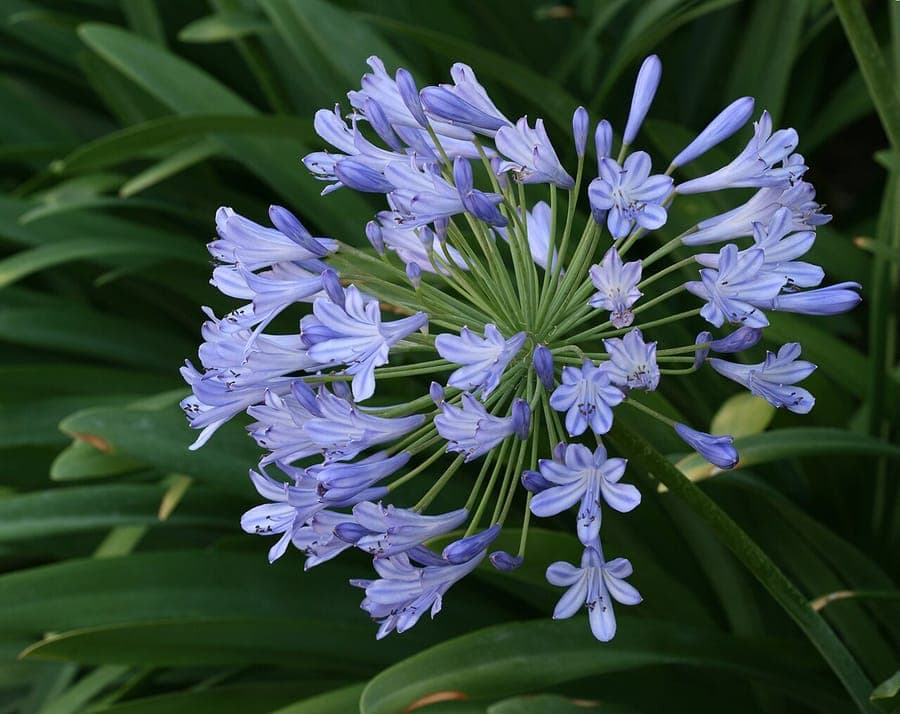
Victorrocha / CC BY-SA 3.0, via Wikimedia Commons
Agapanthus praecox: complete guide
Agapanthus praecox
¿Quieres ver Agapanthus praecox: complete guide en tu jardín?
1 minuto, sin tarjeta de crédito
Overview
Agapanthus praecox, commonly called African lily or common agapanthus, is an elegant ornamental plant native to South Africa. This striking species forms dense clusters of long, coarse foliage and produces spectacular spherical flower heads in purple-blue tones. With its exotic appearance, straightforward cultivation, and exceptional flower longevity, Agapanthus praecox makes a stunning addition to Mediterranean and container gardens throughout Europe.
Appearance & Bloom
African lily forms compact clumps 60 to 80 cm tall with long, coarse, grey-green foliage. Characteristic spherical flower heads (umbels) appear from July through September in striking purple-blue tones, occasionally with lighter centers. Each flower is tubular and funnel-shaped, held tightly within spectacular spheres. These blooms persist for four to six weeks, providing extended colour and attracting numerous butterflies, bees, and birds.
Ideal Location
African lily performs best in full sun on sheltered, warm sites. The plant tolerates partial shade but flowers less profusely. In southern Europe, it thrives outdoors year-round; in northern regions (Netherlands, Belgium, northern France), it requires container cultivation and winter protection. Shelter from strong winds significantly improves flowering success.
Soil
Agapanthus praecox adapts to varied soil conditions but prefers well-drained, moderately fertile soil. The plant tolerates acidic to neutral pH well. Waterlogged conditions are fatal; heavy clay soils should be amended with sand and organic matter to improve drainage and root development.
Diseño gratis
¿Quieres ver Agapanthus praecox: complete guide en tu jardín? Crea un diseño gratis ahora.
Watering
Once established, African lily is moderately drought-tolerant. Young plants should be irrigated regularly until well-rooted. Mature plants can survive extended dry periods but reward regular moisture during the growing season with improved growth and flowering. Container specimens require more frequent watering.
Pruning
Agapanthus praecox requires minimal pruning. Spent flower heads may be removed for aesthetic tidiness. After flowering in October, all flower stems can be cut back to the base. Dead leaves may be removed in late spring as the plant awakens from dormancy.
Maintenance Calendar
March-April: Preparation and clean-up May: Beginning of growth period June-September: Flowering period October: Removal of spent flower stems November-February: Dormancy (container protection in cold regions)
Winter Hardiness
African lily is hardy to -10 degrees Celsius for short periods. In southern Europe it is permanently hardy; in northern regions (Netherlands, Belgium, northern France), it requires container cultivation and winter protection or movement to frost-free locations.
Companion Plants
African lily pairs beautifully with Mediterranean plants including Lavandula, Rosmarinus, and Cistus. In borders, it combines with white Gaura, yellow Coreopsis, and red Crocosmia. The plant is equally valuable in wildlife gardens and as architectural container specimens.
Closing
Agapanthus praecox is an exceptional choice for gardeners seeking exotic, wildlife-friendly plants with spectacular flowering displays. In southern Europe, it thrives as a permanent garden resident; in northern regions, enjoy it as a container specimen with seasonal placement. High-quality nursery stock is readily available from specialized suppliers.
¿Quieres ver Agapanthus praecox: complete guide en tu jardín? Crea un diseño gratis ahora.
Sube una foto, elige un estilo y obtén un diseño fotorrealista con lista de plantas en menos de un minuto.
Más de 10.000 jardines diseñados
Sin tarjeta de crédito


Plantas similares
Douglas' Onion: complete guide
Allium douglasii
Douglas' onion is a compact ornamental allium with purple flowers, perfect for rock gardens and sunny borders. Learn care, siting and hardiness.
Oblique onion: complete guide
Allium obliquum
The oblique onion is a hardy ornamental allium with chartreuse flower heads and blue-green foliage. Location, soil and care explained.
False hooded garlic: complete guide
Allium pseudocalyptratum
Discover false hooded garlic (Allium pseudocalyptratum): a rare ornamental onion from Lebanon for rock gardens and alpine troughs.