
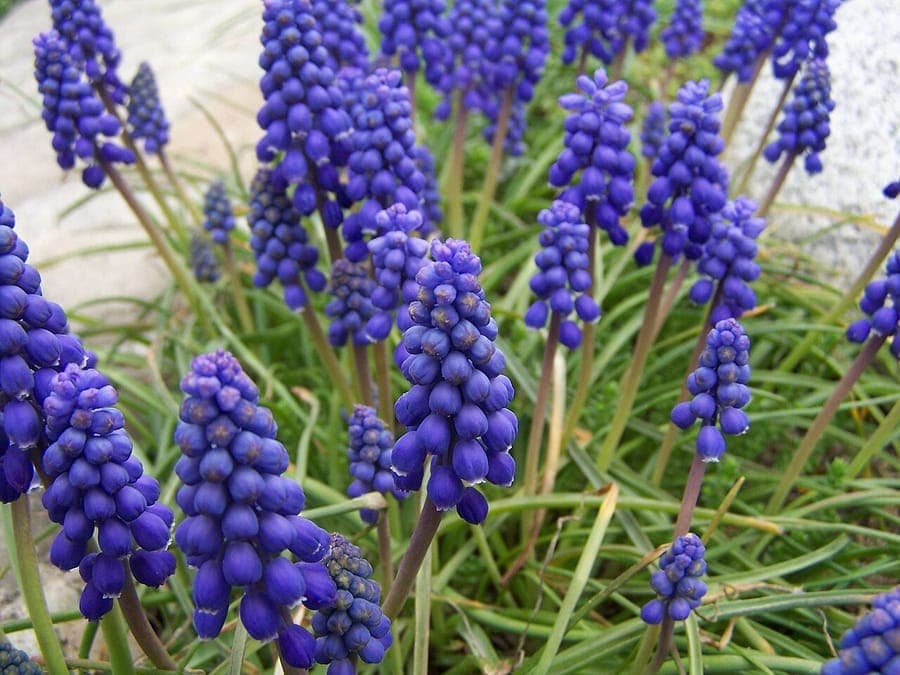
Opioła Jerzy (Poland) / CC BY 2.5, via Wikimedia Commons
Common grape-hyacinth: complete guide
Muscari armeniacum
Want to see Common grape-hyacinth: complete guide in your garden?
1 minute, no credit card
Overview
Muscari armeniacum, commonly known as common grape-hyacinth, is a staple in spring gardens across temperate climates. Native to regions like Turkey, Greece, and the Caucasus, this small herbaceous perennial from the Asparagaceae family has become a favorite for its striking floral display and ease of care. Reaching just 15–20 cm in height, it blooms reliably each year from late March to mid-April, depending on local conditions. Its clusters of tightly packed, urn-shaped flowers resemble bunches of grapes - hence the name.
One of the biggest strengths of this plant is its resilience. It thrives in a wide range of garden settings, from formal beds to wildflower meadows. It's completely hardy in USDA zones 4–8, meaning it survives harsh winters with no special protection. What's more, it spreads gently over time through self-seeding and bulb offsets, gradually forming dense colonies that return year after year. This makes it ideal for low-effort, high-impact planting. With gardenworld.app, you can design a spring garden layout that highlights these natural drifts of blue.
Appearance & bloom cycle
The flowers of Muscari armeniacum are its main attraction. Each stem holds a dense raceme of 20–40 small, deep blue to violet flowers, paler at the tips and nearly black at the base. The contrast gives the inflorescence a two-toned effect that stands out in the garden. Narrow, strap-like leaves emerge at the same time as the flower spikes, staying green for about six to eight weeks after blooming.
The bloom window is typically late March to mid-April, though it can start earlier in milder zones or sheltered spots. After flowering, the foliage dies back naturally, storing energy in the bulb for next year. Never cut the leaves while green - this weakens the bulb over time. Let them yellow fully before tidying up.
One of the joys of growing this plant is watching it spread. Seeds disperse naturally, often popping up in lawn edges, under shrubs, or between pavers. Within two to three years, single bulbs develop into small colonies. This self-sustaining habit is perfect for informal gardens. On gardenworld.app, you can map out a naturalized planting scheme where grape-hyacinth integrates seamlessly with other spring bloomers.
Ideal location
Common grape-hyacinth grows best in full sun to partial shade. In full sun, it blooms earlier and more profusely; in light shade, the flowers last a bit longer. It adapts well to borders, rock gardens, under trees, or even in lawns if mowing is delayed until after leaf dieback (early June).
For visual impact, plant in groups of at least 25 bulbs. Space them 5 cm apart and set 8–10 cm deep. Drifts look more natural than rigid rows, especially when mixed with other spring bulbs like Crocus or Chionodoxa. It also works well as a front-of-border plant, where its deep blue tones complement yellow daffodils or white snowdrops.
Free design
Want to see Common grape-hyacinth: complete guide in your garden? Make a free design now.
Soil requirements
This plant isn't fussy about soil type, as long as drainage is good. Heavy clay soils should be amended with grit or compost to prevent waterlogging. Soggy soil, especially in summer, leads to bulb rot. Sandy soils are fine, though they may dry out too fast in early spring - a light mulch can help retain moisture.
The ideal pH range is 6.0–7.5 (slightly acidic to neutral). Avoid high-nitrogen fertilizers, which promote leafy growth at the expense of flowers. A sprinkle of bone meal at planting time is sufficient.
Watering
After planting, water well to settle the soil and encourage root development. Once established, Muscari armeniacum rarely needs supplemental watering. Rain and natural moisture are usually enough. During unusually dry springs, a weekly soak can support bloom quality, but overwatering is a bigger risk.
In lawns or naturalized areas, avoid irrigation during summer dormancy. The bulbs rest underground and excess moisture increases rot risk.
Pruning
No pruning is required. Allow foliage to die back naturally - cutting it early reduces next year's bloom. Never braid or tie the leaves; this does not help and can trap moisture.
Spent flower spikes can be left in place to self-seed. If you want to limit spread, snip off the heads after flowering but before seeds form. Otherwise, enjoy the way this plant finds its own niches.
Maintenance calendar
- September–October: Plant bulbs 8–10 cm deep, 5 cm apart. Choose well-drained sites.
- November–February: Dormant period. No care needed.
- March–April: Blooming begins. Watch for slug damage, though rarely an issue.
- May: Foliage persists. Do not cut.
- June–August: Dormant. Avoid wet soils.
Winter hardiness
Fully hardy in USDA zones 4–8. Bulbs tolerate temperatures down to -25°C. No mulch or protection required, though heavy snow cover can help insulate in zone 4. The main threat is prolonged wetness, not cold.
Companion plants
Pair with early daffodils, species tulips, or Pulmonaria. In woodland settings, it complements Epimedium or ferns. For contrast, plant alongside white Anemone blanda or golden primroses. Avoid aggressive spreaders like mint or bishop's weed that could overwhelm it.
It also looks striking in gravel gardens or between paving stones, where its compact size shines.
Closing
Muscari armeniacum is a reliable, beautiful, and ecologically valuable spring bulb. It asks for little and gives back with waves of blue. Buy bulbs in autumn from trusted garden centres, and plant them before the ground freezes. Whether you're refreshing a border or designing a natural meadow, this grape-hyacinth earns its place. Use gardenworld.app to plan a seasonal sequence where early bloomers like this set the tone for the year.
Want to see Common grape-hyacinth: complete guide in your garden? Make a free design now.
Upload a photo, pick a style, and get a photorealistic design with plant list in under a minute.
10,000+ gardens designed already
No credit card required


Similar plants
Narrow-leaved dracaena: complete guide
Dracaena angustifolia
Everything about Dracaena angustifolia - the narrow-leaved dracaena: location, care, overwintering and use as a houseplant or patio plant.
Chaparral yucca: complete guide to Hesperoyucca whipplei
Hesperoyucca whipplei
Hesperoyucca whipplei (Our Lord's candle) is a dramatic rosette-forming plant from California that produces a towering flower spike, ideal for dry and gravel gardens.
False lily-of-the-valley: complete guide
Maianthemum dilatatum
Everything about Maianthemum dilatatum, the false lily-of-the-valley. Care, shade location, propagation and garden combinations for this popular shade ground cover.