
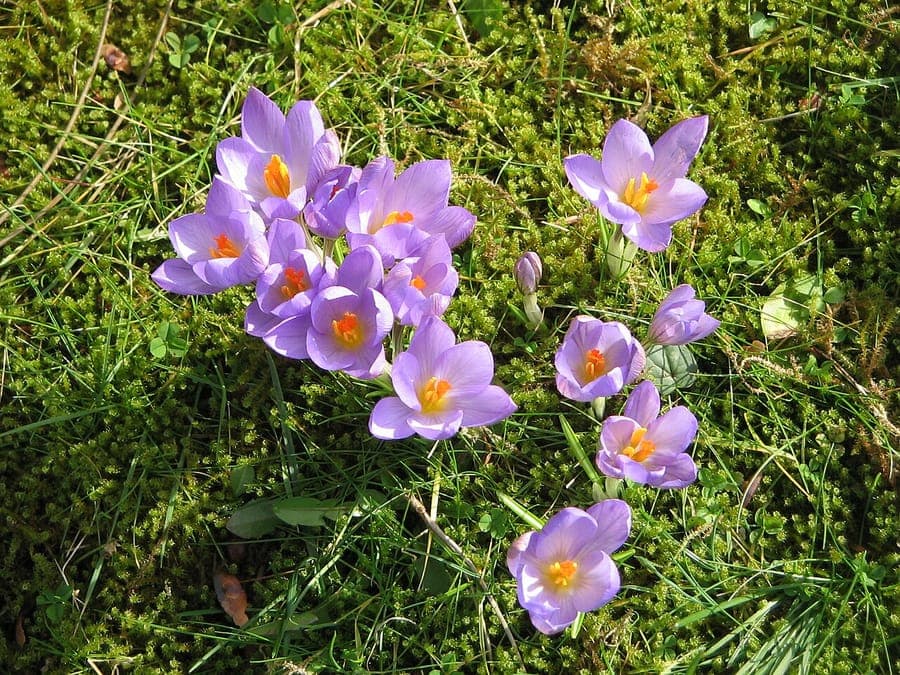
Meneerke bloem / CC BY-SA 3.0, via Wikimedia Commons
Crocus etruscus: complete guide
Crocus etruscus
Want to see Crocus etruscus: complete guide in your garden?
1 minute, no credit card
Overview
Crocus etruscus, commonly known as Etruscan crocus or Rose crocus, is a heritage crocus from the Iridaceae family. This dwarf blooming plant grows naturally only in Northern Italy (Tuscany and surroundings), making it a rare and botanically interesting plant.
The Etruscan crocus is a harbinger of spring with its early blooming character (February-March). For front yard designs where early color is desired, it is an excellent choice. The plant brings botanical authenticity and Italian charm to small front yard spaces.
The plant is also highly valuable for pollinators in early spring when food is scarce.
Appearance & bloom
Etruscan crocus reaches only 5-10 centimeters in height with very small, upright leaves. The leaves are hair-like and grow in tight bundles, emerging alongside the flowers.
The flowers are extremely characteristic, varying from pale pink to deep purple-red, depending on plant population and conditions. The flower cup is oblong with six petals that open on warm days and close in cold weather.
Blooming occurs in February-March, much earlier than common crocuses. Each bulb can produce 2-4 flowers.
Ideal location
Etruscan crocus thrives optimally in full sun to partial shade. Full sun promotes the most beautiful color formation. The plant also accepts apparently half-shaded places.
The plant is hardy to at least -15 degrees Celsius and grows naturally in Northern Italy on high peaks. Snow and frost do not faze it.
The plant prefers well-drained, not waterlogged sites.
Soil
Etruscan crocus grows best in well-drained, sandy to loamy soil with pH 6.5-7.5. The plant tolerates poor soils well and even grows in barren mountain soils.
Ensure good drainage; waterlogging is fatal. Add sand or gravel when amending wetter soils for better drainage.
Organic matter helps but should not be excessive.
Free design
Want to see Crocus etruscus: complete guide in your garden? Make a free design now.
Watering
Etruscan crocus requires minimal watering after planting time. The plant is drought-tolerant and does best with natural rain in fall-winter-spring.
During dry summers, supplemental watering can help, but it is usually unnecessary due to underground bulb water reserves.
Pruning
Pruning does not apply. Let the foliage grow until it naturally dies back (May-June). This returns energy to the bulb for future years.
Remove only dead or damaged flowers.
Maintenance calendar
Fall (September-October): Plant bulbs at depth of 5 centimeters, 5 centimeters apart. Ensure good drainage.
Winter (November-January): Bulbs root underground. No intervention needed.
Spring (February-March): Blooming. Enjoy early colors.
Summer (April-May): Foliage growth fulfills energy storage. No watering needed.
Winter hardiness
Etruscan crocus is very winter-hardy to -20 degrees Celsius. It grows naturally on mountaintops in Northern Italy. No protection needed in the Netherlands or Belgium.
Companion plants
Etruscan crocus works well alongside:
- Other early crocuses: Create different color schemes
- Perennial green: Helleborus, winter shrubs
- Dwarf bulbs: Muscari, scilla
- Bird food plants: Together ignite bird intensities
Avoid strong shade-casters like eternal grapes.
Closing
Etruscan crocus brings Italian beauty and botanical rarity to front yard designs. The early bloom and authenticity make it essential for front yard enthusiasts.
On gardenworld.app you can integrate Etruscan crocus into your front yard design for early spring color: https://gardenworld.app/en/plant-blog/crocus-etruscus and https://gardenworld.app/en/plant-blog/etruscan-crocus
Want to see Crocus etruscus: complete guide in your garden? Make a free design now.
Upload a photo, pick a style, and get a photorealistic design with plant list in under a minute.
10,000+ gardens designed already
No credit card required


Similar plants
Iris tingitana: complete guide
Iris tingitana
Iris tingitana, the Morocco iris, is the bulb species behind the Dutch iris: early blue-violet blooms that need a sunny, well-drained position.
Iris hookeri: complete guide
Iris hookeri
Hooker's Iris is a compact North American native plant with blue flowers. Low-growing and moisture-loving water plant.
Siskiyou iris: complete guide
Iris bracteata
Complete guide to Iris bracteata, the Siskiyou iris: location, soil, bloom cycle, watering, pruning and companion plants for this rare Pacific Coast iris.