

Winter flowering plants for January colour
By the GardenWorld editorial team, updated on
Want to see this in your garden?
Full design in HD: €7.99
Why winter flowering plants save your garden in January
January is the greyest month in the garden: borders sit bare and the summer bloomers are still months from waking up. Winter flowering plants such as witch hazel, winter jasmine, hellebore and snowdrops fix that straight away. They flower exactly between December and March, when nothing else gives colour, and several of them smell wonderful too.
Beyond colour, there is an ecological bonus: on mild January days the first bees and bumblebees are already active, and winter flowers are often their only food source. Plant them close to the house, a window or a path you walk every day, and you get the benefit of the scent and the colour without having to go far into the garden.
Witch hazel: blossom and scent from December to February
Witch hazel (Hamamelis) is the best known winter bloomer. It flowers from December to February with thin, ribbon-like flowers in yellow, orange or red, growing straight on the bare branches. Fragrant varieties such as Arnold Promise and Pallida smell strongest in the afternoon and on mild days, so plant one within a few metres of a window or door you open often.
The shrub grows slowly and usually reaches 2 to 3 metres tall and wide. It wants nutrient rich, free draining soil and dappled shade: in full sun it still flowers, but with less scent. In a pot it also works, with at least 60 litres of soil and regular watering during the growing season. Not sure where it fits in your own garden? On gardenworld.app you can see a preview with a photo of your own garden before you plant anything.
Winter jasmine: yellow flowers against a wall or fence
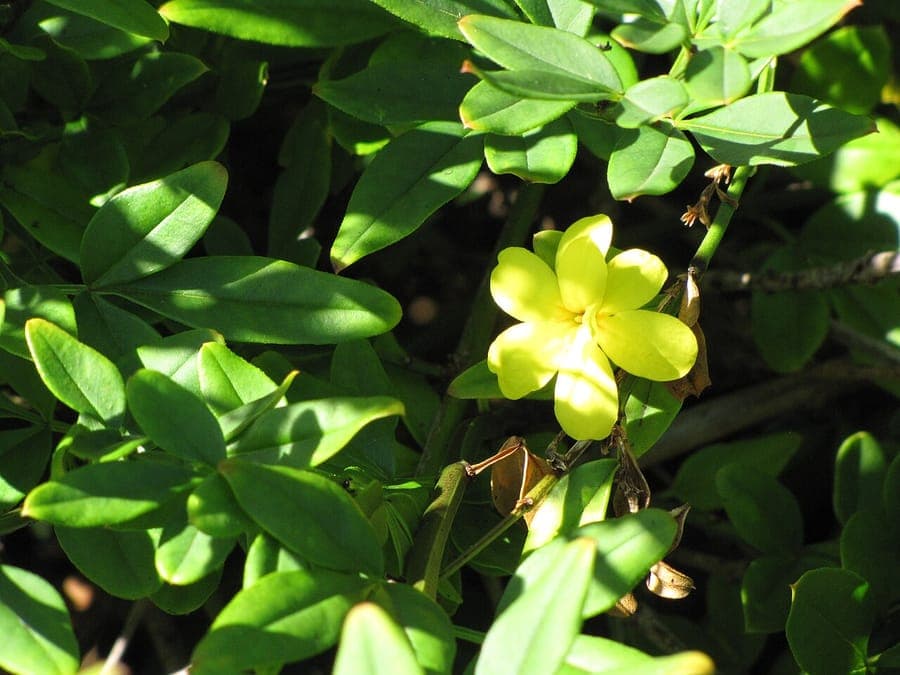
Winter jasmine (Jasminum nudiflorum) flowers from October to March with small, bright yellow blooms on bare, arching stems. It grows faster than witch hazel, up to about 3 metres, and works well against a wall, a fence or as ground cover on a slope. It is hardy to about minus 10 degrees; in hard frost flowering pauses for a while, then simply continues once it warms up.
Winter jasmine grows in almost any soil and needs little care: prune it shortly after flowering, in March, so it fills out again the following year. Tie long stems loosely to a frame or wire, otherwise they flop over in the wind.
Hellebore: flowers that face the ground
Hellebore (Christmas rose or Lenten rose) flowers from December to March depending on the variety, in white, green, purple or pink, with blooms that hang downward. You need to bend down to see them properly, and that is exactly what makes them special. The plant likes dappled shade: in full sun the flowers fade quickly.
Give hellebore moisture retentive, humus rich soil with some compost mixed in, then leave it alone. It is toxic if eaten, so keep children and pets away from the plant and wear gloves when pruning or dividing it. Well known types are Helleborus niger, pure white and early flowering, and Helleborus x hybridus, which comes in a wide range of colours.
Snowdrop: the smallest bloomer with the biggest effect
Snowdrops (Galanthus nivalis) grow only 10 to 15 cm tall, but a group of fifty or more gives a striking effect under bare trees or along a path. They flower from January onward, sometimes late December in a mild winter, and actually need winter cold to come up properly.
Plant the bulbs in September or October, 5 to 8 cm deep, in moist, humus rich soil in dappled shade. Left alone, they spread slowly on their own. Never eat them: the bulb is poisonous. After flowering the leaves die back naturally, so you can plant other things over them from May onward.
Free preview
Create your own garden design
Viburnum: white blossom and red berries for the birds
Viburnum farreri flowers from November to March with small, strongly scented white to pink blooms, and grows 2 to 3 metres tall. It is frost hardy and needs little pruning beyond removing dead wood. A more compact choice for smaller gardens is Viburnum x bodnantense Dawn, which stays under 2 metres.
Viburnum opulus, the guelder rose, flowers earlier in autumn and produces red berries that thrushes and blackbirds love. Plant viburnum where you can catch the scent, against the sunny side of the house or right next to a terrace.
Other winter flowering plants for more colour
Erica carnea, winter heather, stays low, 20 to 30 cm, and flowers from November to April in pink and purple shades, ideal as ground cover at the front of a border. Cornus sanguinea, dogwood, does not flower in winter, but its bright red stems, combined with the yellow twigs of Salix alba Vitellina, give a strong winter picture, especially against low morning light. Combine both colours for contrast.
Step by step
Step 1: Choose the spot for scent and view
Plant fragrant types such as witch hazel and viburnum within a few metres of a window, door or terrace. Dappled shade suits witch hazel and hellebore best; winter jasmine and viburnum also tolerate full sun.
Step 2: Prepare the soil in September or October
Dig a hole twice as wide as the root ball and mix in plenty of compost, roughly a third of the dug out soil. If the ground is heavy clay, add some coarse sand or drainage material.
Step 3: Plant in October or November
Put winter flowering plants in the ground in autumn, so the roots can establish before frost sets in. Plant bulbs such as snowdrops already in September.
Step 4: Water well and add a layer of mulch
Water generously right after planting and keep the soil moist for the first few months. Add a 5 cm layer of compost around the base, but keep it away from the stem itself.
Step 5: Stake tall shrubs against the wind
Winter jasmine and viburnum blow over easily in a storm until they are properly rooted. Use a stake at least 1 metre tall and tie the shrub to it loosely.
Common mistakes
Planting in full sun: witch hazel and hellebore fade and lose scent in full sun. Choose dappled shade instead.
Planting too late: plant in autumn, not in spring. After May the plant has no time left to root in before winter.
Planting too few bulbs: a handful of snowdrops gets lost in a border. Plant at least fifty at once for a real effect.
Underestimating drought: winter flowering plants suffer quietly from dry soil, even in winter. Check the soil regularly, especially in a dry winter.
Frequently asked questions
Can witch hazel grow in a pot? Yes, with at least 60 litres of potting soil, regular watering during the growing season and a spot in dappled shade. Move it to a larger pot every few years.
Do snowdrops grow well under trees? Very well: they get shade in summer, while resting underground, and enough light in winter, while flowering and the trees are still bare.
Is hellebore dangerous for children or pets? The plant is toxic if eaten. Do not plant it within reach of young children, and keep dogs and cats away if they tend to chew on plants.
Can you move or divide winter flowering plants? Hellebore can be divided carefully after flowering, in early spring. Witch hazel is best left in place, since it recovers poorly from root damage.
See it in your own garden first
Want to know how winter flowering plants would look in your garden before you plant? Upload a photo of your garden to gardenworld.app and view a free preview of a new design. The sharp image with a matching plant list costs 7.99 euros, one time, no subscription. That way you see in advance where witch hazel, winter jasmine or snowdrops work best and how much space you need.
Create your own garden design
Upload a photo, pick a style, and get a photorealistic design with plant list in under a minute.
Full design in HD: €7.99


Related articles
PlantingPlanting flower bulbs by season
When do you plant which flower bulbs? From tulips in autumn to dahlias in spring, this guide helps you plan perfectly.
 Planting
Hedge planting: species and spacing guide
Which hedging plant suits your garden? Compare popular species, planting distances and maintenance tips for a thick hedge.
 Planting
How to prune winter jasmine (Jasminum nudiflorum): guide
Winter jasmine flowers in winter (Dec-Feb) when little else blooms. Learn to prune this early bloomer for compact form and rich yellow flowers.