Didier Descouens / CC BY-SA 4.0, via Wikimedia Commons
Japanese pepper: growing, harvesting and care
Zanthoxylum piperitum
Want to see Japanese pepper: growing, harvesting and care in your garden?
Full design in HD: €7.99
Look after your Japanese pepper with the GardenWorld app
Identify plants with your camera and get a care calendar with reminders for this plant.


Overview
Japanese pepper (Zanthoxylum piperitum) is a deciduous, thorny shrub in the rue family, Rutaceae, which also contains the citrus fruits. It grows wild in Japan and Korea, where it has been used in cooking for centuries. The dried and ground fruit husks are sold as sansho, a spice that tastes nothing like black pepper. Instead it has a bright, lemony aroma and leaves a tingling, slightly numbing sensation on the tongue, caused by a compound called hydroxy-alpha-sanshool. In spring the young leaves, known in Japan as kinome, are scattered over soups, rice and grilled fish.
In a garden in Britain or northern Europe, Japanese pepper is a surprisingly rewarding plant. It stays compact, looks elegant all season with its fine, feathery foliage and, after a few years, gives you a harvest of your own. Most plants reach 2 to 3 m tall and roughly as wide, occasionally more in a sheltered spot. If you want to see where an edible shrub like this would sit best among your existing planting, you can have a garden design made on gardenworld.app that takes your soil, aspect and available space into account.
Do not confuse it with Sichuan pepper, which comes from related species such as Zanthoxylum bungeanum and Zanthoxylum simulans.
Appearance and flowering
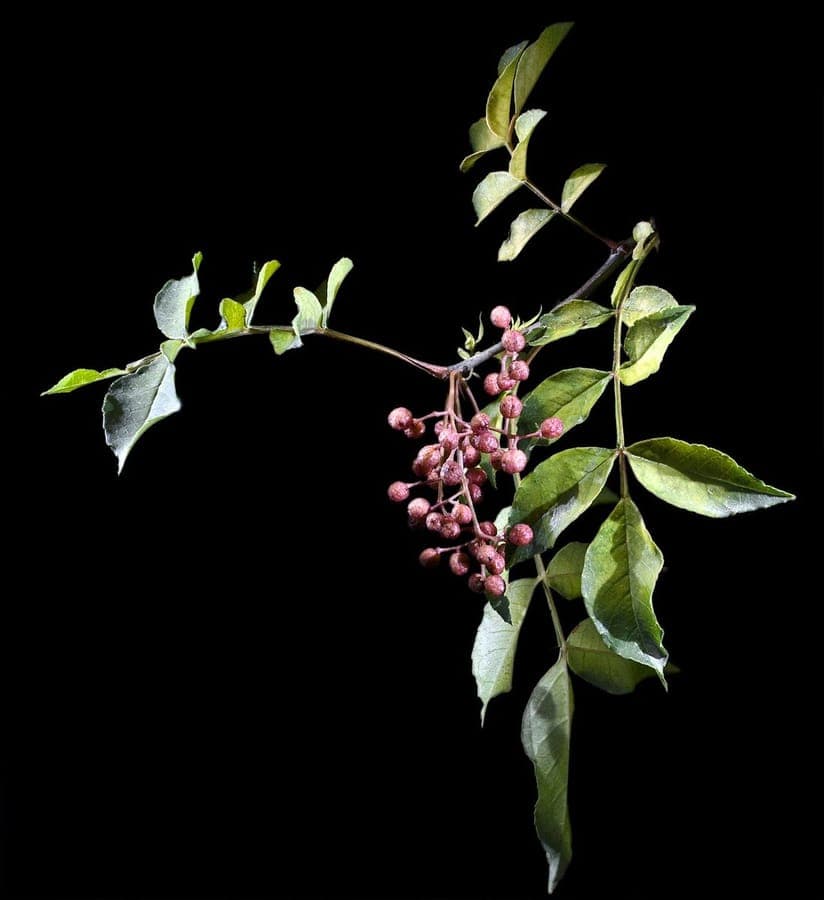
The stems carry a pair of short, sharp thorns at the base of each leaf. The leaves are pinnate, 8 to 15 cm long, with eleven to nineteen small, glossy leaflets with finely toothed edges. Crush one and you smell lemon, mint and pepper. In autumn the foliage turns clear yellow.
Flowering takes place in April and May. The flowers are tiny, yellow-green and easy to overlook, but they attract early bees and hoverflies. Japanese pepper is dioecious, meaning plants are either male or female. Only female plants bear fruit, and they set a much better crop with a male plant nearby. Always ask about the sex of a plant when you buy it, or grow two.
After flowering, clusters of small round fruits about 4 to 5 mm across develop. They start green and turn red in September and October. When ripe they split open to reveal a single glossy black seed. The photo shows such a cluster of half-ripe, pinkish-red fruits among the pinnate leaves.
Ideal position
Plant Japanese pepper in full sun or light, dappled shade. In northern Europe, full sun gives the heaviest crop and the best autumn colour. In a hot, dry garden a little afternoon shade is welcome, as the foliage can scorch in heat and drought.
Choose a sheltered spot out of cold easterly winds. The new shoots are vulnerable to late frosts in April and May. Bear the thorns in mind too: do not plant it right next to a path or a play area where children run past. It works well towards the back of a border or as a single specimen in a herb garden.
Japanese pepper is also happy in a pot. Choose a container of at least 40 litres with drainage holes, so the roots have plenty of room.
Soil requirements
This shrub likes humus-rich soil that holds moisture but drains well. A neutral to slightly acidic soil, with a pH between 5.5 and 7, is ideal. Ordinary garden soil improved with some compost usually suits it well. On heavy clay, work coarse grit and leaf mould into the planting hole so that water does not sit around the roots in winter. Waterlogged soil in the cold months is something it tolerates badly.
On sandy soil, dig a generous amount of compost or well-rotted manure into the top 30 cm. A 5 cm mulch of leaf mould or bark chips around the base keeps the roots cool and suppresses weeds. In a container, use a good shrub compost with about a fifth grit or fine clay granules mixed in.
Watering
During the first year after planting, water weekly in dry weather, around 10 litres per plant, to help the roots establish. After that an established shrub in the ground usually looks after itself, except during long dry spells in summer.
Pots dry out much faster. In summer, check every two or three days whether the top few centimetres feel dry, then water until it runs out of the bottom of the pot. In winter, water container plants only occasionally, just enough to stop the root ball drying out completely.
Free preview
Want to see Japanese pepper: growing, harvesting and care in your garden? Make a free preview of your design.
Pruning
Japanese pepper needs very little pruning. It naturally grows into a loose, open shape. In February or early March, remove dead, damaged or crossing branches. Shorten any stems that hang too far over a path, cutting just above a bud. To keep the shrub compact, you can trim the longest shoots back by about a third after harvest or in late winter.
Always wear sturdy gloves and long sleeves when pruning, because the thorns are sharp. Hard renovation pruning is rarely necessary and will cost you a year or two of fruit.
Harvesting
There are three moments to harvest Japanese pepper. In April you can pick the young, tender leaves. They taste best just after they unfurl and are used fresh, scattered over soup, rice or fish. In June and July you can pick the unripe green fruits, which in Japan are simmered in soy sauce or cooked with fish.
The main harvest comes in September and October, when the fruits turn red and begin to split. Snip off whole clusters and leave them to dry for a few days on a plate or in a paper bag somewhere warm and dry. The husks open further and the black seeds drop out. Discard the seeds, as they are hard and bitter. Only the husks are ground to make sansho; store them in a dark, airtight jar.
On toxicity: Japanese pepper is not considered a poisonous plant and has been eaten for centuries. Large quantities can irritate the mouth and stomach, in people as well as in dogs and cats. The main hazard in the garden is the thorns.
Care calendar
March: Remove dead and crossing branches and spread a layer of compost around the base.
April: New growth appears. Pick the first young leaves and cover the shoots with fleece if frost is forecast.
May: Flowering. Keep young plants moist and move pots to their summer position.
June–July: Pick green fruits if you want them. Water during dry spells.
September–October: Main harvest of the red fruits. Dry them and sieve out the seeds.
November: Leaf fall. Apply a mulch and move pots against a sheltered wall.
December–February: Dormancy. Protect container plants in hard frost.
If you would rather not keep track of these jobs yourself, the plant calendar on gardenworld.app shows you month by month what your plants need.
Hardiness
Planted in the ground, Japanese pepper is reliably hardy across most of Britain and the Low Countries. Established plants tolerate frost down to about -15 °C, and some nurseries quote a little lower. Young plants are more tender, so give them a mulch of leaves or straw around the base for their first two winters.
The real risk is not winter cold but late spring frost, which can blacken the new shoots. The plant usually regrows, but you lose part of the flowering and therefore part of the harvest. In a container the root ball is more exposed. In winter, stand the pot against the house wall on pot feet and wrap it in hessian or bubble wrap when temperatures fall below -8 °C.
Companion plants
As an edible shrub, Japanese pepper fits naturally into a herb garden or edible border. Bay (Laurus nobilis) and rosemary provide evergreen structure in winter, when the pepper is bare. Sage and thyme fill in around its feet and enjoy the same sunny conditions. Japanese bitter orange (Citrus trifoliata), another thorny relative, makes a tough, impenetrable edge alongside it.
For a Japanese feel, pair it with a Japanese maple (Acer palmatum), a few ferns in the shade nearby and some moss or gravel.
Final thoughts
Japanese pepper is a modest shrub that gives a great deal: aromatic leaves, clear yellow autumn colour and your own supply of sansho for the kitchen. It needs little attention, is hardy and stays manageable in a small garden or a large pot. Give it a sunny, sheltered spot, make sure you have a male and a female plant, and wear gloves at harvest time. Within a few years you will be picking your own pepper clusters every autumn.
Frequently asked questions about Japanese pepper
Is Japanese pepper winter hardy?
Planted in the ground, Japanese pepper is reliably hardy across most of Britain and the Low Countries. Established plants tolerate frost down to about -15 °C, and some nurseries quote a little lower.
When and how do you prune Japanese pepper?
Japanese pepper needs very little pruning. It naturally grows into a loose, open shape.
How much water does Japanese pepper need?
During the first year after planting, water weekly in dry weather, around 10 litres per plant, to help the roots establish. After that an established shrub in the ground usually looks after itself, except during long dry spells in summer.
What soil does Japanese pepper need?
This shrub likes humus-rich soil that holds moisture but drains well. A neutral to slightly acidic soil, with a pH between 5.5 and 7, is ideal.

See it in your garden
See Japanese pepper in your garden
One photo of your garden and a few questions. You see the result in about a minute.
Try it with a photoIdentify this plant in your own garden. Identify a plant
Similar plants
Laurel: complete guide
Laurus nobilis
Everything about Bay Laurel (Laurus nobilis): cultivation, hardiness, harvesting, culinary uses and winter protection. A prized herb and ornamental shrub.
Citrus trifoliata: complete guide
Citrus trifoliata
Discover the Hardy Orange: Citrus trifoliata. A rare citrus species with white flowers, trifoliate leaves and hardy to -15C.
Rosemary: complete guide
Rosmarinus officinalis
Everything about Rosemary (Rosmarinus officinalis): planting, care, overwintering and culinary use. Practical tips for a healthy, aromatic shrub.
