
NPS Photo / Public domain, via Wikimedia Commons
Beargrass: complete guide to growing Xerophyllum tenax
Xerophyllum tenax
Want to see Beargrass: complete guide to growing Xerophyllum tenax in your garden?
1 minute, no credit card
Overview
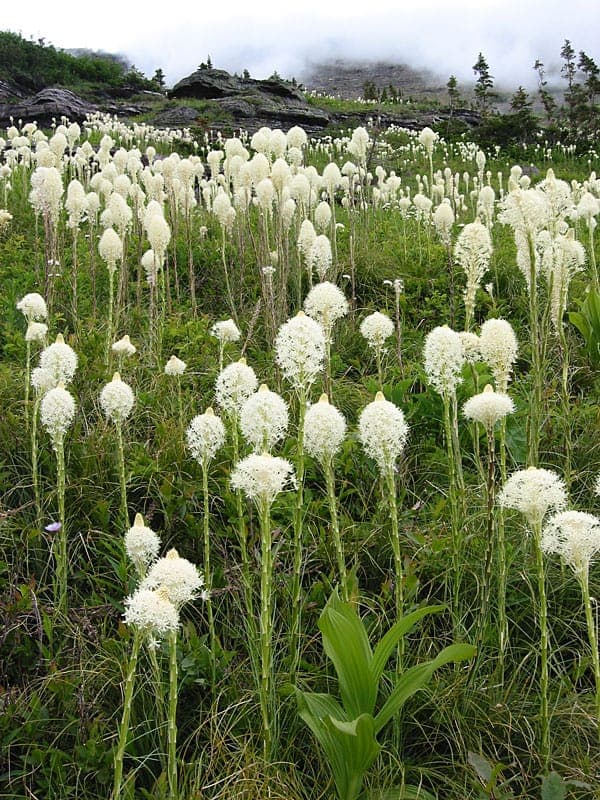
Xerophyllum tenax, known as beargrass, bear-lily, or Indian basket-grass, is one of the most striking perennials of western North America. It belongs to the family Melanthiaceae and grows naturally in mountain ranges from British Columbia and Alberta south through the Cascade Range and Rocky Mountains to California, Idaho, Montana, Oregon, and Wyoming. Hikers in Glacier National Park, Yellowstone, and the Cascades will recognise its silhouette: dense tufts of wiry grass-like leaves crowned by towering white flower plumes on open summer slopes.
The botanical name Xerophyllum means "dry leaf" - from the Greek xeros (dry) and phyllon (leaf) - aptly describing the plant's remarkable drought adaptation. The species name tenax means tough or tenacious, a reference to the fibrous, hard-wearing leaves used by Indigenous peoples across western North America to weave baskets, hats, and other crafted objects. Hence the folk name Indian basket-grass.
Other common names reflect its ecology: fire-lily, because it is one of the first plants to re-sprout after forest fires; elk-grass, because elk graze the young foliage; and western turkey-beard, a reference to the fluffy white flower cluster. In European gardens this plant is still relatively rare but deserves far wider recognition for its architectural beauty and low-maintenance character. Gardeners planning dramatic modern or naturalistic plantings can explore how such plants are used at gardenworld.app.
Appearance and bloom cycle
Xerophyllum tenax forms dense, fountain-like clumps of very narrow, grass-like leaves 30 to 90 cm long and only 3 to 5 mm wide. The leaves are deep green, wiry, and edged with tiny teeth that feel rough to the touch. They grow in dense tufted rosettes from a thick, stout rhizome. The overall effect is similar to a large ornamental grass, but the texture is finer and the leaf colour a deeper, richer green.
Flowering is spectacular but irregular. Individual rosettes may not flower every year - some bloom only once every five to seven years, after which the flowering rosette gradually dies back and is replaced by new offsets from the rhizome. When a rosette does flower, it sends up an imposing stalk of 60 to 150 cm, occasionally reaching 180 cm, topped with a dense, elongated cluster of hundreds of tiny white flowers. Each individual flower has six white tepals and measures just 5 to 8 mm across, but together they form an impressive, creamy-white plume that blooms from June through August. The flowers have a faint sweet scent and attract bees, butterflies, and other pollinators in numbers.
After flowering, small black seeds develop in three-parted capsules. The seed heads remain on the stalk for several weeks and add textural interest as they age.
Ideal location
In its native range, Xerophyllum tenax grows on open mountain slopes, in open conifer forests, on rocky subalpine meadows, and abundantly in post-fire habitats. It thrives in full sun to light partial shade, always in well-drained soil. These are the conditions to replicate in the garden.
Xerophyllum tenax is an exceptional choice for large rock gardens, dry gardens (sometimes called xeric or gravel gardens), prairie-inspired borders, and contemporary naturalistic plantings. It functions as a bold structural plant - the tufted form and tall flower spike create a strong vertical accent - and works particularly well as a specimen plant at a focal point or at the top of a slope where its silhouette can be appreciated from a distance.
For those designing a modern, drought-adapted front garden, this species makes an unforgettable centrepiece or repeated accent. Visit gardenworld.app to see how dramatic perennials like this one are incorporated into complete front garden compositions that are both beautiful and low-maintenance.
Soil requirements
Xerophyllum tenax naturally grows on lean, acidic, free-draining soils - the stony, sandy, or gravelly ground of mountain ridges and slopes. It prefers a pH of 5.5 to 7.2 but performs best in mildly acidic conditions around pH 5.5 to 6.5.
Free drainage is the single non-negotiable requirement. Waterlogging, particularly in winter, leads to root rot and the rapid decline of the plant. In heavy clay soils, substantial soil improvement is necessary before planting: incorporate deep layers of coarse grit, perlite, or fine gravel to create an open, draining structure.
Fertility should be kept low. Overly rich soils promote lush, soft leaf growth at the expense of the characteristic tough, wiry texture, and may reduce the frequency of flowering. A single light application of well-matured garden compost around the plant each spring is the most that is beneficial.
Watering
True to its name, Xerophyllum tenax is among the most drought-tolerant perennials available to European gardeners. Once established after its first season, it can survive extended dry periods without supplemental water, making it an excellent choice for water-wise garden schemes.
During the first growing season after planting, regular watering is important to help the root system establish. Water thoroughly once a week when there is no rain, but allow the soil to dry out completely between sessions. After establishment in the second year, the plant can rely largely on natural rainfall in most west European climates.
During extreme summer droughts extending beyond four to six weeks without precipitation, a single thorough watering is beneficial. The plant is far more tolerant of underwatering than of overwatering. If in doubt, err on the dry side.
Free design
Want to see Beargrass: complete guide to growing Xerophyllum tenax in your garden? Make a free design now.
Pruning
Xerophyllum tenax requires minimal pruning. After flowering, the spent flower stalk can be removed at the base to keep the plant tidy. The rosette that has flowered will slowly die back over the following year and be replaced by new shoots emerging from the rhizome - this is a completely natural process and no cause for concern.
Dead or dried leaves can be removed at any time by pulling them gently away from the clump or cutting them close to the base with sharp secateurs. Always wear thick gloves when handling this plant: the leaf edges are rough and abrasive and can cause minor skin irritation. Never cut leaves halfway along their length, as this leaves unsightly brown stubs and increases the risk of disease entry. Always cut at the base.
To propagate, collect ripe seeds after the flower heads dry, or divide established clumps carefully in early spring, ensuring each division retains a good section of rhizome with attached leaves.
Maintenance calendar
March-April: Remove any winter-damaged leaves by pulling or cutting at the base. Check that drainage remains adequate. Apply a thin layer of mature compost around the base if desired.
May-June: Growth picks up. Watch for emerging flower stalks on mature rosettes - the base of the spike will be visible several weeks before it extends. No feeding needed.
June-August: Flowering period for blooming rosettes. Admire the spectacular white plumes. Water only during extended droughts. No fertiliser required.
September-October: Remove spent flower stalks after seeds have dispersed. New offsets visible around the base.
November-February: Dormant period. Leaves remain green. Ensure drainage is sound to prevent winter root rot.
Winter hardiness
Xerophyllum tenax is hardy to USDA zone 5, meaning it withstands temperatures down to approximately -28 degrees Celsius. This makes it suitable for the vast majority of west European gardens, including all of the Netherlands, Belgium, the UK, and most of Germany and northern France.
The primary winter risk in mild, wet European climates is not cold but persistent moisture around the roots. Wet, poorly drained soil in winter is far more dangerous to this plant than frost. Planting on a slope or raised bed where excess rainfall drains freely is the best prevention.
The evergreen leaves remain intact through winter and need no protection. Fleece or straw mulching is unnecessary in most European gardens. Only in regions where temperatures regularly fall below -20 degrees Celsius would supplementary protection be worth considering.
Companion plants
Xerophyllum tenax is a bold structural plant that combines well with others sharing its preference for dry, moderately acidic, free-draining soils in full sun. Strong companions include:
- Festuca glauca (blue fescue): lower-growing, blue-grey fine-leaved tuft that echoes the form of the Xerophyllum while providing colour contrast.
- Salvia nemorosa (balkan sage): tall purple-blue flower spikes in summer that contrast beautifully with the white Xerophyllum plumes.
- Echinacea purpurea (purple coneflower): bold purple-pink blooms, drought tolerant, same sun preference.
- Penstemon strictus (rocky mountain penstemon): upright blue flower spikes that work well in a western North American native planting theme.
- Agastache foeniculum (anise hyssop): vertical blue-purple spikes creating a harmonious prairie aesthetic alongside the Xerophyllum.
Avoid combining with moisture-loving plants such as Astilbe, Hosta, or Ligularia, which require the opposite conditions.
Closing thoughts
Xerophyllum tenax is one of the most architectural and distinctive perennials available for European garden planting. Its dense fountain of wiry leaves, its extraordinary white flower plume, and its capacity to thrive on dry, lean soils make it a unique and rewarding addition to borders, rock gardens, and contemporary dry-style plantings. It asks for patience - not every rosette flowers every year - but when it does bloom, the display is genuinely unforgettable.
For inspiration on how to combine this type of structural accent plant into a complete, coherent front garden design, gardenworld.app offers photorealistic planning tools with curated planting lists. Seek out Xerophyllum tenax from specialist perennial nurseries and alpine plant suppliers, as it is rarely found in mainstream garden centres. Several reputable online nurseries in the UK and continental Europe now carry it as pot-grown plants or as seed, which can be germinated with some patience under cool conditions. At gardenworld.app you can also find more guides to similarly striking low-maintenance perennials for modern front garden schemes.
Want to see Beargrass: complete guide to growing Xerophyllum tenax in your garden? Make a free design now.
Upload a photo, pick a style, and get a photorealistic design with plant list in under a minute.
10,000+ gardens designed already
No credit card required


Similar plants
California false hellebore (Veratrum californicum): complete guide
Veratrum californicum
Full guide to Veratrum californicum, the imposing native perennial from western North America. Toxicity warning, site, soil, watering and bold companion plant ideas.
Anticlea elegans: complete guide
Anticlea elegans
Anticlea elegans, commonly called white camas or mountain death camas, is an elegant alpine plant with delicate white-yellow flowers and distinctive blue-tinged foliage. Perfect for rock and alpine gardens.
Paris polyphylla: complete guide
Paris polyphylla
Paris polyphylla: an exotic Himalayan mountain flower. Growing this rare plant with its characteristic multi-leaf structure.