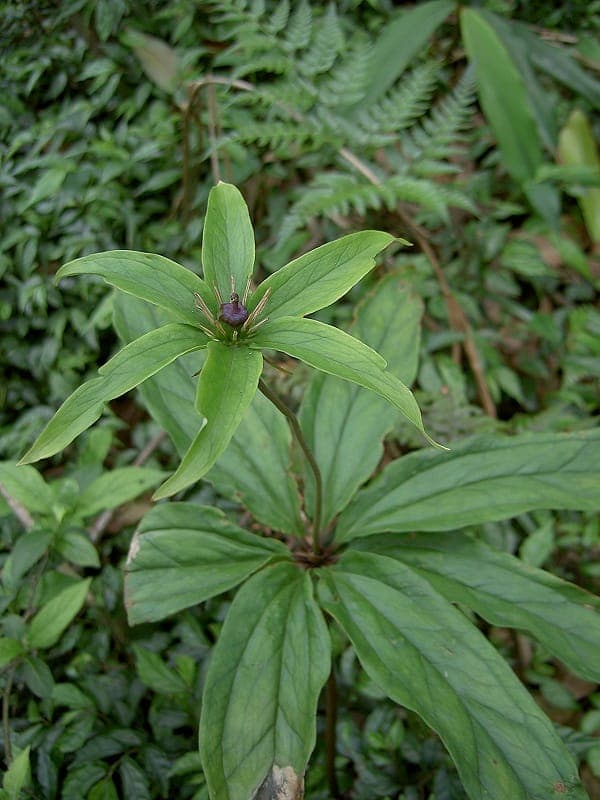
Alnus / CC BY-SA 3.0, via Wikimedia Commons
Paris polyphylla: complete guide
Paris polyphylla
Want to see Paris polyphylla: complete guide in your garden?
Full design in HD: €7.99
Look after your Paris polyphylla with the GardenWorld app
Identify plants with your camera and get a care calendar with reminders for this plant.


Paris polyphylla is a fascinating mountain plant originating from the Himalaya to Central China and Northern Myanmar. This plant belongs to the Melanthiaceae family and holds great importance in traditional Chinese medicine. The plant is remarkable for its characteristic architecture with multi-leaf structure, red berries, and medicinal underground tubers.
Paris polyphylla reaches heights of 40-80 cm in mature form. The most characteristic feature is the spiral or crown of 6-8 green leaves at the plant's top, around which the tiny flowers and later red berries grow. The plant forms underground tubers that expand after several years of growth.
This mountain plant grows in dense mountain forests with filtered sunlight in its habitat. For home cultivation, a location with light shade is ideal - east or north side of buildings, under deciduous trees, or under shade cloth providing 30-50% sunlight. The plant requires cool growing conditions. High humidity (50-70%) is preferred.
Rich, well-draining forest soil is essential. A mixture of leaf mold, peat moss, and sand in a 4:3:1 ratio mimics the natural habitat. Regular watering is essential, especially during growth and bloom. Paris polyphylla is a unique opportunity to cultivate an important Himalayan mountain crop at home.

See it in your garden
See Paris polyphylla in your garden
One photo of your garden and a few questions. You see the result in about a minute.
Try it with a photoIdentify this plant in your own garden. Identify a plant
Similar plants
California false hellebore (Veratrum californicum): complete guide
Veratrum californicum
Full guide to Veratrum californicum, the imposing native perennial from western North America. Toxicity warning, site, soil, watering and bold companion plant ideas.
Beargrass: complete guide to growing Xerophyllum tenax
Xerophyllum tenax
Xerophyllum tenax is a dramatic perennial with fine grass-like leaves and tall white flower plumes, ideal for dry, sunny gardens and naturalistic border designs.
Anticlea elegans: complete guide
Anticlea elegans
Anticlea elegans, commonly called white camas or mountain death camas, is an elegant alpine plant with delicate white-yellow flowers and distinctive blue-tinged foliage. Perfect for rock and alpine gardens.
