
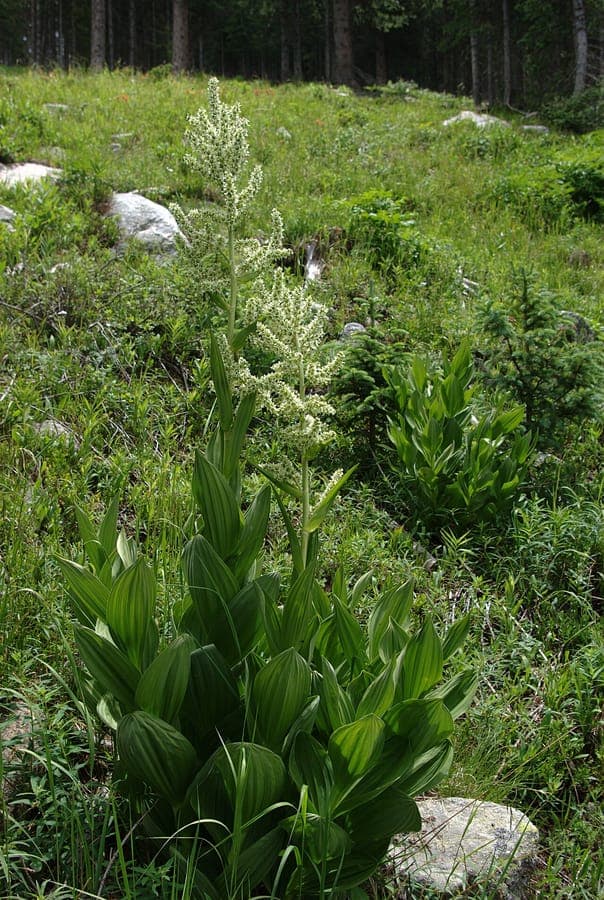
JerryFriedman / CC BY-SA 3.0, via Wikimedia Commons
California false hellebore (Veratrum californicum): complete guide
Veratrum californicum
Want to see California false hellebore (Veratrum californicum): complete guide in your garden?
1 minute, no credit card
Overview
Veratrum californicum, commonly called California false hellebore, corn lily, or western false hellebore, is a large rhizomatous perennial in the family Melanthiaceae. Native across the western United States and into northwestern Mexico, it grows naturally in moist mountain meadows, streamside fringes, and subalpine basins from Washington and Oregon south to Arizona, New Mexico, Idaho, and Colorado. In the wild it is often found in dense stands where conditions stay reliably moist through the growing season.
The plant is immediately striking: broad, deeply pleated leaves arranged alternately up stout stems that reach 1 to 2 metres, topped in summer with an imposing branched plume of creamy-white flowers. Few native perennials can match it for sheer presence in a large moist border or waterside planting.
Critical warning: every part of Veratrum californicum is highly toxic to humans and animals, including livestock such as cattle, sheep, and horses. The plant contains potent steroidal alkaloids that cause serious poisoning if ingested. Never plant it near children's play areas or grazing animals. Always wear gloves when handling the plant and wash hands thoroughly afterwards. Symptoms of poisoning include burning in the mouth, vomiting, low blood pressure, and cardiac effects.
Despite its toxicity, the plant has a long history in indigenous medicine and is the subject of ongoing pharmaceutical research. In the ornamental garden it is an outstanding statement plant, but one that demands respect and appropriate siting. Visit gardenworld.app for design ideas on incorporating large architectural perennials into a cohesive garden plan.
Appearance and bloom cycle
Veratrum californicum is one of the most architecturally impressive herbaceous perennials from western North America. The stout stems rise each year from a thick, fleshy rhizome and reach 100 to 200 cm in height. Leaves are large, broadly elliptical, 20 to 40 cm long and up to 20 cm wide, with a characteristic deep, parallel ribbing running the full length of each leaf. This pleating gives the plant an almost tropical quality, reminiscent of hosta or Veratrum album but on a grander scale.
The foliage is a fresh, bold green throughout the growing season and contributes substantial texture to the garden even before the flowers appear. The way the clasping leaves spiral up the stem creates a structured, column-like effect from spring through summer.
The flower head is a large, branched panicle 30 to 60 cm long, carrying hundreds of small star-shaped flowers in cream-white to pale greenish-white. Each individual flower has six spreading perianth segments with a darker central stripe. Flowering occurs from July to August in most garden conditions. The plumes are dramatic at full development and create an attractive contrast with the broad leaf mass below.
After flowering, three-parted seed capsules develop and turn brown in autumn. The entire plant dies back to ground level each winter; the rhizomes remain in the soil and produce fresh growth the following spring.
Ideal location
In nature, Veratrum californicum grows in cool, moist situations - mountain meadows fed by snowmelt, stream margins, and subalpine flats where moisture is reliably available through summer. This habitat profile translates directly into garden requirements.
The plant performs best in full sun to partial shade, provided the soil stays consistently moist. In full sun with adequate moisture it grows most vigorously and blooms most freely. Partial shade is quite acceptable and reduces water stress on hot days; deep shade produces weak, drawn growth and poor flowering.
A waterside position is the most natural and maintenance-friendly choice: pond margins, streambanks, bog gardens, or rain gardens all work well. In a conventional border, a moist, heavy soil position at the back of a large bed suits it well. The height and bulk mean it functions best as a backdrop or focal point rather than a filler plant.
Shelter from strong wind helps prevent the tall stems from being damaged. In exposed positions, the stems may need staking, particularly in the first year of growth at a new site.
Soil requirements
Venatrum californicum thrives in moist to wet, humus-rich soils. The acceptable pH range is 5.5 to 7.5. In its mountain habitats, the plant grows in deep, organically rich soils that hold moisture well through the growing season.
Heavy clay that stays consistently damp but is not permanently stagnant is very suitable. Loam and clay loam soils generally work well. Sandy soils require regular amendment with organic matter to improve moisture retention - work in generous amounts of well-rotted compost or leaf mould before planting and mulch heavily each year.
At planting time, incorporate a good quantity of garden compost or leaf mould into the planting hole. Annual mulching with a 5 to 10 cm layer of leaf compost keeps the soil moist, cool, and biologically active - conditions that match the plant's mountain meadow origins.
Soil that stays moist through winter is not a problem; the rhizomes are tolerant of wet winter conditions as long as water is not frozen solid around them for extended periods.
Free design
Want to see California false hellebore (Veratrum californicum): complete guide in your garden? Make a free design now.
Watering
This plant has a high water requirement. It is not drought tolerant and should not be placed where summer moisture is unreliable. During the growing season from April through August, the soil should remain consistently moist.
In average garden soils without a waterside position, regular watering is essential in dry weather. A heavy mulch of 5 to 10 cm of bark chippings or leaf compost around the plant reduces evaporation significantly and helps maintain soil moisture between rain events. Mulch also keeps the root zone cooler, which this mountain plant appreciates during warm summers.
The simplest solution is to position the plant where natural moisture is available: a pond margin, stream edge, or naturally low, damp area of the garden. In these situations, supplemental watering is rarely needed.
Avoid overhead watering in the evening. Although the plant grows in moist conditions, prolonged wet foliage in warm weather can encourage fungal disease. Water at the base of the plant in the morning.
Pruning
No routine pruning is needed during the growing season. In autumn, once the stems and leaves have completely died back and turned brown, cut them to ground level and remove the debris. This is also a good time to apply the winter mulch layer.
During the growing season, remove any individual leaves that are damaged or diseased. Always wear gloves - the toxins in the plant can cause skin irritation in sensitive individuals as well as serious harm if any plant material reaches the mouth.
Flower heads do not need to be removed after blooming unless you want to prevent self-seeding. In large gardens, allowing the plant to self-seed is a slow but effective way to build up a colony. Seedlings take 5 to 8 years to reach flowering size, so patience is required.
Maintenance calendar
March - April: Strong new shoots push through the soil. Apply mulch to retain moisture. Check the site for adequate dampness as temperatures rise.
May - June: Rapid growth. Stems may grow 30 cm or more per week in good conditions. Ensure consistent moisture. Weed around the plant early; its large canopy will suppress weeds later.
July - August: Peak flowering. Water requirements are highest. Enjoy the impressive white plumes over the bold foliage.
September: Flowering finishes. Seed capsules develop. Begin tapering off watering slightly.
October - November: Top growth dies back completely. Cut stems to ground level. Apply a generous mulch layer for winter.
December - February: Dormant period. Rhizomes rest in soil. Ensure the site does not freeze solid for extended periods.
Winter hardiness
Veratrum californicum is hardy in USDA zones 5 to 9. Across most of Northern and Western Europe, in zones 7 to 8, the plant overwinters in the ground without difficulty. The rhizomes tolerate frost well; it is wet and frozen conditions simultaneously that pose the greatest risk.
A mulch layer of 5 to 10 cm of leaf compost or straw applied after cutting back in autumn gives the rhizomes extra protection in zones experiencing severe frost below -20 degrees Celsius. In such conditions lifting and storing rhizomes in barely moist peat at 2 to 5 degrees Celsius is an alternative, with replanting in spring once the risk of hard frost has passed.
The plant's origin in high-elevation mountain environments means it is well adapted to cool winters with deep snowpack - conditions that in many ways resemble a temperate European winter in terms of cold tolerance combined with soil moisture.
Companion plants
Veratrum californicum needs companions with presence and similar moisture requirements. Good pairings for large moist borders and waterside plantings include:
- Rodgersia aesculifolia (fingered rodgersia): similar scale and moisture preference, with large palmately lobed leaves that create a strong textural counterpoint.
- Filipendula ulmaria (meadowsweet): creamy-white flowers at the same time, lower in stature, providing a finer-textured foil.
- Ligularia dentata (bigleaf ligularia): large rounded leaves and bright orange-yellow flowers that contrast vividly with the Veratrum plumes.
- Iris pseudacorus (yellow flag): water-loving iris that blooms earlier in the season, extending the period of interest.
- Carex pendula (pendulous sedge): elegant, arching plumes that frame the base of the Veratrum and fill the lower layer of a damp planting.
Avoid pairing with small or delicate plants that will be overwhelmed by the Veratrum's dense shade and competitive root system.
Closing thoughts
Veratrum californicum is a plant for gardeners with space, moisture, and a taste for bold effects. Its combination of dramatic foliage, impressive summer flowers, rapid growth, and genuine hardiness makes it one of the most striking native perennials available for large moist gardens in temperate climates.
The toxicity of all plant parts is a real concern that must be managed thoughtfully - keep it away from children, pets, and livestock, and always handle it with gloves. With proper siting and awareness, however, it is a safe and rewarding garden plant.
For help designing a large or naturalistic garden where plants like Veratrum californicum can play a starring role, visit gardenworld.app. A well-considered design will place this plant where its scale works in its favour rather than becoming a problem. Look for Veratrum californicum at specialist perennial nurseries; it is occasionally available at larger garden centres in the perennial or waterside plant section.
Want to see California false hellebore (Veratrum californicum): complete guide in your garden? Make a free design now.
Upload a photo, pick a style, and get a photorealistic design with plant list in under a minute.
10,000+ gardens designed already
No credit card required


Similar plants
Beargrass: complete guide to growing Xerophyllum tenax
Xerophyllum tenax
Xerophyllum tenax is a dramatic perennial with fine grass-like leaves and tall white flower plumes, ideal for dry, sunny gardens and naturalistic border designs.
Anticlea elegans: complete guide
Anticlea elegans
Anticlea elegans, commonly called white camas or mountain death camas, is an elegant alpine plant with delicate white-yellow flowers and distinctive blue-tinged foliage. Perfect for rock and alpine gardens.
Paris polyphylla: complete guide
Paris polyphylla
Paris polyphylla: an exotic Himalayan mountain flower. Growing this rare plant with its characteristic multi-leaf structure.