
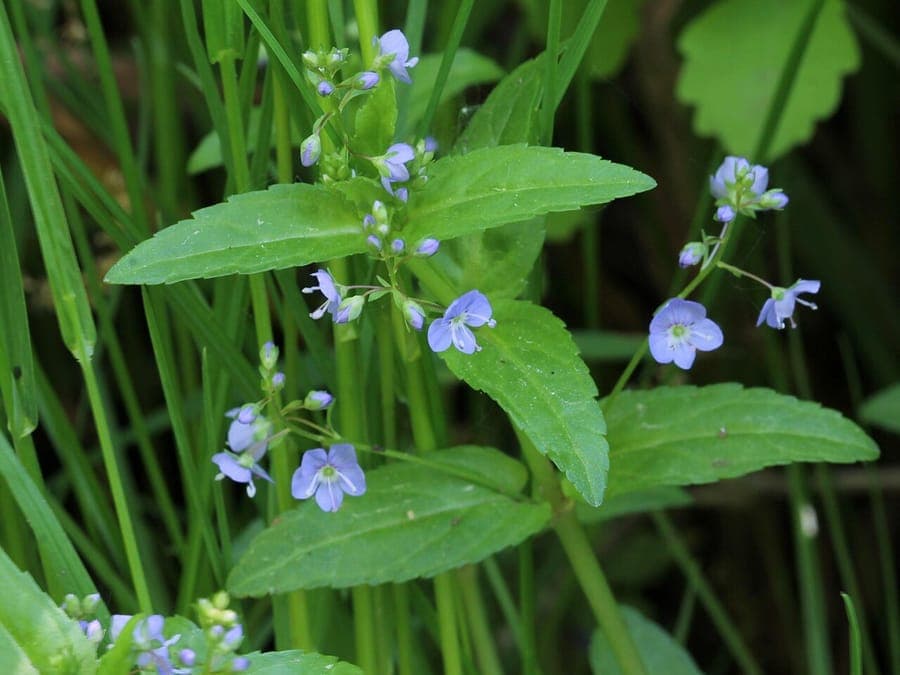
Rob Routledge, Sault College, Bugwood.org / CC BY 3.0 us, via Wikimedia Commons
American brooklime: complete guide
Veronica americana
Want to see American brooklime: complete guide in your garden?
1 minute, no credit card
Overview
American brooklime (Veronica americana) is a native, rhizomatous herbaceous perennial in the Plantaginaceae family - the same family as plantains and snapdragons. In the wild it is one of the most widely distributed wetland plants in North America, growing along stream banks, in marshes, on wet pond margins and in periodically flooded areas from Alaska and the Yukon all the way south to Mexico, and from coast to coast. That extraordinary range hints at just how adaptable this plant is.
The species was described in 1846 under the current name Veronica americana. It belongs to the genus Veronica, which is well represented in European gardens by dozens of species including the familiar germander speedwell (Veronica chamaedrys) and water speedwell (Veronica anagallis-aquatica). The American species is larger and more vigorous than most of its European relatives but shares the same characteristically clear blue flower colour that makes the genus instantly recognisable.
In the garden, Veronica americana is an outstanding choice for wet corners, pond margins, bog beds and stream edges. It grows rapidly, forms an attractive ground cover and flowers over a long season with delicate blue-to-violet flower spikes that attract a wide range of insects. For a wildlife pond or a naturalistic wet planting, this is one of the most rewarding plants you can use. On gardenworld.app you can find garden designs that incorporate water and margin plants like this speedwell into a coherent planting scheme.
Appearance and bloom cycle
American brooklime is a low to semi-erect herbaceous perennial reaching 20 to 60 cm in height. It spreads by rhizomes underground and by stems that root at the nodes wherever they touch wet soil or shallow water, quickly forming dense mats. The stems are fleshy, hollow and sometimes partly prostrate or floating on shallow water.
The leaves are oval to lance-shaped, light green, finely toothed and fairly smooth in texture. They are arranged in opposite pairs up the stem and give the plant a fresh, bright appearance. Leaf length ranges from 2 to 7 cm.
The individual flowers are small - just 5 to 8 mm across - but they are gathered into loose racemes that stand above the foliage. The colour is a clear, bright blue with a white centre, sometimes tending toward violet-blue. Four petals are the hallmark of the genus Veronica. Bloom time runs from May through August depending on location and climate, with mild autumns sometimes extending flowering into September or October. After flowering, small round seed capsules form. The flowers attract small bees, hoverflies and other small pollinators in good numbers.
Ideal location
American brooklime is first and foremost a water-margin plant. It thrives wherever its roots can remain permanently or near-permanently moist: the shallow margins of a garden pond, alongside a stream, at the edge of a bog bed or in a persistently damp depression in the garden. It will even tolerate being briefly submerged, as long as this is not prolonged.
In terms of light it is fairly flexible: it flowers most abundantly in a sunny to lightly shaded position but tolerates deeper shade, albeit with somewhat reduced flowering. Along a pond or ditch margin it works excellently in combination with other moisture-loving plants.
For a standard dry summer border it is less suitable; the roots need permanent access to moist ground. It can be grown in containers if watered very regularly or if the pot is stood in a saucer of water.
Soil requirements
Veronica americana has a pH preference of 5.7 to 7.5, meaning slightly acidic to neutral. It grows naturally in rich, humus-laden bank soils but also adapts to poorer wet soils. What matters most is that the soil never dries out completely.
For planting in a pond margin, a mixture of general-purpose compost and pond basket substrate or clay works well. It also grows in ordinary garden soil as long as it is kept consistently moist. Adding compost improves water retention and gives the plant a stronger start.
Free design
Want to see American brooklime: complete guide in your garden? Make a free design now.
Watering
As a water-margin plant, Veronica americana needs permanent access to moist soil or a shallow water layer. In a pond margin or alongside a stream this takes care of itself. In an ordinary garden border you need to water frequently and generously during dry spells. Mulching with bark or compost helps to retain moisture.
During prolonged dry periods the plant may wilt temporarily but recovers quickly once watered. In a bog garden or naturally wet planting it is almost entirely self-sufficient. The plant also grows with its roots in water up to about 10 cm deep and its stems above the waterline, making it an ideal filler for pond margins and shallow water zones.
Pruning
American brooklime needs very little attention when it comes to cutting back. After the main flush of flowers you can trim the spent stems to encourage a second wave of bloom and keep the plant tidy. This is not obligatory; without trimming the plant spreads by seed and by underground runners, forming an ever-wider mat.
If you want to limit its spread, cut back the outermost runners in autumn or dig them up. The removed pieces root easily if replanted in another moist spot - handy for extending the pond margin planting or filling gaps. In early spring you can cut the whole plant back to 10 cm above the ground; it regrows quickly and flowers normally in the same year.
Maintenance calendar
January to February: Plant rests but often stays partially green through mild winters. Nothing to do.
March: Growth resumes. Trim any runners that have spread too far if desired.
April: Strong growth begins. Check the spread in established plantings.
May to August: Bloom period. Enjoy the blue flowers and the insect activity.
September: Optional light trim of spent stems to encourage further flowering.
October to December: Plant becomes less active. Stems can remain standing.
Winter hardiness
Veronica americana is hardy in USDA zones 3 to 9, surviving minimum temperatures down to around -40 degrees Celsius in the most extreme zones. In western Europe (broadly USDA zone 7 to 8) it needs no winter protection whatsoever. It is even found naturally along waterways in Alaska and northern Canada, regions with long, harsh winters.
The plant is evergreen or semi-evergreen in mild winters, with leaves persisting or dropping only late. After sharp frost the above-ground stems may die back, but the rootstock survives without difficulty and produces vigorous new growth in early spring.
Companion plants
American brooklime works beautifully in wet borders and pond margins alongside:
- Caltha palustris (marsh marigold): yellow spring flowers that contrast beautifully with the blue summer bloom of the speedwell.
- Iris pseudacorus (yellow flag iris): tall, elegant stems at the water's edge.
- Lythrum salicaria (purple loosestrife): pink-purple summer flowering with similar moisture requirements.
- Mentha aquatica (water mint): fragrant, low-growing, exactly the same wet margin preference.
- Carex riparia (greater pond sedge): structural grass for the pond margin.
Avoid pairing it with drought-tolerant plants in the same border; the difference in water requirements is simply too great.
Closing thoughts
American brooklime is a versatile, fast-growing water-margin plant that brings colour and life to any wet spot in the garden. It requires minimal maintenance, is outstandingly cold-hardy and provides a long flowering season with blue blooms that attract insects in good numbers. For pond margins, bog beds or naturally damp garden corners it is one of the best plants available. Look for it at specialist aquatic or perennial nurseries; well-stocked garden centres also sometimes carry pond plants in season. Wondering how a pond margin or wet border planting with plants like this could look in your own garden? Visit gardenworld.app, upload a photo of your garden and receive a personalised garden design with planting advice tailored to your specific conditions.
Want to see American brooklime: complete guide in your garden? Make a free design now.
Upload a photo, pick a style, and get a photorealistic design with plant list in under a minute.
10,000+ gardens designed already
No credit card required


Similar plants
Missouri ironweed: complete guide
Vernonia missurica
Missouri ironweed (Vernonia missurica) delivers deep-purple flower clusters in late summer. Planting, care and design tips for this top pollinator plant.
New York ironweed: complete guide
Vernonia noveboracensis
New York ironweed (Vernonia noveboracensis) blooms August to October with rich purple heads. Full guide to location, soil, watering, pruning and companion planting.