
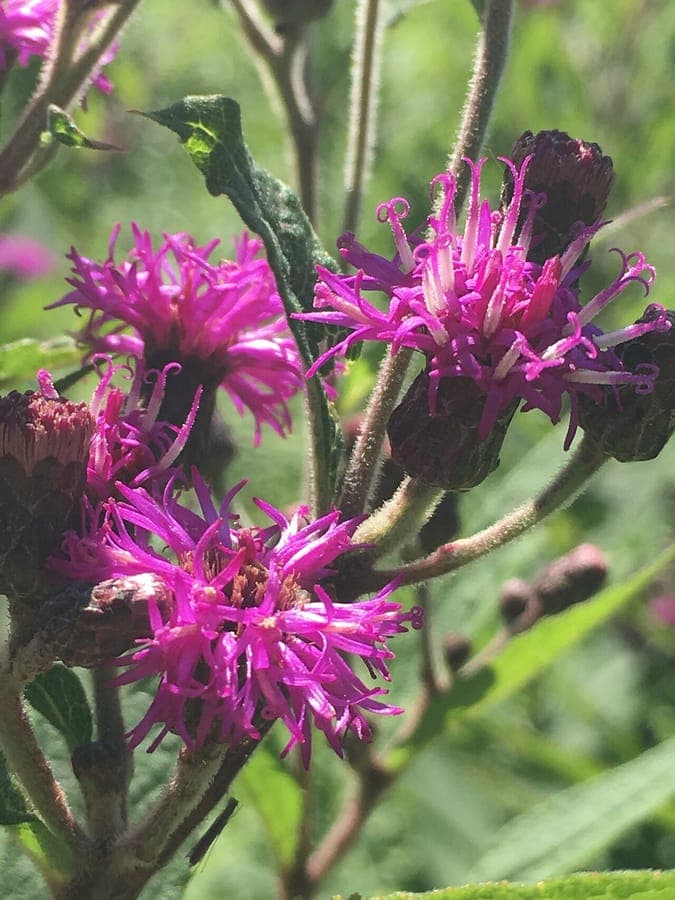
KatieLMiller / CC BY 4.0, via Wikimedia Commons
Missouri ironweed: complete guide
Vernonia missurica
Want to see Missouri ironweed: complete guide in your garden?
1 minute, no credit card
Overview
Missouri ironweed (Vernonia missurica) is a bold, upright perennial in the Asteraceae family, native to the moist prairies, open woodlands and stream margins of the central and south-eastern United States - from Kansas and Missouri east to Alabama, Tennessee and Georgia. In European gardens it remains something of an undiscovered gem, but once you see it in full bloom - smothered in rich purple flower heads while butterflies crowd every stem - you will immediately understand why it deserves a prominent spot in any late-summer border.
The species was first formally described by the botanist Rafinesque in 1833 under the name Vernonia missurica, and it has carried that name ever since. It belongs to the large genus Vernonia, which encompasses well over a thousand species worldwide, though only a handful are available in European garden centres. Missouri ironweed stands out from its relatives by its slightly more compact habit and by the particularly intense, near-velvety quality of its purple flowers. On gardenworld.app you will find garden design examples showing how wild perennials like this ironweed create dramatic late-season borders.
Appearance and bloom cycle
Mature plants typically reach 100 to 150 cm in height, forming erect, sturdy stems that need no staking under normal conditions. The leaves are lance-shaped, coarsely toothed and have a noticeably rough texture - characteristic of the ironweeds. They are deep green and can reach 10 to 15 cm in length. The stems gradually take on a light purple tint toward the base as the season progresses.
The individual flowers are small and tubular, grouped into flat to slightly dome-shaped clusters 3 to 5 cm across. The colour is a deep, saturated purple-violet that glows in direct sunlight. Bloom time runs from August through September, and in mild years well into October. After flowering, small feathery seeds form that disperse on the wind and create attractive winter silhouettes.
During the flowering period the plant attracts extraordinary numbers of butterflies and bees. Painted ladies, red admirals, fritillaries and tortoiseshells are regular visitors, and bumblebees work the flower heads intensively. For a pollinator garden or a wildlife-friendly planting scheme, Missouri ironweed is genuinely exceptional.
Ideal location
This plant performs best in a sunny to lightly shaded position. Full sun - at least 6 hours of direct sunlight per day - gives the most compact growth and the richest flowering. In partial shade the stems become slightly more slender and taller, but flowering is still good.
In its natural habitat Missouri ironweed grows in moist prairies, along stream banks and in clearings within open deciduous woodland. In the garden this translates to a position that should not dry out severely but equally should not remain waterlogged. It is an excellent choice for the back of a prairie border, a naturalistic garden or a wildflower meadow edge. Combine it with other late-summer perennials such as autumn asters, golden-flowered species (Rudbeckia, Helenium) and ornamental grasses for a coherent prairie-style planting.
Soil requirements
Missouri ironweed is not particularly fussy about soil type but grows best in moderately fertile, slightly moist ground. The pH should fall between 5.0 and 7.0 - neutral to slightly acidic is optimal. In excessively rich, nitrogen-heavy soils the plant grows too vigorously, can flop, and tends to produce fewer flowers.
Heavy clay soils are acceptable as long as they do not remain saturated for extended periods during winter. Light sandy soils can work if you water regularly or improve the soil with well-rotted compost. Loamy soil is ideal. At planting, add a modest amount of compost but do not overdo it; over-rich soil is more harmful to this plant than poor soil.
Free design
Want to see Missouri ironweed: complete guide in your garden? Make a free design now.
Watering
In its native range Missouri ironweed grows in prairies where rainfall is moderate to good but dry spells occur regularly. The plant has a reasonably well-developed root system that can cope with temporary drought. In the garden, supplementary watering is necessary during prolonged dry spells, but persistent waterlogging is poorly tolerated.
Water regularly during the first summer after planting to help the plant establish - this is the critical period. Once well-established (second year and beyond) it survives mild dry spells without serious damage. When conditions are dry, water deeply but not too frequently: two to three deep waterings per week is more effective than a small amount every day. Mulching around the base of the plant helps retain moisture and suppress weeds.
Pruning
Missouri ironweed requires little pruning. The most effective intervention is the Chelsea chop in May to mid-June: cut the stems back to 30 to 40 cm. This delays flowering by a few weeks but produces a more compact, self-supporting plant. If you skip this step you can insert sturdy stakes in late July, or let the plant lean on neighbouring tall plants.
After flowering you can leave the stems standing for winter decoration and as a seed source for birds. Only in early spring, when new shoots are emerging from the ground, cut the old stems down to about 10 cm above the soil.
Maintenance calendar
January to February: Plant is dormant. Leave stems standing for winter interest and bird food.
March: As new shoots emerge, remove old stems. Apply a light layer of well-rotted compost around the plant if desired.
April: Growth begins. Check for unwanted self-sown seedlings and remove them from where they are not wanted.
May to mid-June: Optional Chelsea chop - cut stems back to 30 to 40 cm for a more compact plant.
July: Water during dry spells. Plant reaches its full height.
August to October: Peak bloom. Enjoy the purple display and the abundant insect visitors.
November to December: Top growth dies back. Stems can remain standing through winter.
Winter hardiness
Missouri ironweed is hardy in USDA zones 4 to 9, equivalent to surviving minimum temperatures of around -34 degrees Celsius. In most of north-western Europe (broadly USDA zone 7 to 8) the plant overwinters without any protection. The root crown survives even sharp frost periods without difficulty.
The aerial parts die back in autumn but the rootstock remains active and overwinters reliably. Only in persistently wet winters combined with very heavy clay soils can root rot become an issue; a layer of coarse grit or bark mulch around the crown improves drainage and reduces this risk.
Companion plants
Missouri ironweed combines beautifully with other late-season perennials. Good companions include:
- Rudbeckia fulgida (black-eyed Susan): yellow against purple gives a classic prairie contrast.
- Helenium autumnale (sneezeweed): similar height and bloom time, with orange-red tones.
- Aster novi-belgii (Michaelmas daisy): comparable purple tones but smaller flowers and slightly later.
- Panicum virgatum (switchgrass): the airy grass structure contrasts well with the solid flower clusters.
- Echinacea purpurea (purple coneflower): blooms earlier but its dried seed cones are still present when the ironweed flowers.
Avoid pairing it with very small or fine-textured plants at the front of the border - ironweed is imposing and can visually overwhelm its neighbours.
Closing thoughts
Missouri ironweed is one of the most rewarding late-summer perennials you can plant in a north-western European garden. The combination of spectacular purple flowering, remarkable attractiveness to butterflies and bees, and excellent winter hardiness makes it a plant that pays back handsomely for the small effort of planting it. Look for it at specialist perennial nurseries or check well-stocked garden centres in autumn. For a garden design that integrates bold native-style perennials like Missouri ironweed to full effect, visit gardenworld.app and upload a photo of your own garden - you will receive a personalised redesign complete with planting recommendations tailored to your soil and climate.
Want to see Missouri ironweed: complete guide in your garden? Make a free design now.
Upload a photo, pick a style, and get a photorealistic design with plant list in under a minute.
10,000+ gardens designed already
No credit card required

