
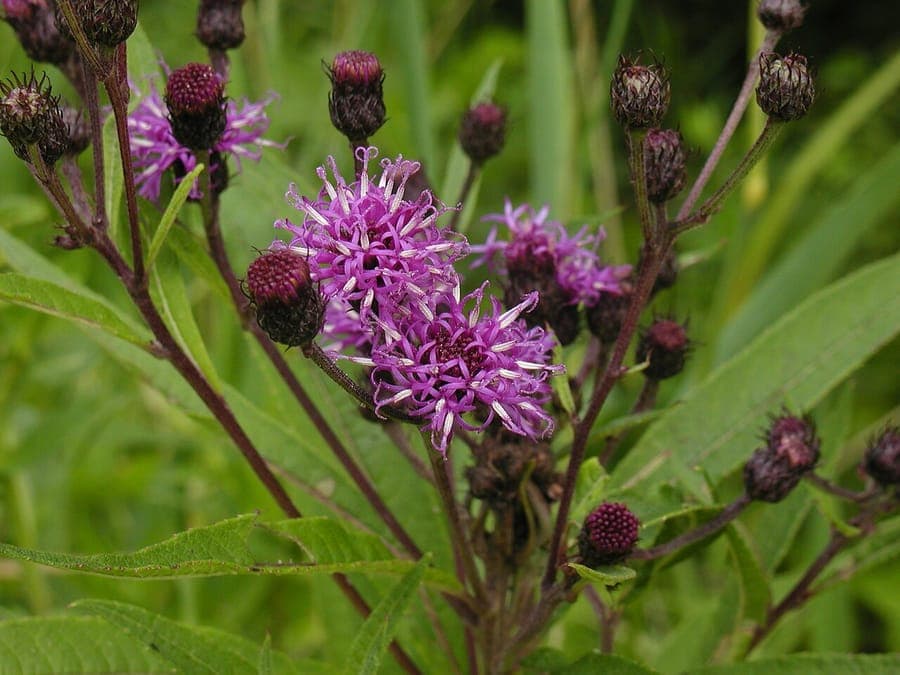
User:SB_Johnny / CC BY-SA 3.0, via Wikimedia Commons
New York ironweed: complete guide
Vernonia noveboracensis
Want to see New York ironweed: complete guide in your garden?
1 minute, no credit card
Overview
New York ironweed (Vernonia noveboracensis) is a tall, striking perennial in the Asteraceae family, native to the eastern United States from New York and Pennsylvania south to Alabama and Florida. It was formally described as early as 1803 by the botanist Michaux, working from earlier material collected by Linnaeus, making it one of the longer-documented North American perennials. The common name reflects its historical abundance along stream banks and moist thickets in the state of New York.
In European gardens it is still relatively uncommon, but within the world of prairie-style and naturalistic planting it is gaining recognition rapidly. The appeal is obvious: few perennials deliver such an unambiguous burst of colour in August and September, at the very moment when many summer flowers are fading. The intense purple flower clusters draw extraordinary numbers of butterflies and bees, making the plant a genuinely valuable ecological addition to any planting scheme. On gardenworld.app you can explore garden designs that combine wild, bold perennials like New York ironweed with other late-season species for maximum seasonal impact.
Unlike its close relative Missouri ironweed (Vernonia missurica), which typically forms a single-stemmed clump, New York ironweed is a multi-stemmed plant. This gives it a fuller, more bushy silhouette that fits well in informal borders and wildflower edges.
Appearance and bloom cycle
Mature plants typically reach 120 to 180 cm in height. The stems are erect, sturdy and finely hairy. The leaves are narrowly lance-shaped, coarsely toothed and dark green, with a slightly rough surface. They can reach 15 cm in length and are arranged alternately up the stem, giving the plant an open, airy look.
The individual flower heads are relatively small - 1 to 1.5 cm across - but they are gathered into large, rounded clusters so that the total visual effect is truly impressive. The colour ranges from lilac-violet to a deep, saturated purple. There is also a rare white-flowered form, known as Vernonia noveboracensis f. albiflora. Bloom time runs from August through October, making this one of the longest-flowering autumn perennials for a temperate garden.
After flowering, small feathery seeds form and disperse on the wind. These give the plant a decorative quality in late autumn, and the winter stems provide structure and food for seed-eating birds.
Ideal location
New York ironweed performs best in a sunny position. In its native habitat it grows along moist stream banks, in open wetlands and in damp thickets, but also in clearings within open deciduous woodland. In the garden a spot receiving at least 5 to 6 hours of direct sunlight per day gives the best flowering.
Because of its slender stems and open leaf arrangement, New York ironweed is less visually dominant than Missouri ironweed, and it fits into a wider range of border types. It is well-suited to the middle or back of a tall border, alongside a garden pond, in a bog bed, or as a background plant in a butterfly or bee garden. Combine it with tall ornamental grasses such as Miscanthus or switchgrass (Panicum virgatum) for a genuine prairie effect.
Soil requirements
New York ironweed has a notably wide pH tolerance of 4.5 to 8.0, making it suitable for a broader range of garden soils than many perennials. It prefers slightly moist, moderately fertile ground but adapts to heavy clay (as long as it is not waterlogged during summer) and to lighter soils with adequate moisture retention.
Avoid overly rich, nitrogen-heavy soils: in these conditions the plant grows too vigorously, becomes too tall and tends to fall over. A moderately fertile, slightly moist loamy soil with some organic matter is ideal. Work in a modest amount of compost at planting time; further feeding is generally unnecessary in most garden conditions.
Free design
Want to see New York ironweed: complete guide in your garden? Make a free design now.
Watering
The plant's natural association with stream banks and moist sites translates into a preference for consistently moist soil in the garden. Regular watering during the first summer after planting is essential to support root development. Once established - typically from the second year onward - the plant is surprisingly resilient and can cope with short dry spells.
During prolonged dry periods water deeply two to three times a week rather than giving a little water every day. Mulching around the base of the plant stabilises soil moisture. Along a garden pond or in a naturally damp low spot, New York ironweed thrives without supplementary watering. Waterlogging in winter is more damaging than temporary summer drought.
Pruning
As with related species, the Chelsea chop in May to mid-June is effective: cut the stems back to 30 to 40 cm. This delays flowering by two to three weeks but produces a more compact, self-supporting plant. For taller specimens, staking or relying on neighbouring tall plants for support is an alternative.
After flowering, leave the stems standing. They provide winter decoration, seeds for birds and shelter for overwintering insects. Only in early spring, as new shoots emerge from the ground, cut the old stems down to about 10 cm above the soil.
Maintenance calendar
January to February: Plant is dormant. Leave stems standing for winter interest and bird food.
March: Remove old stems as new shoots appear. Apply a thin layer of compost if desired.
April: Growth begins. Check for self-sown seedlings in unwanted locations.
May to mid-June: Optional Chelsea chop - cut stems back to 30 to 40 cm.
July: Water during dry spells. Plant reaches its full height.
August to October: Peak bloom period with abundant insect visitors.
November to December: Top growth dies back. Stems can remain standing through winter.
Winter hardiness
New York ironweed is hardy in USDA zones 5 to 9, tolerating minimum temperatures of around -29 degrees Celsius. In north-western Europe - broadly USDA zone 7 to 8 - the plant overwinters without any protection. In cooler parts of Germany, Switzerland and Austria it is generally also fully reliable. The root crown survives sharp frost without difficulty.
The aerial parts die back after the first autumn frosts but the rootstock overwinters well. A layer of coarse mulch or compost in autumn provides additional protection in very cold winters and also improves soil structure. In very wet winters on heavy clay, root rot can occasionally occur; a handful of coarse grit around the crown improves drainage.
Companion plants
New York ironweed pairs well with a wide range of late-season perennials and grasses:
- Aster novi-angliae (New England aster): similar height, purple to pink tones, simultaneous flowering.
- Helianthus salicifolius (willow-leaved sunflower): tall, graceful stems with yellow flowers.
- Panicum virgatum 'Shenandoah' (switchgrass): striking contrast of reddening grass and purple flowers.
- Eupatorium maculatum (Joe Pye weed): similar height and moisture preference, with pink flowers.
- Solidago rugosa (rough goldenrod): yellow flower sprays create a vibrant purple-and-yellow display.
Avoid using New York ironweed in settings that are too formal; it has a pronounced wild character that looks best in informal, naturalistic borders.
Closing thoughts
New York ironweed is an outstanding perennial for the late summer and early autumn garden, with an ecological value that few plants can match. The combination of rich purple flowering, a long bloom season, wide pH tolerance and good winter hardiness makes it a solid choice for gardeners at all levels of experience. Look for it at specialist perennial nurseries or check autumn stock at well-supplied garden centres. Curious about how bold, wildlife-friendly plants like New York ironweed could work in your own garden? At gardenworld.app you can upload a photo of your garden and receive a personalised redesign with planting recommendations suited to your soil and climate conditions.
Want to see New York ironweed: complete guide in your garden? Make a free design now.
Upload a photo, pick a style, and get a photorealistic design with plant list in under a minute.
10,000+ gardens designed already
No credit card required

