
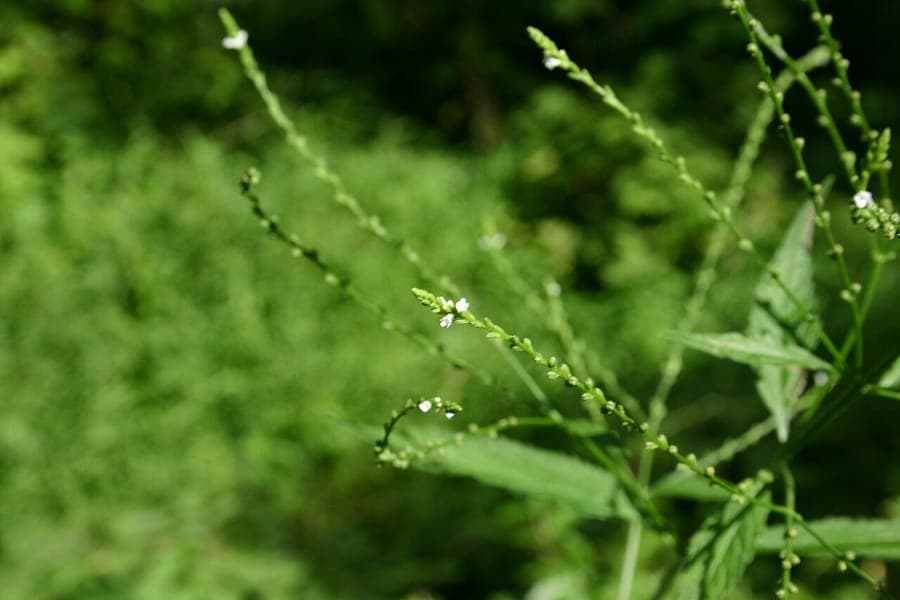
User:SB_Johnny / CC BY-SA 3.0, via Wikimedia Commons
Verbena urticifolia: complete guide
Verbena urticifolia
Want to see Verbena urticifolia: complete guide in your garden?
1 minute, no credit card
Overview
Verbena urticifolia, commonly known as Burvine or White vervain, is an elegant, cold-hardy perennial native to North America. This member of the Verbenaceae family enchants with its delicate, white flower panicles held above distinctive nettle-like foliage. The unusual leaf texture (resembling Urtica, common nettle) makes it a fascinating choice for naturalistic, cottage, and native plant gardens.
The plant grows to modest height and is ideal for borders, wildflower gardens, and shaded corners. It's remarkably adaptable, tolerating variable soils better than many verbena species. The snowy-white flowers attract numerous butterflies and beneficial insects throughout summer and autumn.
Appearance and bloom
Verbena urticifolia grows as a compact, upright to slightly spreading plant reaching 40 to 80 centimeters tall. Stems are thin, angular, and finely hairy. The leaves are distinctly nettle-like: rough-textured, irregularly toothed, resembling common nettle foliage. This wild appearance appeals to gardeners seeking natural-looking landscapes.
Flowers are diminutive (2-3 millimeters) arranged in slender, delicate panicles. Color is pure white to very pale lavender. These refined flower spikes are considerably more subtle and less voluminous than those of other verbena species. Blooming extends from July through October.
Ideal location
Verbena urticifolia is more shade-tolerant than most verbena species. While it prefers full sun (at least 4-6 hours daily), it thrives in partial shade. This versatility makes it valuable for shade-challenged gardens. In hot southern climates, afternoon shade can prevent leaf scorch.
The plant is extremely cold-hardy (USDA zones 4-9), easily overwinter-able throughout the Netherlands, Belgium, and Germany.
Soil
Verbena urticifolia exhibits remarkable soil tolerance. It thrives in poor, dry to moderately moist soils. Unlike some verbena species, it handles clay-heavy soils reasonably well, provided drainage is adequate. Soil pH preference is neutral (6.5-7.0), though it tolerates slightly acidic soils.
The plant spreads by seed without aggressive self-seeding like some verbena relatives.
Free design
Want to see Verbena urticifolia: complete guide in your garden? Make a free design now.
Watering
Once established, watering requirements are minimal. The plant tolerates drought well thanks to its deep, extensive root system. Water regularly during the first growing season to establish deep roots. Thereafter, supplemental water is needed only during extreme drought.
The plant actually prefers drier conditions. Overwatering invites fungal infection. Ensure well-draining soil. Mulching helps but keep it away from the stem base to prevent rot.
Pruning
In spring, cut the plant back to about one-third of its previous height to encourage more compact, branched growth. Deadheading spent flowers extends bloom time, though it's optional. The plant requires minimal maintenance.
Maintenance calendar
Spring (March-April): Spring pruning, division of older plants if desired.
Late spring (May): Ensure young plants establish well.
Summer (June-August): Deadhead spent flowers (optional), manage watering.
Autumn (September-October): Enjoy final blooms, allow seed set if desired.
Winter (November-February): Minimal activity required, plant is extremely hardy.
Winter hardiness
Verbena urticifolia is exceptionally cold-hardy, rated zone 4 (-28 degrees Celsius or colder). This makes it an excellent choice for gardeners throughout most of Western Europe. The plant overwinters with ease, requiring no additional protection. Even in severe conditions, supplemental mulch provides extra security.
Companion plants
Verbena urticifolia excels in naturalistic, wildflower schemes. It pairs beautifully with other white and purple-flowered North American natives. Plant alongside Echinacea, Rudbeckia, and native grasses for authentic prairie aesthetics.
Its insect-attracting nature makes it valuable in pollinator gardens. It performs well in shaded settings where many verbenas falter.
Closing thoughts
Verbena urticifolia is an underrated, valuable garden plant. Its distinctive foliage, delicate white flowers, and exceptional cold-hardiness deserve greater recognition. Add it to your garden today and discover its unique appeal.
For information and plant sources, consult local nurseries or visit gardenworld.app for personalized garden planning. Happy gardening!
Want to see Verbena urticifolia: complete guide in your garden? Make a free design now.
Upload a photo, pick a style, and get a photorealistic design with plant list in under a minute.
No credit card required


Similar plants
Bigbract verbena: complete guide
Verbena bracteata
Full guide to Verbena bracteata, the creeping North American vervain. Growth habit, care, soil needs, and use as ground cover in drought-tolerant gardens.
Purpletop vervain: complete guide
Verbena incompta
Verbena incompta, a South American charmer. Discover long blooming period and care for sunny borders.
Verbena canescens: complete guide
Verbena canescens
Discover the elegant American gray vervain with purple flowers and exceptional drought tolerance. Perfect shrub for sunny, dry borders.