
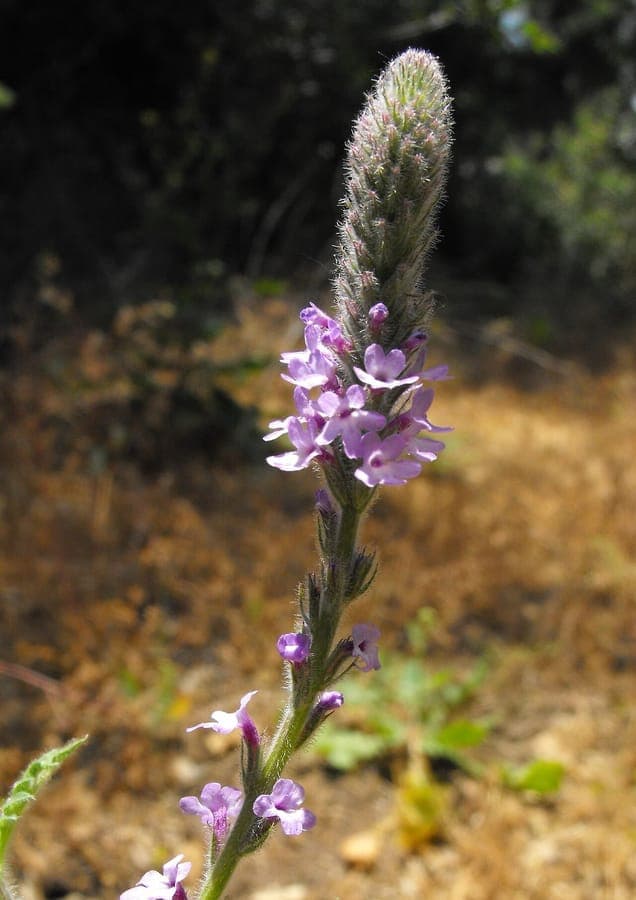
Stickpen / Public domain, via Wikimedia Commons
Vervain: complete guide
Verbena lasiostachys
Want to see Vervain: complete guide in your garden?
1 minute, no credit card
Overview
Verbena lasiostachys, commonly known as vervain or hairy nettle-leaved vervain, is a flexible, resilient wildflower distributed from Oregon through California and into Mexico. This North American native belongs to the large Verbenaceae family and represents a vital component of numerous native ecosystems across its natural range.
In gardens, vervain thrives in full sun with well-drained soil and tolerates both drought and periodic wet conditions once established. The plant is highly adaptable to various soil types and climate conditions, making it an excellent choice for xeriscaping, native plantings, and pollinator gardens throughout North America and Europe.
Appearance and bloom cycle
Verbena lasiostachys typically grows 30-60 cm tall with a spreading to upright form. Stems are finely corrugated and densely hairy, giving the plant a soft texture. Leaves are twice-divided into fine, hairy segments, creating delicate textural interest.
Flowers are small, approximately 3-4 mm in diameter, grouped in long, narrow spikes that open progressively from base to apex. Flower colour ranges from pale pink to deep purple, sometimes with white accents. The blooming period extends from June through October under full sun conditions, with peak flowering in July-August.
The distinctive characteristics include very hairy flower spikes (from which the species name "lasiostachys" derives, meaning "hairy spike") and finely divided leaves compared to many other Verbena species. This finely textured foliage remains attractive throughout the growing season.
Ideal location
Verbena lasiostachys performs best in full sun to partial shade: a minimum of four to six hours of direct daily sunlight. Although it tolerates some shade, flowering is optimal in full sun. The plant is highly flexible in placement and suits:
- Wildflower meadows and native plantings
- Dry rocky sites and xeriscaping
- Border margins and perennial borders
- Front-of-border placements
- Wildflower seed mixtures
- Pollinator and butterfly gardens
- Informal, naturalistic garden designs
Explore gardenworld.app for combination ideas with other native flowers in natural garden settings.
Soil requirements
Verbena lasiostachys is highly adaptable to various soil types, thriving in everything from dry sandy soils to moderately moist clay loams. The only absolute requirement is good drainage; it suffers in waterlogged soils, particularly during winter dormancy.
Ideal soil parameters:
- pH: 6.0-7.5 (acidic to neutral)
- Drainage: good to excellent
- Moisture: moderately dry to moderate
- Organic matter: low to moderate
- Texture: sandy to sandy loam
In heavy clay soils, incorporate at least 30% gravel or sand, or plant on raised beds. Once established, the plant survives extended drought periods through its deep root system.
Free design
Want to see Vervain: complete guide in your garden? Make a free design now.
Watering
Once established (after 4-6 weeks), Verbena lasiostachys is highly drought-tolerant and requires minimal supplemental irrigation. Young plants, however, need consistent moisture until they develop strong roots.
Watering schedule:
- Young plants: maintain evenly moist (not waterlogged) soil for first six weeks
- Established plants: water only during extreme drought (no rain for 3+ weeks)
- Container plants: allow soil surface to dry between waterings
- Winter watering: reduce significantly; plant requires minimal water during dormancy
Overwatering causes root rot, especially during winter. In rainy climates, supplemental irrigation is rarely needed.
Pruning
Verbena lasiostachys responds well to regular pruning, particularly for promoting bushiness and extending flowering.
Pruning schedule:
- June: Cut back strong stems by 10-15 cm to encourage branching
- July-September: Remove spent flower spikes (deadheading) to stimulate continuous flowering
- October: Light pruning may encourage autumn flowering
- November: Cease pruning; allow plant to prepare for dormancy
In mild climates, heavy pruning in early spring (March) rejuvenates the plant.
Maintenance calendar
March-April: Soil preparation, drainage check, planting May: Young plant care, supportive watering June-July: Pruning for bushiness, watering regime August-September: Deadheading, further flowering encouragement October: Remove spent plant material November-February: Minimal maintenance, dormancy preparation
Winter hardiness
Verbena lasiostachys is hardy to USDA zone 7b-8a (minimum temperature -12 to -10 degrees Celsius). In milder parts of northern Europe, it may survive winter with protection; in colder regions, it is typically replanted annually.
Overwintering strategies:
- Zones 7-8: Apply mulch, keep dry
- Zones 6-7: Collect seed for next season
- Colder zones: Treat as annual
- Container cultivation: Move to cool greenhouse (4-10°C) in October
Companion plants
Verbena lasiostachys combines beautifully with:
- Gaura (Gaura lindheimeri)
- Coneflower (Echinacea purpurea, E. pallida)
- Sunflower (Helianthus maximiliani)
- Bergamot (Monarda fistulosa, M. bradburiana)
- Phlox (Phlox paniculata, P. subulata)
- Coreopsis (Coreopsis lanceolata, C. verticillata)
- Sage (Salvia pratorum, S. nemorosa)
- Catmint (Nepeta mussinii)
- Ornamental grasses (Bouteloua, Stipa)
Explore gardenworld.app for natural border combinations and design inspiration.
Final thoughts
Verbena lasiostachys represents a resilient, beautiful choice for gardeners valuing wild, native plantings. Its extended blooming period, minimal maintenance requirements, and flexibility in soil conditions make it ideal for modern, ecologically minded gardens. Seeds are readily available from native plant nurseries and wildflower seed suppliers. Consult gardenworld.app for detailed cultivation tips and native garden design guidance.
Want to see Vervain: complete guide in your garden? Make a free design now.
Upload a photo, pick a style, and get a photorealistic design with plant list in under a minute.
10,000+ gardens designed already
No credit card required


Similar plants
Texas vervain: complete guide
Verbena halei
Hardy, drought-tolerant ornamental for dry, sunny gardens. Discover cultivation tips, maintenance, and ideal companion plantings for wildflowers.
Official vervain: complete guide
Verbena officinalis
Discover how to grow and care for Verbena officinalis: ideal conditions, watering, pruning, and companion planting. Perfect for sunny, dry borders and pollinator gardens.