
Planchon / CC BY-SA 3.0, via Wikimedia Commons
White veratrum: complete guide
Veratrum album
Want to see White veratrum: complete guide in your garden?
1 minute, no credit card
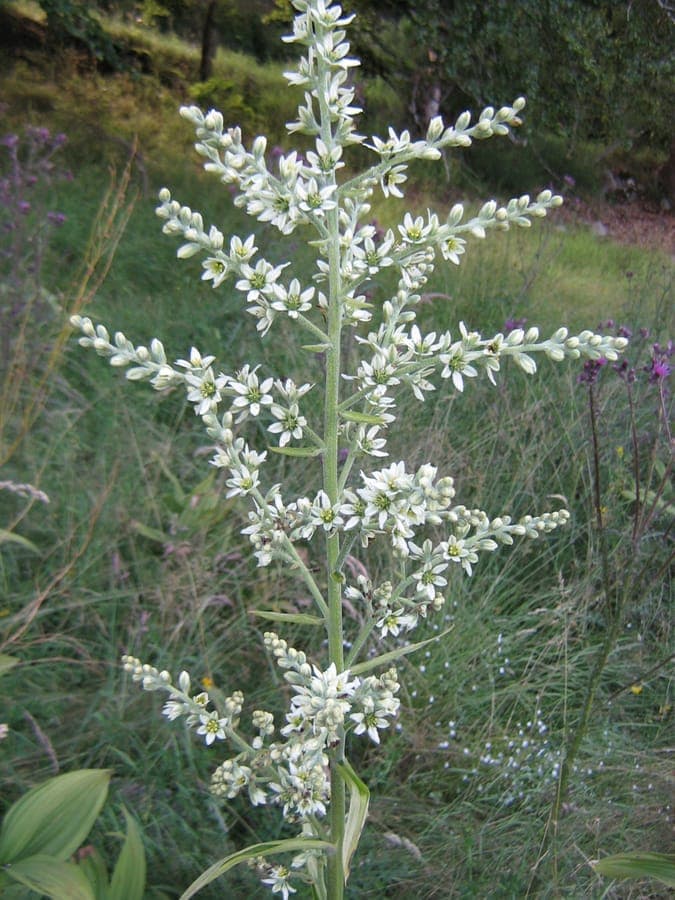
White veratrum (Veratrum album) is a striking perennial from the Melanthiaceae family. This impressive plant reaches 80-150 cm in height and has large, dark green foliage arranged in layers. The plant is probably the most toxic herb of Europe and must be handled with caution. The beautiful greenish-white flowers appear from June to August on tall flower spikes.
The foliage of white veratrum is large, elongated and deeply grooved. It has a distinctive parallel vein structure and can reach 30-50 cm in length. The leaves grow in two rows along the stem, creating a symmetrical, interesting shape. In autumn, the leaves turn yellow and fall.
The flowers of white veratrum are small but abundant. They are greenish-white and appear in densely compound panicles. The flowers are hermaphrodite and are pollinated by insects. After pollination, seed capsules form containing seeds.
For optimal growth, white veratrum needs shaded locations with nutrient-rich soils. The plant thrives best in places with partial to full shade. pH values of 6 to 7.5 are suitable. The plant prefers moist soils.
Soil preparation is crucial. White veratrum thrives in heavy, clayey soils that are nutrient-rich. Organic bedding must be worked in. The plant cannot thrive in dry, nutrient-poor soils.
Watering must be regular. The plant thrives in moisture-rich, yet not waterlogged soils. Mulching helps retain moisture during dry periods. In very dry summers, extra watering may be needed.
The maintenance calendar is simple. The plant grows slowly and requires little maintenance work. After flowering, spent flowers can be removed. In autumn, the foliage falls and the plant can be cut back.
Winter hardiness is not an issue. White veratrum is fully hardy in temperate and arctic climates. The underground roots remain vital under snow and ice.
Companion plants for white veratrum include other shade-loving perennials. Well-matching plants are liveflowers, hellebores, columbines and bleeding hearts.
Warning: All parts of white veratrum are highly toxic. Ingestion can cause severe poisoning. Gloves must be worn when handling. For garden design and safe plant use, visit gardenworld.app.
Want to see White veratrum: complete guide in your garden? Make a free design now.
Upload a photo, pick a style, and get a photorealistic design with plant list in under a minute.
No credit card required


Similar plants
California false hellebore (Veratrum californicum): complete guide
Veratrum californicum
Full guide to Veratrum californicum, the imposing native perennial from western North America. Toxicity warning, site, soil, watering and bold companion plant ideas.
Beargrass: complete guide to growing Xerophyllum tenax
Xerophyllum tenax
Xerophyllum tenax is a dramatic perennial with fine grass-like leaves and tall white flower plumes, ideal for dry, sunny gardens and naturalistic border designs.
Anticlea elegans: complete guide
Anticlea elegans
Anticlea elegans, commonly called white camas or mountain death camas, is an elegant alpine plant with delicate white-yellow flowers and distinctive blue-tinged foliage. Perfect for rock and alpine gardens.