Schwäbin / CC BY-SA 3.0 de, via Wikimedia Commons
Lamb's lettuce: sowing, harvesting and use
Valerianella locusta
Want to see Lamb's lettuce: sowing, harvesting and use in your garden?
Full design in HD: €7.99
Look after your Lamb's lettuce with the GardenWorld app
Identify plants with your camera and get a care calendar with reminders for this plant.


Overview
Lamb's lettuce (Valerianella locusta), also sold as corn salad, is the quiet workhorse of the winter vegetable plot. Long after the tomatoes, beans and courgettes have gone to the compost heap, its small, glossy rosettes are still sitting fresh in the bed. You sow it in late summer, and from October well into March you can cut a handful for a salad with a soft, slightly nutty flavour. Few crops give you so much fresh leaf in the dark months for so little effort.
The plant grows wild across much of Europe, North Africa and western Asia, on field margins, in vineyards and on dry grassland. Botanists now place Valerianella locusta in the honeysuckle family (Caprifoliaceae), although older books still file it under the valerian family (Valerianaceae). It is a winter annual: it germinates in autumn, overwinters as a rosette, then flowers and sets seed in spring.
Every part you eat is perfectly safe; lamb's lettuce is not toxic to people or pets. If you want to plan the whole kitchen garden properly, with room for winter crops alongside your summer beds, you can have a garden design made on gardenworld.app that takes your soil and aspect into account. Well-known varieties include 'Verte de Cambrai' (small, dark leaves, very hardy), 'Large Leaved Dutch' (broader leaves, quicker to bulk up) and 'Vit' (smooth, elongated leaves with good resistance to downy mildew).
Appearance and flowering
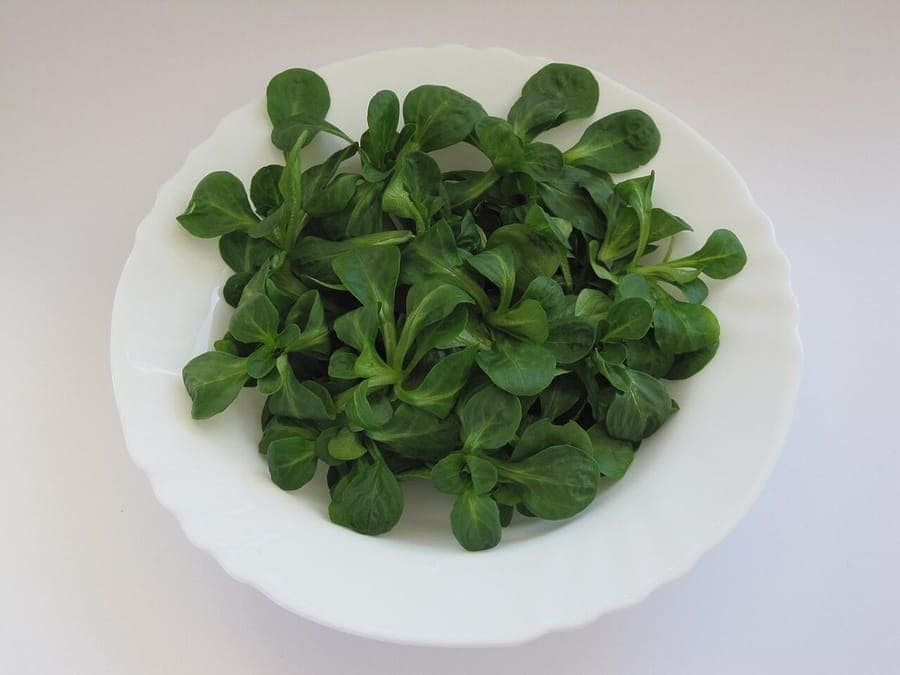
At the stage you harvest, lamb's lettuce forms a flat to slightly upright rosette 5 to 15 cm across. The leaves are spoon-shaped to oblong-oval, 2 to 7 cm long, smooth-edged or faintly toothed and a glossy mid to dark green. They feel tender and a little fleshy. Those are exactly the rosettes in the photo: loose little plants as they look once they have been picked and dropped into a salad bowl.
In April and May the plant bolts. A forked, branching stem 15 to 30 cm tall grows from the centre, topped with tiny clusters of pale blue to almost white flowers barely 1 to 2 mm across. These are followed by small, flattened seeds that drop when ripe. As soon as the stem starts to stretch, the leaves become tougher and more bitter, so harvest whatever is left at that point.
Position
Lamb's lettuce is easy-going. Full sun to light shade suits it. In autumn and winter, when the sun is low, every bit of light helps, so an open spot is best. Because you sow it in late summer, it is the ideal follow-on crop for beds cleared after the summer harvest: after early potatoes, onions, shallots, beans or peas.
It also thrives in a cold frame, an unheated greenhouse or under a polytunnel. There it keeps growing slowly through the winter and you can pick it even during frosty spells. On a balcony it does well in a trough at least 15 cm deep, provided the compost never dries out.
Soil requirements
It will grow in almost any ordinary garden soil, from sand to light clay. What matters is a firm surface. Do not dig the bed just before sowing; rake the top to a fine tilth and then press it down gently with the back of the rake or a board. In loose soil the seed germinates unevenly and frost can heave the young seedlings out of the ground.
Extra feeding is rarely needed, especially after a well-manured previous crop. Too much nitrogen makes the leaves soft and more prone to disease and frost damage. A pH between 6 and 7.5 is ideal. Starting with a weed-free bed helps a great deal, as the tiny seedlings are easily smothered.
Sowing
Sow outdoors from mid-August to the end of September. A first sowing in mid-August gives leaves from October; a sowing at the end of September provides plants for February and March. In a cold frame or greenhouse you can keep sowing until mid-October. Two or three sowings three weeks apart are better than one large batch.
Lamb's lettuce germinates poorly in heat. Above 20 °C much of the seed simply sits there, so in a heatwave either wait or keep the drill cool and moist. Sow 1 cm deep in rows 10 to 15 cm apart, or broadcast over a fine seedbed. Cover with fine soil, firm it and keep it moist until germination, which takes 10 to 20 days. Then thin to 5 to 8 cm in the row; the thinnings are perfectly good to eat.
Free preview
Want to see Lamb's lettuce: sowing, harvesting and use in your garden? Make a free preview of your design.
Watering and care
After a late-summer sowing the ground is often dry. Keep the seedbed evenly moist until the seedlings appear, then water during dry spells, ideally in the morning so the leaves dry off before night. From October the autumn rain usually provides enough moisture. Under glass you will need to keep watering, but sparingly, and ventilate generously on mild days to keep downy mildew at bay.
Hoe carefully between the rows while the plants are small. Birds, pigeons in particular, love to peck at lamb's lettuce in winter; netting or a layer of fleece keeps them off. Slugs can do damage in a mild autumn. Grey, felty patches on the leaves point to mildew: remove affected plants and sow more thinly next year.
Harvesting and use
Start harvesting once the rosettes have four to six good leaves, usually six to ten weeks after sowing. Cut the whole rosette just above soil level so the leaves stay together. Avoid picking during a hard frost: frozen leaves turn glassy as they thaw. Wait until the plants have thawed on a mild afternoon.
Wash it thoroughly, as grit tends to collect between the leaves. It is lovely in a winter salad with apple, walnuts, goat's cheese or crisp bacon, with beetroot or simply with a sharp vinaigrette. You can also wilt it briefly into soup or scatter it over a pizza after baking. The leaves supply vitamin C, folate, iron and carotene. In the fridge, in a closed box, it keeps fresh for two to three days.
Growing calendar
August: Clear the bed after the summer crop, rake fine and firm. First sowing from mid-August.
September: Second and third sowings. Thin to 5 to 8 cm. Water in dry weather.
October: First harvest from the earliest sowing. Final sowings under glass or in a cold frame. Put up netting against birds.
November to February: Harvest on days without frost. Lay fleece over the bed in severe cold.
March: Last pickings before the plants bolt. Clear the bed for spring crops.
April to May: Leave a few plants to flower and seed if you like; a new generation will then appear by itself in late summer.
If you want a week-by-week reminder of what to sow and harvest, the planting calendar on gardenworld.app helps you fit lamb's lettuce in between your other crops.
Winter hardiness
Valerianella locusta is one of the hardiest salad crops you can grow. Well-hardened rosettes tolerate frost down to around -15 °C, especially beneath a light covering of snow or fleece. Small, dark-leaved varieties such as 'Verte de Cambrai' are the toughest; large-leaved types are a little more tender. More dangerous than the cold are long, wet, still spells, when mildew takes hold, and bare frost combined with bright sun, which can scorch the leaves. Fleece guards against both and also speeds up growth.
Companion plants
Lamb's lettuce likes to follow or sit beside crops that clear the bed in late summer. Good predecessors are onions (Allium cepa), early carrots (Daucus carota) and peas. Over winter it pairs nicely with rocket (Eruca vesicaria) and winter spinach (Spinacia oleracea) in the same bed or cold frame. You can sow a row between leeks to keep the soil covered. In spring, lettuce (Lactuca sativa) can take over the same spot. Avoid crowding it with other mildew-prone winter crops in exactly the same place year after year, and rotate a little.
Final thoughts
Lamb's lettuce is the simplest way to keep the vegetable garden productive through winter. Sow in late summer on a firm bed, let the seed germinate in cool conditions, protect it from pigeons and harvest on mild days. With two or three sowings you will have fresh salad from your own plot every week from October to March. Leave a few plants to flower and the next generation takes care of itself.
Frequently asked questions about Lamb's lettuce
Is Lamb's lettuce winter hardy?
Valerianella locusta is one of the hardiest salad crops you can grow. Well-hardened rosettes tolerate frost down to around -15 °C, especially beneath a light covering of snow or fleece.
How much water does Lamb's lettuce need?
After a late-summer sowing the ground is often dry. Keep the seedbed evenly moist until the seedlings appear, then water during dry spells, ideally in the morning so the leaves dry off before night.
What soil does Lamb's lettuce need?
It will grow in almost any ordinary garden soil, from sand to light clay. What matters is a firm surface.

See it in your garden
See Lamb's lettuce in your garden
One photo of your garden and a few questions. You see the result in about a minute.
Try it with a photoIdentify this plant in your own garden. Identify a plant
Similar plants
Lettuce (Lactuca sativa): complete growing guide
Lactuca sativa
Learn how to grow fresh lettuce at home with this comprehensive guide. Tips for continuous harvesting, ideal growing conditions, and popular varieties for spring to fall production.
Spinacia oleracea: complete guide
Spinacia oleracea
Spinacia oleracea is common spinach, a nutritious leafy green for kitchen gardens. Fast-growing plant full of vitamin A, iron and nutrients.
Rocketsalad: complete guide
Eruca vesicaria
Learn how to grow Rocketsalad (Eruca vesicaria) successfully in your garden. Ideal for herb beds and kitchen gardens with well-drained soil and full sun exposure.
