
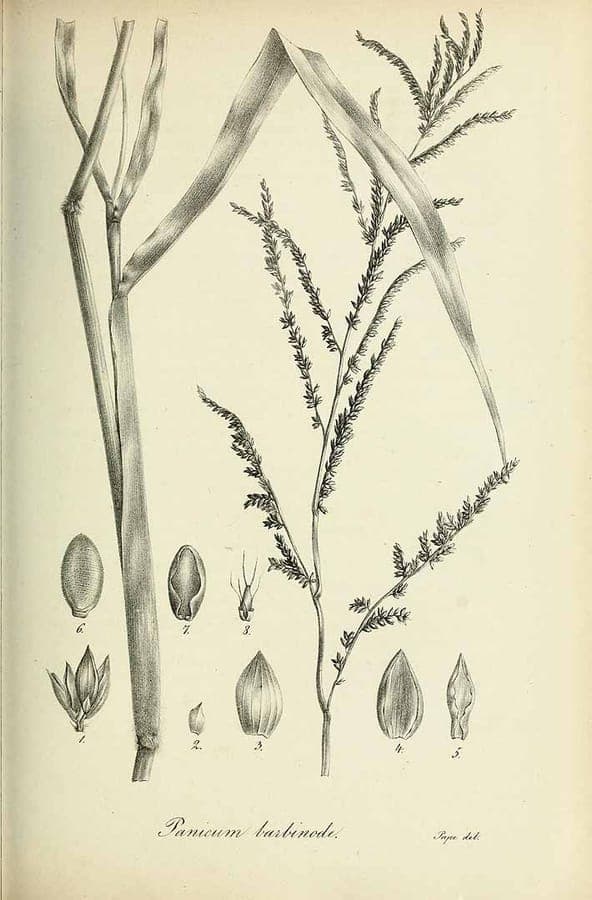
Carl Bernhard von Trinius / Public domain, via Wikimedia Commons
Para grass: complete guide
Urochloa mutica
Want to see Para grass: complete guide in your garden?
1 minute, no credit card
Overview
Urochloa mutica, commonly known as Para grass, is a vigorous tropical grass species in the family Poaceae. The genus name Urochloa groups together a range of tropical and subtropical grasses, while the species epithet "mutica" (Latin for "blunt" or "lacking a point") refers to the somewhat blunt leaf tips characteristic of certain forms. It was formally described by (Forssk.) T.Q.Nguyen in 1966, published in Novosti Sist. Vyssh. Rast. 3: 13.
The plant goes by many English names: Para Grass is the most widely used, but Buffalo Grass, California Grass, Mauritius Grass, Dutch Grass, and Scotch Grass are also recorded. Its native range extends across tropical Africa and the Middle East, from the Sahara south to Angola and from North Africa through to Syria and the southwestern Arabian Peninsula. From this origin it has spread, largely through human activity, to tropical and subtropical regions worldwide - covering much of South America, Southeast Asia, the Pacific Islands, and Australia.
For gardeners in temperate climates such as those of the UK and northern Europe, Para grass is an interesting specimen as a container plant or a seasonal outdoor plant during the summer months. In warmer climates it must be handled with awareness of its invasive potential. For garden design ideas incorporating grasses and exotic specimens, visit gardenworld.app.
Appearance and bloom cycle
Urochloa mutica is a powerfully built, clump-forming grass species capable of reaching impressive dimensions. In tropical climates it can grow 3 to 5 metres tall with thick, robust, prominently jointed stems (culms). In temperate conditions, outdoor summer growth is far more modest, typically 50 to 150 cm depending on the growing season length and temperatures.
The leaves are broad, lance-shaped, and light to dark green. Individual leaves can reach 20 to 40 cm in length and 2 to 3 cm in width. The leaf sheath is ribbed and lightly hairy at the base, a characteristic feature of the species. The leaf margin is smooth to finely toothed.
The inflorescence is a panicle of small spikelets, typical of grasses. In tropical climates the plant flowers regularly during the rainy season. In temperate regions it rarely flowers outdoors because temperatures are insufficient to trigger flower initiation. Growth is therefore predominantly vegetative in gardens of northern Europe.
A particularly notable characteristic is the plant's ability to form roots from stem nodes when those nodes come into contact with moist soil or water. This trait makes Para grass extremely effective at vegetative spread in tropical environments, but in a container garden it is simply a convenient means of producing new plants by pegging stem sections into moist compost.
Ideal location
In its native range, Urochloa mutica grows on moist riverbanks, lakeshores, in swampy ground, and across all manner of open, disturbed terrain. It tolerates temporary flooding well and can grow with its stems partially submerged in shallow water.
In temperate climates, outdoor placement should be in a warm, sheltered, south-facing position in full sun. Full sun produces the most vigorous and attractive growth. The plant is not frost-hardy and will not survive winter outdoors in the UK or northern Europe. Bring it inside before the first autumn frost, typically around October. As a houseplant or in a heated greenhouse or conservatory, it performs well in a bright, warm position.
Avoid exposed, windy spots because the broad leaves can tear in strong winds. A sheltered terrace or courtyard planting works well, giving the plant a warm microclimate and protection from wind while allowing it to develop its full tropical character through the summer.
Soil requirements
Para grass is notably tolerant of varied soil types. In its natural range it grows on alluvial river sediments, sandy soils, and heavy loam. The key requirement is adequate moisture: the species does not tolerate prolonged drought, particularly during active growth.
For container growing in temperate climates, a rich, moisture-retentive potting mix works best. Blend standard multi-purpose compost with around 20 percent additional coir fibre or peat-free moisture-retaining granules to improve water retention. A pH of 6 to 7 is optimal, though the plant is tolerant of a wider range.
Rich, fertile soil or compost produces the most spectacular growth. Apply a nitrogen-rich fertiliser two or three times during the growing season for lush, vigorous foliage. On poor growing media the plant survives but stays compact.
Free design
Want to see Para grass: complete guide in your garden? Make a free design now.
Watering
Urochloa mutica is a moisture-loving plant. In its tropical native environment it grows best on permanently moist substrates, along watercourses, and even with its roots in shallow water. It handles drought poorly: in dry conditions the leaves droop and lose turgor, though the plant recovers quickly after watering.
For outdoor summer growing: water every two to three days in dry weather, and daily during hot, sunny spells. Containers dry out more rapidly than open ground - check the top 2 to 3 cm of compost daily and water as soon as it feels dry. Saucers filled with water can help maintain moisture during hot periods.
During indoor winter storage: reduce watering significantly. The plant enters a partial rest period and requires much less water. Water only when the compost has almost completely dried out. Overwatering in the cooler winter period leads to root rot, which is the most common cause of winter loss.
Pruning
Regular cutting back keeps Para grass compact and attractive in a container. In early spring, when the plant is about to return outdoors, cut stems back to 15 to 20 cm above compost level. This encourages fresh, vigorous new shoots and prevents the plant from looking straggly.
During the growing season you can regularly trim overly long or bushy stems to maintain a tidy shape. The plant tolerates hard cutting and regrows rapidly from the base. Remove yellowed or damaged leaves routinely to keep the planting looking fresh and healthy.
Note that the leaf edges are sharp enough to cause small cuts on bare hands during extended pruning sessions. Wearing gloves is a sensible precaution.
Maintenance calendar
This schedule gives a straightforward overview of seasonal care for Para grass in a temperate climate.
January - February: Indoor dormancy. Minimal watering. Keep in a frost-free, light position at a minimum of 10 degrees Celsius. No fertilising.
March - April: Plant begins growing again as temperatures rise. Cut back to 15 to 20 cm. Restart fertilising. Keep indoors until frost risk has passed.
May: Gradual transition outdoors. Acclimatise the plant over one to two weeks in a sheltered spot before moving to its final outdoor position in full sun.
June - August: Full growing vigour. Water regularly, fertilise every two weeks with a nitrogen-rich feed. Trim stems as needed to maintain shape.
September: Growth slows. Last fertiliser application of the season. Begin planning for indoor storage.
October: Move indoors before the first frost. A temperature of 10 to 15 degrees Celsius is preferable to a warm living room - the plant benefits from a cool resting period.
November - December: Winter rest indoors. Keep dry, provide adequate light, no feeding.
Winter hardiness
Urochloa mutica is not frost-hardy in temperate European climates. Originating in tropical and subtropical Africa, it has no cold tolerance: even a light frost of -1 to -2 degrees Celsius damages the foliage severely, and sustained freezing temperatures will kill the plant outright. In temperate climates it must therefore be treated either as a half-hardy annual, discarded after one season, or brought indoors each autumn for winter storage.
Successful overwintering requires a frost-free space with a minimum temperature of 5 to 10 degrees Celsius. A cool but light spare room, an unheated but frost-free greenhouse, or a barely heated conservatory are all suitable. Cutting the plant back hard before bringing it indoors makes it much easier to handle and store.
The plant is perennial in USDA hardiness zones 9 to 11, where it can remain outdoors year-round. In cooler zones it must be treated as a tender perennial or annual.
Companion plants
In a tropical-themed summer container display, Para grass combines superbly with other large, lush specimen plants. Banana palms (Musa), elephant ear (Colocasia esculenta), and cannas create the same exotic atmosphere. Papyrus (Cyperus papyrus) pairs particularly well given their shared love of moisture, and both can be placed in partially submerged containers near a garden pond.
For colour accents in a summer display, large-flowered begonias, bold geraniums (Pelargonium), and Angelonia planted around the base of Para grass create a striking composition. The broad, light green foliage of the grass makes an excellent foil for flowering plants.
Avoid combining Para grass with small or delicate species in the same container, as its vigorous root system can quickly overwhelm companions. Separate containers placed together as a group display give each plant adequate root space. For further inspiration on garden and terrace design with exotic and tropical species, explore gardenworld.app.
Closing thoughts
Urochloa mutica is a rewarding specimen for the adventurous gardener seeking a bold tropical accent in the garden or on the terrace. Its vigorous growth, impressively broad foliage, and ease of propagation from stem cuttings make it a satisfying plant to grow. Keep in mind the need for winter shelter in our climate, and provide generous watering and feeding through the summer for the best results.
For tropical grass species and exotic summer patio plants, ask at your local garden centre for available varieties. With the right care, Para grass will give your outdoor space an exotic, lush appearance from May through to October.
Want to see Para grass: complete guide in your garden? Make a free design now.
Upload a photo, pick a style, and get a photorealistic design with plant list in under a minute.
10,000+ gardens designed already
No credit card required


Similar plants
Sporobolus pungens: complete guide
Sporobolus pungens
Sporobolus pungens is a stoloniferous Mediterranean coastal grass with outstanding salt and drought tolerance, perfect for seaside and dry gardens.
Mediterranean aegilops: complete guide
Aegilops biuncialis
Everything about Aegilops biuncialis, a Mediterranean annual grass with ornamental spikes and outstanding drought tolerance for dry gardens.
Silver bluestem: complete guide
Bothriochloa saccharoides
Full guide to Bothriochloa saccharoides (silver bluestem): site, soil, watering, winter hardiness, pruning, and garden companions.