
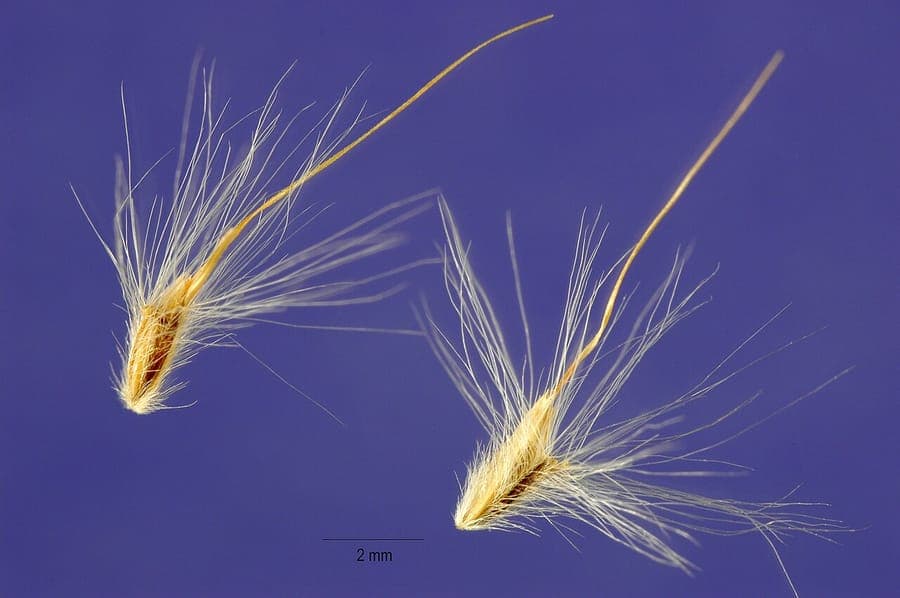
Steve Hurst / Public domain, via Wikimedia Commons
Silver bluestem: complete guide
Bothriochloa saccharoides
Want to see Silver bluestem: complete guide in your garden?
1 minute, no credit card
Overview
Bothriochloa saccharoides, commonly known as silver bluestem, is a perennial, clump-forming grass in the family Poaceae. It was formally described in 1931 by Per Axel Rydberg, building on the earlier name given by Olof Swartz. The epithet 'saccharoides' refers to the plant's resemblance to sugarcane (Saccharum). Silver bluestem is native across a wide arc from the southwestern and south-central United States - Texas, Arizona, New Mexico, California - through Mexico and Central America to the Caribbean and South America as far south as Argentina and Chile.
The species is prized for its silvery-white, silky inflorescences that catch and scatter light from late summer through autumn. In low afternoon sun, the seed heads glow almost incandescent - a quality that makes silver bluestem a sought-after structural plant in prairie-inspired and dry garden designs. It grows as a tidy, upright bunch that stays compact without staking, making it a practical as well as beautiful choice.
At gardenworld.app you can upload a garden photo and see personalised planting suggestions, including how drought-tolerant ornamental grasses like silver bluestem might work in your outdoor space.
Appearance and bloom cycle
Silver bluestem forms upright, clumping mounds of narrow, fine-textured foliage reaching 60 to 90 cm in height, sometimes taller when including the flower stems. Leaves are mid-green, slender, and keeled; the fine leaf texture (rated fine by Trefle data) gives the clump an airy, feathery presence that combines well with bolder neighbours.
In spring, fresh shoots emerge as tightly rolled blueish-green leaves; through summer the clump fills out to a rich, medium-green column. From August onwards, often extending well into October, the plant produces erect flower stems topped with fluffy, silvery-white panicles that are densely covered in silky hairs. These hairs catch the light and give the inflorescences their characteristic shimmering appearance. Brown fruit follows in September and October.
As temperatures drop in autumn, the foliage transitions from green through russet-copper tones that persist into December. The combination of glowing plumes and warm-coloured leaf gives the plant multiple seasons of interest.
Ideal location
Full sun is essential for silver bluestem. The Trefle database assigns this species a light score of 9 out of 10 - one of the highest possible - reflecting its origin in open prairies and dry, sun-baked grasslands. In partial shade the clump becomes loose and floppy, flowering declines, and the characteristic tight habit is lost.
Choose a sheltered yet open position. Good air circulation reduces the risk of fungal issues in wet climates. This plant is ideal for dry borders, gravel gardens, prairie plantings, roof gardens with thin substrate, and hot sunny slopes. It is well suited to the back or mid-section of a mixed border where its vertical plumes can be seen against lower-growing companions.
Avoid heavy shade from buildings or dense overhanging tree canopy. Avoid low-lying areas with standing water after rain.
Soil
Silver bluestem is not demanding about soil composition provided drainage is excellent. It thrives in a pH range of 6.5 to 7.2, from mildly acidic to neutral. The species tolerates rocky, sandy, gravelly, and loamy soils equally well. Trefle data places soil nutriment requirements at 6 out of 10, indicating moderate needs - but richer soils tend to produce excessively lush foliage at the expense of flowering.
Good drainage is the single most critical factor. Waterlogged or compacted clay soils cause root rot, especially during winter wet. On heavy clay, amend generously with coarse grit or sharp sand. In containers, use a well-draining mix with at least 25 percent perlite or fine gravel, and choose a pot at least 30 cm deep to accommodate the root system.
This plant naturally colonises disturbed, dry soils where competition from other plants is limited, so a somewhat lean substrate suits it perfectly.
Free design
Want to see Silver bluestem: complete guide in your garden? Make a free design now.
Watering
Once established, silver bluestem is among the most drought-tolerant ornamental grasses available for temperate gardens. Trefle atmospheric humidity data rates it at just 3 out of 10 - confirming its adaptation to low-moisture environments. In its native habitat it survives prolonged dry spells with minimal rainfall.
During the first growing season after planting, water every two weeks to help develop a deep, robust root system. After establishment, supplemental watering is only necessary during extended summer drought exceeding four weeks. In containers, water weekly in summer but always allow the top layer of compost to dry out between waterings; never water onto a still-damp medium.
In winter, in-ground plants need no irrigation at all. Container plants should be kept almost dry - just enough water every three to four weeks to prevent desiccation of the roots.
Pruning
Management is straightforward. In late winter or early spring - late February to mid-March depending on your climate - cut the entire clump back to about 10 to 15 cm above the ground. This removes dead foliage, stimulates fresh growth, and maintains the tidy clump shape that makes silver bluestem so effective in borders and gravel gardens.
During the growing season no pruning is necessary. Leave seed heads standing for as long as they hold their form: they are decorative through autumn and winter, and provide food for seed-eating birds. Remove only when they collapse or become untidy.
Avoid cutting back in autumn before the plant has fully entered dormancy. Premature pruning removes insulating material just when it is needed most during cold spells.
Maintenance calendar
January - February: Plant is dormant. Leave plumes standing for wildlife and winter structure. March: Cut the clump back to 10-15 cm. Fresh growth appears quickly in mild weather. April - May: Active growth phase. No supplemental feeding needed in average soils. June: Clump is in full growth, lush mid-green. July - August: Flower stems extend. First silvery plumes appear in August. September - October: Peak flowering. Plumes shimmer in low autumn light. November: Foliage turns russet-copper. Plumes dry but remain decorative. December: Full dormancy. Leave stems in place for frost protection and habitat.
Winter hardiness
Silver bluestem is reliably hardy in USDA zones 7 to 10, tolerating minimum temperatures around -17 degrees Celsius in zone 7. In the mild coastal regions of northwestern Europe - including the warmer parts of the Netherlands, Belgium, and the UK - it generally overwinters without difficulty, especially when planted in free-draining soil on a south-facing slope or against a warm wall.
In colder continental areas (zone 6 and below), or in heavy wet soils, the plant may not survive severe winters. Improving drainage before planting is the single most effective precaution. A light covering of dry straw or bracken in November helps in marginal areas. Container-grown plants should be moved to a sheltered spot such as an unheated greenhouse or porch.
Look for silver bluestem at specialist grass nurseries and well-stocked garden centres. It is occasionally available at larger outlets during the spring planting season.
Companion plants
Silver bluestem shines in combinations with drought-tolerant perennials and prairie-style plants:
- Purple coneflower (Echinacea purpurea): pink or white daisy flowers from July through September.
- English lavender (Lavandula angustifolia): silver-grey foliage and blue-purple flowers, identical drought preferences.
- Culver's root (Veronicastrum virginicum): tall candelabra spires that complement the graceful clump form.
- Anise hyssop (Agastache foeniculum): long-flowering, beloved by bees and butterflies.
- Blue oat grass (Helictochloa sempervirens): cool blue foliage for contrast throughout the year.
- Mullein (Verbascum): bold vertical spikes against the soft, rounded clump silhouette.
At gardenworld.app, your garden photo becomes the starting point for a full planting plan that balances structural grasses, flowering perennials, and seasonal colour - all matched to your local climate and soil conditions.
Closing
Silver bluestem is one of the most rewarding ornamental grasses for the sun-drenched, water-conscious garden. Its silvery plumes in late summer, coppery autumn colour, and strong upright habit make it a year-round contributor to borders, gravel gardens, and prairie plantings. It demands little beyond good drainage and full sun, and repays that modest investment with season after season of effortless beauty. As gardens increasingly need to cope with hotter, drier summers, Bothriochloa saccharoides is precisely the kind of resilient, characterful plant that earns its place permanently.
Want to see Silver bluestem: complete guide in your garden? Make a free design now.
Upload a photo, pick a style, and get a photorealistic design with plant list in under a minute.
10,000+ gardens designed already
No credit card required

