
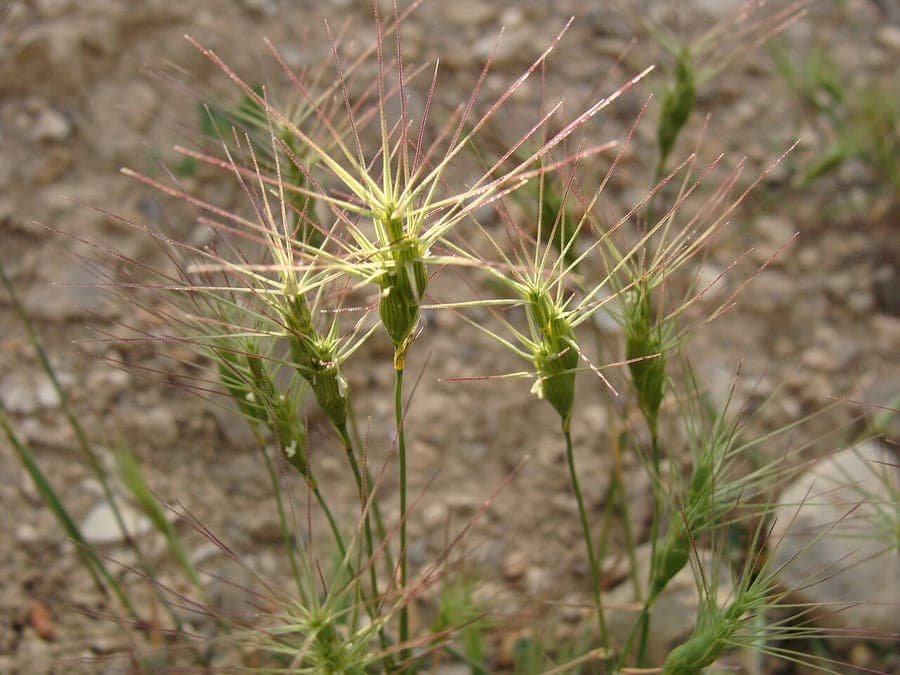
Abdenour Kheloufi / CC BY 4.0, via Wikimedia Commons
Mediterranean aegilops: complete guide
Aegilops biuncialis
Want to see Mediterranean aegilops: complete guide in your garden?
1 minute, no credit card
Overview
Aegilops biuncialis, commonly known as Mediterranean aegilops or two-awned goatgrass, is an annual species in the grass family Poaceae. First described scientifically by the Dalmatian botanist Vis. in 1842, this plant is native to an extensive range spanning from Macaronesia and the Mediterranean basin eastward to Iran. Its natural habitats include rocky hillsides, dry scrubland edges, olive groves, and disturbed ground on thin calcareous soils. In the garden, Aegilops biuncialis offers something genuinely different - authentic botanical character with minimal maintenance. The spikes are its most distinctive feature: each bears two long rigid awns that catch the light and remain ornamental for weeks after the plant has finished flowering. Garden designers at gardenworld.app regularly incorporate this species and its relatives into dry Mediterranean-style planting schemes where structure and drought resilience matter most.
Appearance and bloom cycle
Aegilops biuncialis is a tufted annual typically reaching 20 to 50 cm in height. The stems are slender and upright, clothed in narrow, rough-textured leaves that are pale to mid-green. The flower spikes emerge in May and are immediately recognisable by the two prominent awns - each 4 to 8 cm long - that project from the tip of each spikelet; the species epithet "biuncialis" refers precisely to these two awn-like projections. As the season progresses, the spikes mature from green to a warm golden-straw colour by late June or July. At this stage the plant is technically dying back, but the dried spikes remain on the plant and retain decorative value for many weeks. They move gracefully in the breeze, adding a dynamic quality to gravel or rock garden planting. Self-seeding occurs readily on open, dry ground.
Ideal location
This species demands a warm, sunny position. In its native range across the Mediterranean, the Canary Islands, North Africa, Greece, Turkey, and Iran, Aegilops biuncialis colonises exposed, sun-baked sites with little shade or competition. In a garden setting, full sun or at most light, dappled shade suits it best. It thrives against a warm south or south-west facing wall, on sunny banks, in gravel gardens, or at the front of a dry border. Container growing on a sunny terrace is entirely feasible provided drainage is excellent. This is not a plant for sheltered, humid corners; in such conditions it tends to produce excessive leaf at the expense of its ornamental spikes and may succumb to fungal problems in wet winters.
Soil
Poor to moderately fertile, well-drained soil is ideal. Aegilops biuncialis is adapted to thin, stony, often calcareous ground and performs poorly in heavy, waterlogged soils. Sandy loam, gravelly substrates, and chalk soils all suit it well. Avoid enriching the soil with organic matter or fertiliser - on fertile ground the plant produces more leaf and fewer spikes. A pH between 6.5 and 8.0 is optimal. For container growing, mix standard potting compost with at least 30% perlite or fine grit to ensure swift drainage. Replenish the container annually in early spring, as Aegilops is an annual that must be grown fresh from seed each year.
Watering
Once established, Mediterranean aegilops is highly drought-tolerant and needs very little supplementary watering. Young seedlings benefit from occasional watering until they have developed a root system, but mature plants rely almost entirely on natural rainfall. During prolonged summer drought, occasional deep watering is sufficient to keep the plant healthy through to seed maturity. Overwatering is the main risk - waterlogged soil causes rapid root rot and the plant collapses within days. In containers, water only when the top few centimetres of compost are completely dry. Collected rainwater is preferable to hard tap water for long-term container cultivation.
Free design
Want to see Mediterranean aegilops: complete guide in your garden? Make a free design now.
Pruning
As an annual plant, Aegilops biuncialis requires no conventional pruning. Once the seeds have ripened and dropped - usually by late July or August - you can cut or pull out the dried stems. If you wish the plant to self-seed in the same spot next year, allow the spikes to ripen fully and scatter their seeds before removing the plant. In formal settings where spontaneous self-seeding is unwanted, remove the spikes before the seeds are fully mature. There is no need for deadheading during the growing season; the plant's entire lifecycle is compressed into a single season of germination, growth, flowering, seed set, and dormancy.
Maintenance calendar
March-April: sow seeds directly on the prepared site or in pots; keep moist until germination. Late April-May: thin seedlings if overcrowded; established plants need no further attention. May-June: flowering and spike development; enjoy the display. July: spikes mature to golden-straw colour; decide whether to allow self-seeding or collect seed for controlled sowing. August-September: remove dead plant material if desired; leave spikes standing for birds and as winter structure if preferred. October-November: check for self-sown seedlings; manage if necessary. December-February: dormant period; no action required.
Winter hardiness
Aegilops biuncialis is an annual and therefore does not survive winter as a growing plant. It overwinters reliably as dormant seed in the soil, which tolerates moderate frost without damage. In mild climates (USDA zone 8 and above) germination may begin as early as late February or March; in cooler zones (USDA zone 6-7) the seeds wait until the soil warms in April. No winter protection of the planting site is needed. The dormant seed bank is the plant's survival strategy in its native Mediterranean climate, where summer drought rather than winter cold is the main challenge. In very cold climates where the ground freezes solid for extended periods, seeds stored dry in a cool shed and sown in spring will produce identical results.
Companion plants
Aegilops biuncialis pairs beautifully with drought-adapted perennials and subshrubs in dry, sun-baked plantings. Artemisia chamaemelifolia (camomile-leaved wormwood) is a natural companion, echoing the fine-textured foliage and grey-silver tones. Stipa tenuissima, lavender, sage, thyme, Centranthus ruber, and Echium vulgare all share similar cultural requirements and create a coherent Mediterranean-style composition. For full planting design inspiration tailored to your specific garden and climate, gardenworld.app offers detailed design tools that bring dry border plantings to life visually before you make any purchases. Bulbs such as Allium hollandicum or Tulipa species add seasonal colour among the annual grasses in spring.
Closing thoughts
Mediterranean aegilops is a genuinely rewarding plant for gardeners who appreciate botanical authenticity and low-maintenance planting. Its elegant long-awned spikes, remarkable drought tolerance, and self-seeding habit make it a valuable addition to rock gardens, gravel gardens, and dry borders. It asks for nothing more than a sunny position, poor well-drained soil, and minimal watering - and in return it delivers weeks of ornamental value and ongoing ecological benefit for seed-eating birds. Whether grown as a deliberate feature plant or as part of a naturalistic meadow mix, Aegilops biuncialis earns its place in any drought-conscious garden.
Want to see Mediterranean aegilops: complete guide in your garden? Make a free design now.
Upload a photo, pick a style, and get a photorealistic design with plant list in under a minute.
10,000+ gardens designed already
No credit card required


Similar plants
Camomile-leaved wormwood: complete guide
Artemisia chamaemelifolia
Everything about Artemisia chamaemelifolia, an aromatic perennial with silver finely cut foliage, ideal for dry Mediterranean-style borders.
Maqui berry: complete guide to Aristotelia chilensis
Aristotelia chilensis
Everything about the maqui berry shrub: cultivation, care, harvesting, and garden value of this handsome fruiting evergreen.