
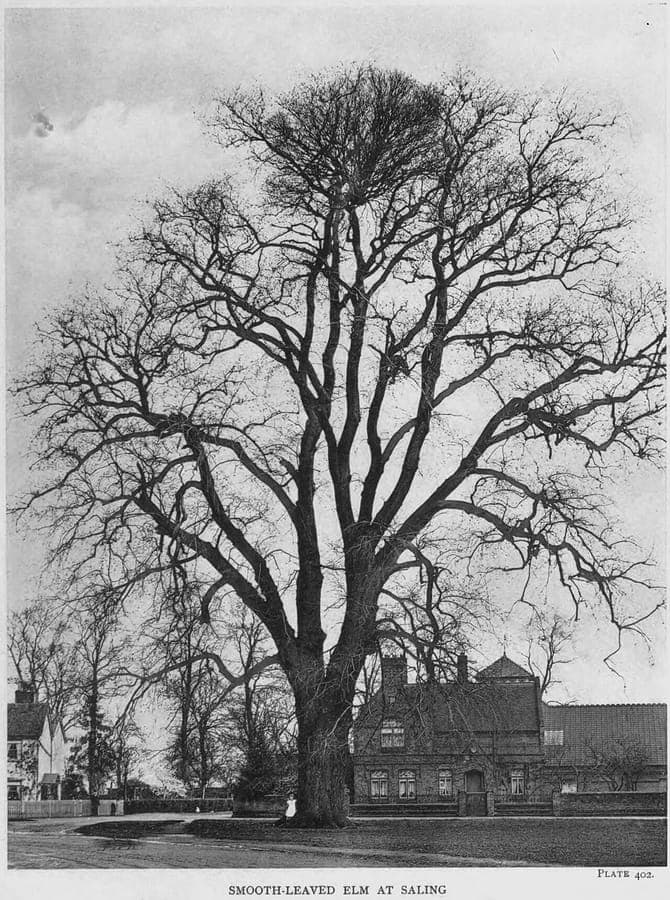
Elwes, Henry John, 1846-1922; Henry, Augustine, 1857-1930 / Public domain, via Wikimedia Commons
Dutch elm: complete guide
Ulmus × hollandica
Want to see Dutch elm: complete guide in your garden?
1 minute, no credit card
Overview
The Dutch elm, known botanically as Ulmus × hollandica, is one of the most historically significant and ecologically valuable trees of North-Western Europe. A natural hybrid between the field elm (Ulmus minor) and the wych elm (Ulmus glabra), it combines the broad, arching crown of the wych elm with the urban tolerance of the field elm. First formally described by Philip Miller in his Gardeners Dictionary of 1768, the tree has been planted along canals, roads, and dykes in the Low Countries since at least the seventeenth century.
The natural distribution runs from Belgium, the Netherlands, and France through Germany, Great Britain, and Sweden to Hungary, Turkey, and Iran. The species is introduced in Ireland and parts of Australia. The hybrid is exceptionally variable: dozens of synonyms and regional forms are recognised, with well-known cultivars including 'Commelin', 'Groeneveld', 'Lobel', and 'New Horizon', all selected for some degree of resistance or tolerance to Dutch elm disease.
The ecological value of the Dutch elm is considerable. Its leaves support the larvae of dozens of moth species; the flowers are an early source of pollen and nectar for bees in late winter and early spring; and the bark provides shelter for beetles and other invertebrates. Learn how a large shade tree like the Dutch elm can anchor a front garden or driveway design at gardenworld.app.
Unfortunately, the species suffered devastating losses through the twentieth century due to Dutch elm disease, a vascular wilt caused by the fungus Ophiostoma ulmi and, later, the more aggressive Ophiostoma novo-ulmi. Dispersal occurs via the elm bark beetle genus Scolytus - particularly the iepenspintkever Scolytus - which carries fungal spores from diseased to healthy trees while boring its brood galleries beneath the bark. In the Netherlands and Belgium, most mature specimens have been lost; only the more resistant cultivars and young plantings survive long-term.
Appearance & bloom cycle
The Dutch elm is a large, broad-leaved deciduous tree reaching 25-35 metres in its natural state. The trunk is straight to slightly curved with grey-brown, longitudinally furrowed bark that becomes deeply grooved and rough in older specimens. The crown is broadly oval to parasol-shaped, with wide-spreading branches that can create a canopy 10-15 metres wide in large trees.
Leaves are ovate to obovate, 7-15 cm long, dark green and glossy above, more coarsely hairy below. Characteristic of the Ulmus group is the unequal leaf base: one side of the leaf blade attaches lower on the petiole than the other. The leaf margin is doubly serrate. In autumn, leaves turn yellow to golden-brown before falling, providing an attractive seasonal display.
Flowering occurs early in spring before leaf break, typically February to March depending on the region. The flowers are small, reddish-purple, and hang in dense clusters along the branches; they are wind-pollinated. After fertilisation, the characteristic winged fruits (samaras) develop and ripen in April-May, each carrying a single seed at the centre of the wing.
Growth rate is vigorous: young trees can add 60-80 cm in height per year under favourable conditions. Older specimens grow more slowly but remain impressively present in the landscape for centuries.
Ideal location
The Dutch elm is both demanding and adaptable in its site requirements. It makes few demands on light exposure and thrives in full sun or light partial shade. In urban settings, it tolerates air pollution, salt spray in coastal areas, and compacted city soils better than many other large deciduous trees.
The ideal position is a spacious, open site with adequate underground root space: along wide streets, in parks, on country estates, or as a specimen tree in a large garden. The tree requires a planting distance of at least 8-10 metres from other large trees and 4-5 metres from buildings and utility pipes. In small gardens, the ultimate size of the species makes it generally unsuitable unless a compact cultivar or a specifically managed specimen is chosen from the outset.
The Dutch elm tolerates periodic flooding of the root zone better than most other large deciduous trees, which made it historically popular along dykes, riverbanks, and polder areas. However, it is not suited to permanently dry, nutrient-poor sandy soils.
At gardenworld.app, you will find garden design ideas featuring large shade trees in more spacious front garden settings, with guidance on matching the right tree species to your soil type and available space.
Soil requirements
Ulmus × hollandica grows best in deep, moisture-retentive, moderately fertile loam or clay soil with a pH of 6.0-7.8. It is tolerant of heavy clay provided the soil is not permanently saturated. On light, dry sandy soils, supplemental feeding and regular watering are necessary.
Root growth of the Dutch elm is vigorous and wide-spreading. At planting, dig a hole at least 80 cm deep and 100 cm wide, mixing the excavated soil with 20-30% well-rotted compost to support establishment in the first years. Adding a mycorrhizal inoculant at planting is beneficial for rapid root establishment.
For urban tree pits, specialised tree substrates (Stockholm or Amsterdam structural soil systems) using a crushed stone base are preferable to standard garden soil, as they resist compaction while retaining a water reserve for dry periods. A balanced slow-release tree fertiliser applied in early spring (approximately 150-200 g of NPK 12-5-8 per tree) is sufficient for young trees during the establishment phase. Established trees on good soils need little supplemental feeding.
Watering
Young Dutch elms require generous watering in the first three to five years after planting to develop an extensive root system. During the first growing season, weekly deep watering (20-30 litres per tree per session) is recommended during dry weather, ensuring water penetrates to 40-50 cm depth.
Established trees generally need no supplemental water in normal rainy summers in the Low Countries. During heat waves or prolonged dry spells exceeding three weeks, supplemental irrigation is advisable, especially for trees in urban settings where roots are constrained by paving. Apply 50-80 litres per tree in a slow trickle, allowing time for the water to penetrate rather than run off.
No watering is needed in autumn and winter. Avoid watering during frost; frozen ground does not absorb water, and standing water around the roots can cause damage through expansion.
Trees planted alongside well-established canal banks or stream margins rarely need supplemental watering once established, as roots self-regulate their water supply from the water table.
Free design
Want to see Dutch elm: complete guide in your garden? Make a free design now.
Pruning
The Dutch elm is naturally vigorous and requires little structural pruning to form a good crown. During the establishment phase (first five years), guide the trunk shape by removing competing leaders and encouraging a clear central stem. Remove all branches arising below two metres on the trunk to achieve a clear stem height of two to three metres.
In established trees, pruning is limited to removing dead, diseased, or crossing branches. The best pruning windows are early winter (December-January) or late spring (May-June) once the tree is in full leaf. Avoid pruning between February and April and from August to September: during these periods, fungal spore activity is highest and open wounds are quickly colonised via the elm bark beetle (iepenspintkever Scolytus) visiting the fresh cuts.
If Dutch elm disease symptoms are detected (wilting and brown discolouration of leaves and shoots), affected branches must be removed immediately, cutting at least half a metre beyond the visible brown vascular tissue. Tools must be disinfected with 70% alcohol or 10% bleach solution between cuts. Diseased prunings should not be composted but removed as green waste or chipped with heat generation (minimum 65 °C) to prevent spore spread.
Maintenance calendar
January - February: Best window for necessary structural pruning. Check trees for signs of structural weakness (dead branches, cracks in the trunk). Disinfect all pruning tools. Apply slow-release tree fertiliser to the soil around the trunk if required.
March - April: Leaf break and flowering. Check for first signs of Dutch elm disease (wilting shoot tips). Plant new trees in March once the ground is frost-free. Water young trees during dry spring weather.
May - June: Vigorous leaf growth. Remove any water shoots (epicormic growth) arising vertically from the trunk. Check for aphid colonies; apply biological controls if populations are very large.
July - August: Peak activity period for the elm bark beetle (iepenspintkever Scolytus): avoid all pruning during this period. Water young trees weekly during drought. Check regularly for Dutch elm disease symptoms.
September - October: Autumn colour and leaf fall. Remove fallen leaves if confirmed Dutch elm disease is present in the vicinity. Container-grown trees can still be planted in early autumn before winter sets in.
November - December: Rest period. Plan any necessary pruning for December-January. Check stability of young trees and adjust support stakes if needed.
Winter hardiness
The Dutch elm is excellent in cold hardiness, classified in USDA zones 4-6. The tree survives temperatures down to -25 °C without damage to roots or wood. Its natural range, extending from the Low Countries to Iran and Sweden, encompasses highly diverse winter conditions.
In the mild maritime climates of the Netherlands and Belgium, where average January temperatures rarely fall below -8 °C, the tree faces minimal cold stress. Frost damage to the wood itself is virtually unknown. Late spring frost after unusually early leaf break can damage young shoots in exceptional years, but is rarely fatal and the tree recovers quickly.
Very young trees (one to two years old) may suffer tip dieback in severe winters below -20 °C. A light mulch layer of 5-10 cm of well-rotted compost around the base protects the roots in the first overwintering season.
The greatest threat to survival is not cold but Dutch elm disease. For new plantings, choose exclusively from confirmed disease-resistant cultivars such as 'Commelin', 'Groeneveld', 'New Horizon', or 'Lutece', all selected for reduced susceptibility to Ophiostoma novo-ulmi.
Companion plants
The Dutch elm suits large-scale, spacious environments, and the choice of suitable underplanting depends partly on the shade intensity and root competition created by the large tree. Good companions include:
- Hedera helix (Common ivy) - forms a dense ground cover under the tree canopy, thriving in the sheltered shade zone without competing significantly with the tree's root system.
- Vinca minor (Lesser periwinkle) - low, evergreen ground cover with blue flowers in spring; suitable for dry shaded spots beneath large trees.
- Geranium macrorrhizum (Rock cranesbill) - forms an aromatic, spreading carpet that copes well under established large trees where other plants struggle.
- Lamium galeobdolon (Yellow archangel) - variegated leaves and pale yellow flowers in May-June; robust ground cover for dry, shaded root zones.
- Iris pseudacorus (Yellow flag iris) - an ideal companion along wet banks and canal margins; the elm's root zone tolerates temporary wet conditions well.
- Cornus sanguinea (Common dogwood) - grouped along larger elm plantings, it creates species-rich hedgerow edges with ornamental value across all seasons.
Avoid small, sun-loving plants directly under the dense canopy of a mature Dutch elm. Position companion plants outside the immediate trunk zone (at least 1.5 metres from the trunk) to reduce root competition.
Conclusion
The Dutch elm is a majestic, ecologically valuable tree with a rich history woven into the landscapes of the Netherlands and Belgium. Those who choose a disease-resistant cultivar and manage pruning and phytosanitary measures with care can still enjoy the monumental grandeur of this hybrid elm. The broad canopy provides welcome shade and coolness in summer; the early flowers feed bees in spring; and the rich autumn leaf colour brings a golden close to the growing season.
Ready to integrate a large statement tree into a coherent garden design? Visit gardenworld.app and discover how to create a balanced planting plan that combines the beauty of trees with the practical requirements of your front garden.
Want to see Dutch elm: complete guide in your garden? Make a free design now.
Upload a photo, pick a style, and get a photorealistic design with plant list in under a minute.
10,000+ gardens designed already
No credit card required


Similar plants
Ulmus thomasii: complete guide
Ulmus thomasii
The cork elm is a North American deciduous tree with distinctive corky branches and elegant leaves. Discover how to cultivate and maintain this durable tree.
Caucasian zelkova: complete guide
Zelkova carpinifolia
Discover Zelkova carpinifolia, the elegant Caucasian elm. Growing guide and care tips for landscapers.
Ulmus americana: complete guide
Ulmus americana
Discover American elm, a majestic tree with ivory-tinted foliage. This impressive fast-growing tree is ideal for landscape planting and park-like settings. Learn all about care and maintenance.