
Kurt Stüber [1] / CC BY-SA 3.0, via Wikimedia Commons
Caucasian zelkova: complete guide
Zelkova carpinifolia
Want to see Caucasian zelkova: complete guide in your garden?
1 minute, no credit card
Overview
Zelkova carpinifolia, also known as Caucasian elm or Caucasian zelkova, is a stylish deciduous tree with native roots in Eastern Turkey, Transcaucasus, and Northern Iran. This elegant tree is closely related to the American elm but less susceptible to diseases. With striking foliage, interesting bark structure, and broad crown, it is perfect for parks, large gardens, and landscape applications.
The plant belongs to the Ulmaceae family (elms and related trees). In its native range, it grows to 20-25 meters tall in forests and mountain slopes. As an ornamental tree, it is much smaller and easier to manage.
Appearance and Bloom
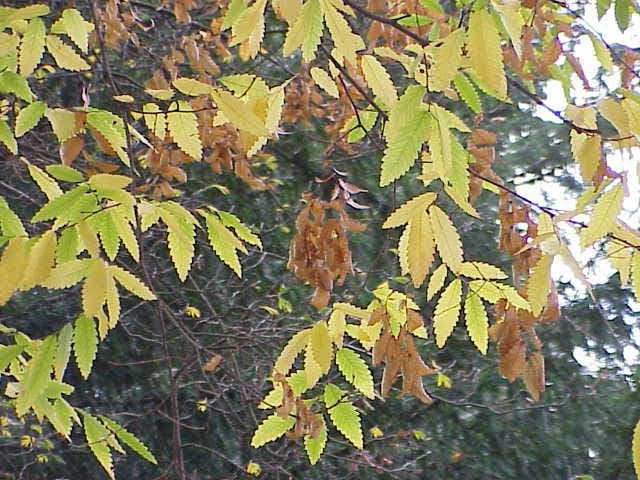
The Caucasian zelkova grows into an impressive tree with a broad, rounded crown. The leaves are small and elegant, about 3-6 cm long, green and finely divided (hence "carpinifolia" - hornbeam-leaved). In autumn they turn yellow to red-orange.
Flowers are small and inconspicuous, appearing in April-May and rarely noticed. They are followed by small, flat seeds (samaras) about 3-5 mm. These seeds help birds and wind disperse the tree.
The bark is striking - yellow-orange to grey with characteristic scales creating interesting texture. This fissuring develops more as the tree ages, providing extra visual interest.
Ideal Location
The Caucasian zelkova grows best in full sun to partial shade with minimum 4-6 hours direct sunlight daily. In full sun it grows faster and develops a denser crown. Partial shade is acceptable but slows growth.
It can be planted in large gardens or parks. The tree tolerates urban conditions reasonably well, though it prefers open space. Plant it not too close to buildings - it can become 15-20 meters wide.
This tree works well as a single specimen or in groups of 2-3. In urban applications it can serve as a street or park tree.
Soil
The Caucasian zelkova grows in diverse soil types, from light sandy to heavy clay. The critical factor is good drainage - waterlogging leads to root rot. In clay soils we recommend raising the planting area and creating drainage ditches.
The tree grows in both acidic (pH 5.5) and neutral (pH 7.0) soil. In rich, nutrient-rich soil it grows faster. In poor soil it grows more slowly but is equally healthy.
When planting, work 50-100 liters of ripened compost or leaf mold into the hole. This aids root development in the first year.
Watering
Once established (after 1-2 years), the Caucasian zelkova needs minimal supplemental water. It tolerates drought reasonably well and grows well even in periods of normal rainfall.
In the first year after planting, water regularly (1-2 times weekly in dry periods) to stimulate root development. After year two this can be reduced to sporadic watering.
In the open ground, it tolerates normal rainfall well. In containers (not recommended for mature trees) water when soil surface feels dry.
Free design
Want to see Caucasian zelkova: complete guide in your garden? Make a free design now.
Pruning
Pruning is not essential but can be useful for shaping. Pruning is best done January-February before sap begins flowing. Remove dead, damaged, or crossing branches.
To shape the crown, remove lower branches to about 2 meters height. This creates a neat "tree" form. Don't remove more than 20-30% of the crown per year to prevent shock.
Old, thick branches can be carefully removed, but this requires sawing - call a professional arborist if unsure.
Maintenance Calendar
March: examine overall health. Remove rotten or damaged branches. Begin feeding with slow-release tree granules.
April-June: growing season. Monitor for pests (caterpillars, aphids). Check that tree is growing well.
July-August: ensure adequate drainage in case of heavy rainfalls. Check trunks for diseases.
September-October: leaf fall and autumn color. Collect fallen leaves around the tree.
November-February: pruning and maintenance period. No feeding required.
Winter Hardiness
The Caucasian zelkova is fairly winter hardy and grows in zones 6-8 (roughly Netherlands, southern Germany, France). In the Netherlands it grows best in the south and middle regions, less well in the north.
In very cold winters (below -25 degrees), young wood may freeze, but the tree will usually recover from stronger branches. In extremely cold countries (Canada, Siberia) this tree is unsuitable.
Companion Plants
The Caucasian zelkova harmonizes well with other deciduous trees like oak, beech, and elm. Plant it with understory shrubs like hazel, holly, and privet for layered structure.
Flowering understory plants like lilac, forsythia, and dogwood bloom together or just after the zelkova, creating interesting seasonal combinations.
In larger landscape applications combine it with conifers (spruce, fir) for contrasting texture.
Summary
Zelkova carpinifolia is an elegant, robust deciduous tree that lasts decades. With minimal care it grows into an impressive specimen. It tolerates drought, urban air, and diverse soil types well, making it flexible for various applications.
For young material and expertise contact specialist tree nurseries in your region. Larger garden centers sometimes have specimens, especially in southern areas.
This tree is an investment for generations - plant it now and enjoy its elegant presence for decades to come. For landscape design with trees like zelkova, visit gardenworld.app and share your front yard photo for free advice!
Want to see Caucasian zelkova: complete guide in your garden? Make a free design now.
Upload a photo, pick a style, and get a photorealistic design with plant list in under a minute.
No credit card required


Similar plants
Dutch elm: complete guide
Ulmus × hollandica
Full guide to Ulmus x hollandica: siting, soil, watering, pruning, Dutch elm disease management, and companion plants for this majestic hybrid elm.
Ulmus thomasii: complete guide
Ulmus thomasii
The cork elm is a North American deciduous tree with distinctive corky branches and elegant leaves. Discover how to cultivate and maintain this durable tree.
Ulmus americana: complete guide
Ulmus americana
Discover American elm, a majestic tree with ivory-tinted foliage. This impressive fast-growing tree is ideal for landscape planting and park-like settings. Learn all about care and maintenance.