Kurt Stüber [1] / CC BY-SA 3.0, via Wikimedia Commons
Tulipa praestans: complete guide
Tulipa praestans
Want to see Tulipa praestans: complete guide in your garden?
Full design in HD: €7.99
Look after your Tulipa praestans with the GardenWorld app
Identify plants with your camera and get a care calendar with reminders for this plant.


Overview
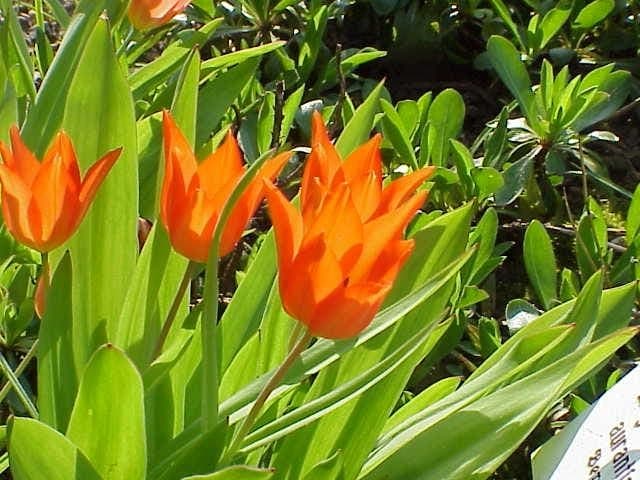
Tulipa praestans is a species tulip from Central Asia with one standout trait: each bulb sends up a stem that branches and carries three to five flowers at once. A group of ten bulbs can therefore give a patch of forty bright orange-red cups. The plant stays low, around 20 to 30 cm, and in a good spot it returns year after year. That makes it quite different from the large garden tulips that are exhausted after one or two seasons.
In the wild the species grows in the Pamir-Alay mountains, mainly in Tajikistan, on stony slopes and in open woodland. There it has cold winters, a short wet spring and a hot, dry summer. That climate also tells you how to treat it in the garden: sun, drainage and a dry summer rest.
It is sold as a species or botanical tulip, in the 'miscellaneous' group of the official tulip classification. If you want to know where such a long-lived spring flower would fit in your own garden, you can have a garden design made on gardenworld.app that takes account of sun and soil.
Toxicity
Tulips are poisonous to people and animals, and Tulipa praestans is no exception. The bulb in particular contains compounds (tulipalin and tuliposides) that cause vomiting, diarrhoea and drooling if eaten. Cats and dogs that chew or dig up bulbs can become quite ill. Tulips are related to lilies, but they do not cause the acute kidney failure that true lilies cause in cats; they do still make them sick. In people, frequent handling of bulbs can lead to an itchy rash. Wear gloves when planting and keep bulbs out of reach of children and pets.
Appearance and flowering season
The leaves are broad, lance-shaped and grey-green, four to six per plant. They are fairly upright and form a sturdy tuft around the flower stem. The stem is short and thick and branches at the top into two to five side stems, each with one flower.
The flowers are cup-shaped, roughly 5 to 6 cm long, and usually bright scarlet to orange-red, without the dark basal blotch that many tulips have. They open wide in sunshine and close in the evening and in cold weather. Flowering falls in March and April, well ahead of most garden tulips.
The best-known selections are 'Fusilier', bright scarlet with up to five flowers per stem, 'Unicum', with red-orange flowers and cream-edged leaves, and 'Shogun', with warm apricot-orange flowers. 'Van Tubergen's Variety' is an old, vigorous selection in orange-red.
Several flowers per stem
What makes Tulipa praestans special is that it spreads its flowers over a branched stem. Large garden tulips carry one flower per bulb; with this species the same number of bulbs gives three to five times as many flowers. Even a small group looks full. Flowering also lasts longer, because the flowers on a stem do not all open on the same day.
Because the plant is low and sturdy, it stays upright even in a spring gale. It never needs staking.
Ideal position
Give Tulipa praestans the sunniest spot you have. In shade the stems stretch, the flowers barely open and the bulb builds too little reserve for the following year. A rock garden, a gravel garden, the front of a sunny border or a south-facing edge along a patio are all ideal.
Choose a spot where the bulbs can stay dry in summer. Under a frequently watered lawn or among thirsty summer flowers they are more likely to rot. The species also does well in a pot on a sunny patio, especially if you keep the pot dry once the leaves have died down.
Free preview
Want to see Tulipa praestans: complete guide in your garden? Make a free preview of your design.
Soil requirements
Good drainage matters most. Sandy or gritty soil is ideal. On heavy clay, work coarse sand or fine grit into the top 20 cm, or plant in a raised bed. Soil pH is not critical; slightly alkaline to neutral is best. Feeding is hardly needed. Soil that is too rich produces lots of leaf and a weaker bulb.
Planting the bulbs
Plant the bulbs in October and November, once the soil has cooled down. This reduces the risk of tulip fire, a fungal disease that spreads faster in warm soil. Plant them about 10 to 15 cm deep and 8 to 10 cm apart, in groups of at least seven to ten. Set the bulbs pointed end up.
Check when planting that the bulbs are firm and show no mouldy patches. If mice are a problem, plant the bulbs in a wire mesh basket.
Watering
Water thoroughly once after planting. After that, autumn and winter rain supplies enough moisture. In a dry spring, water now and then while the leaves are green.
As soon as the foliage starts to yellow, stop watering. A dry summer rest helps the bulb form a new flower bud and is what makes the plant come back reliably. Move pots under cover for the summer.
After flowering
Snip off the faded flowers unless you want seed, so the plant puts its energy into the bulb. Leave the leaves until they turn yellow and come away on their own. Only then cut them off. A high-potash feed straight after flowering can help keep flowering at its best.
In a good spot Tulipa praestans forms dense clumps after a few years. Lift them in summer once the foliage has gone, divide them and replant the bulbs in autumn. Store them dry and airy until then.
Maintenance calendar
March–April: Flowering. Remove plants with grey, shrivelled patches (tulip fire).
April–May: Snip off faded flowers. Give a high-potash feed if you like.
May–June: The leaves turn yellow. Stop watering and leave the foliage until it has withered.
July–August: Summer dormancy. Divide congested clumps and store the bulbs dry.
October–November: Plant new or divided bulbs 10 to 15 cm deep.
December–February: Resting underground. No protection needed.
Winter hardiness
Tulipa praestans comes from a land of harsh winters and is fully hardy. It tolerates temperatures of -20 °C and below without protection. A cold winter is in fact needed for good flowering.
As with other bulbs, wet soil is a greater risk than cold. On poorly drained ground the bulb rots in winter or summer.
Companion plants
Tulipa praestans pairs beautifully with other spring flowers. Grape hyacinths (Muscari armeniacum) make a contrasting blue underplanting beneath the orange-red. Tulipa turkestanica, another species tulip with white star-shaped flowers, blooms around the same time and enjoys the same sunny, dry spot.
In a gravel garden, blue fescue (Festuca glauca) and Euphorbia myrsinites work well, with grey-blue foliage that intensifies the warm flower colour. Pasque flower (Pulsatilla vulgaris) flowers at about the same time and also wants sun and drainage. If you want to spread the flowering of all these bulbs across the whole of spring, the plant calendar on gardenworld.app helps you see what flowers when.
Final thoughts
Tulipa praestans is a tulip for anyone who wants more than one season of colour. With its branched stems it gives plenty of flowers from few bulbs, it stays low and sturdy, and in a sunny, well-drained spot it returns year after year. Plant the bulbs in late autumn, leave the foliage after flowering and keep the bulbs away from pets. Then you will have a bright patch of orange-red in the garden every spring.
Frequently asked questions about Tulipa praestans
Is Tulipa praestans winter hardy?
Tulipa praestans comes from a land of harsh winters and is fully hardy. It tolerates temperatures of -20 °C and below without protection.
How much water does Tulipa praestans need?
Water thoroughly once after planting. After that, autumn and winter rain supplies enough moisture.
What soil does Tulipa praestans need?
Good drainage matters most. Sandy or gritty soil is ideal.

See it in your garden
See Tulipa praestans in your garden
One photo of your garden and a few questions. You see the result in about a minute.
Try it with a photoIdentify this plant in your own garden. Identify a plant
Similar plants
Turkestan tulip: complete guide
Tulipa turkestanica
Discover the Turkestan tulip, a compact dwarf from Central Asia. Extremely hardy, multi-flowering and ideal for rock gardens.
Common grape-hyacinth: complete guide
Muscari armeniacum
Muscari armeniacum blooms in early spring with dense clusters of blue, grape-like flowers. Hardy, low-maintenance, and bee-friendly, it's perfect for borders, lawns, and naturalized plantings.
Blue spurge: complete guide
Euphorbia myrsinites
Blue spurge (Euphorbia myrsinites) is an elegant low-growing groundcover with glaucous blue-green foliage and bright yellow-green blooms.
