
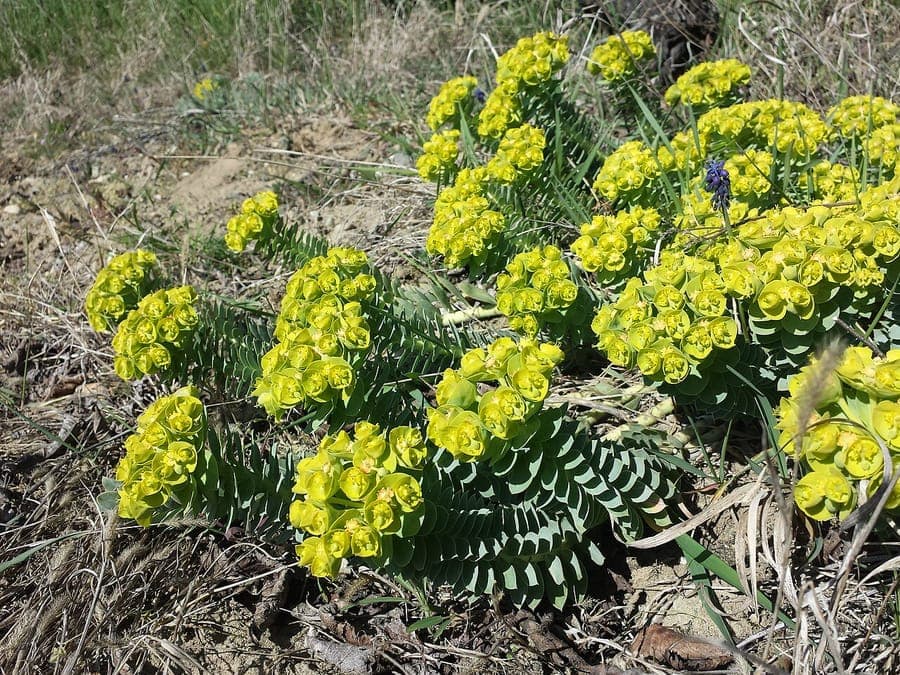
Stefan.lefnaer / CC BY-SA 4.0, via Wikimedia Commons
Blue spurge: complete guide
Euphorbia myrsinites
Want to see Blue spurge: complete guide in your garden?
1 minute, no credit card
Overview
Blue spurge (Euphorbia myrsinites), also called Corsican euphorbe or creeping spurge, is an elegant low-growing perennial from the Mediterranean. At just 20-30 cm tall with spreading, creeping growth, it forms an exceptional groundcover with unique blue-green, succulent-like foliage.
This plant deserves far more attention in European gardens, particularly in dry, sunny locations where many groundcovers struggle.
Appearance & bloom cycle
Blue spurge develops into a low spreading mat of fleshy, blue-green leaves arranged in distinctive ascending spiral patterns along the stems. From March through April, brilliant yellow-green flowers appear in dense clusters that stand out dramatically against the blue-green background.
The plant is evergreen, retaining its blue-green color year-round, providing extra value in winter-grey gardens.
Ideal location
Blue spurge thrives optimally in full sun on warm, well-drained sites. It is extremely drought-tolerant and accepts even poor soils. A blazing-hot, sunny spot where other plants struggle is ideal.
In shade, the plant grows much less compactly and loses much of its characteristic blue-green coloring.
Soil requirements
Blue spurge is supremely tolerant of poor soil conditions. In fact, it grows best on nutrient-poor, well-drained soils. Heavy clay can be amended with coarse sand to drastically improve drainage.
The plant is grown in extreme Mediterranean conditions and tolerates absolute drought without difficulty.
Free design
Want to see Blue spurge: complete guide in your garden? Make a free design now.
Watering
Once established, blue spurge is extremely drought-tolerant and requires virtually no watering. After planting, water regularly until the plant is well-rooted (4-6 weeks).
Thereafter watering can cease entirely. The plant is drought-aggressive: excessive moisture can lead to root rot.
Pruning
Blue spurge requires no pruning. The plant grows naturally compact. Removing spent flowers is optional but helps the plant conserve energy. Dead leaves or damaged stems can be carefully removed.
Maintenance calendar
January-February: Plant in winter; select full sun location March-April: Peak flowering; no maintenance needed May-October: Summer dormancy October-December: Winter preparation; no maintenance
Winter hardiness
Blue spurge is hardy to USDA zone 5 (-29°C). In most European gardens, even in the Netherlands, Belgium, and large parts of Germany, the plant is fully winter-hardy. In very severe winters, minor damage may occur, but the plant recovers in spring.
Companion plants
Blue spurge pairs beautifully with:
- Sedum & Sempervivum - matching succulence
- Thymus (Thyme) - purple flowers contrast blue-green
- Lavandula (Lavender) - blue flowers harmonize
- Dianthus (Pinks) - similar low-growing habit
- Artemisia - silvery foliage complements blue-green
Closing
Blue spurge is an overlooked gem for dry, sunny spots. The combination of blue-green evergreen foliage and brilliant spring bloom makes it invaluable year-round ornament. Most garden centers stock young plants in spring.
On gardenworld.app you can design a garden that embraces the dry, sunny corners of your outdoor space, with blue spurge as a striking accent plant.
Want to see Blue spurge: complete guide in your garden? Make a free design now.
Upload a photo, pick a style, and get a photorealistic design with plant list in under a minute.
No credit card required


Similar plants
Woolly mercury: complete guide
Mercurialis tomentosa
All about Mercurialis tomentosa, the woolly mercury from southwestern Europe: site, soil, watering, care and garden design tips.
Shurur: complete guide
Euphorbia fruticosa
Everything about Shurur: cultivation in dry climates, xeriscaping, care and tips for drought-resistant gardens in warm climates
Glary spurge: complete guide
Euphorbia glareosa
Everything about glary spurge: cultivation, maintenance, frost hardiness and use in Mediterranean and mountain-inspired gardens