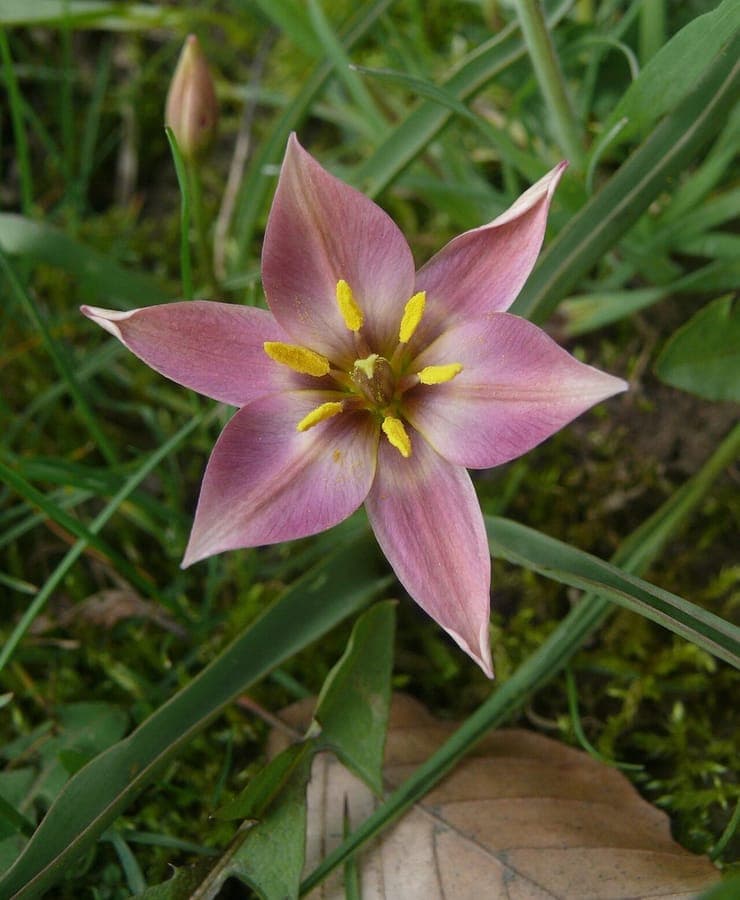
Bernd Haynold / CC BY-SA 3.0, via Wikimedia Commons
Tulipa humilis: a species tulip for rockeries and gravel
Tulipa humilis
Want to see Tulipa humilis: a species tulip for rockeries and gravel in your garden?
Full design in HD: €7.99
Look after your Tulipa humilis with the GardenWorld app
Identify plants with your camera and get a care calendar with reminders for this plant.


Overview
Tulipa humilis is a small wild tulip from the mountains of the Middle East. In the wild it grows on stony slopes and in high meadows from south-eastern Turkey to northern Iran, Iraq and the Caucasus. Its year follows a strict rhythm: cold winters, a short wet spring and a long, baking summer. Understanding that rhythm is the key to growing it well in a garden.
Unlike the large hybrid tulips that so often fade after a single season, this species tulip is a true perennial when it is given the right spot. In full sun and sharp drainage it returns year after year and gradually builds up into small colonies. It rarely grows taller than 10 to 15 cm, which makes it a natural choice for rock gardens, gravel beds, the front of a sunny border or a shallow pan on the patio. On gardenworld.app you can have a garden design created in which small spring bulbs like this one have a permanent place among perennials that take over later in the year.
Botanically, Tulipa humilis is extremely variable. Plants once described as separate species, including Tulipa pulchella, Tulipa violacea and Tulipa aucheriana, are now generally treated as forms or groups within it. That is why bulb catalogues list names such as Violacea Group, Pulchella Group, 'Persian Pearl', 'Eastern Star', 'Lilliput' and 'Alba Coerulea Oculata'. All of them belong to the lily family, Liliaceae.
Appearance and flowering season
Tulipa humilis flowers in March and April, and occasionally at the end of February after a mild winter. Each bulb usually produces a single flower on a short stem. In bud the flower is narrow and pointed, but in sunshine it opens into a flat star 4 to 6 cm across. On dull days and in the evening it closes again, so the plant is at its most striking on a bright afternoon.
Colours range from the palest lilac and soft pink to deep magenta and purplish red. The centre is yellow in many forms, often bluish black in the Violacea forms, and in 'Alba Coerulea Oculata' the white petals surround a steel-blue eye. The stamens are usually yellow or dark. The backs of the outer petals are often washed with green or grey, so a closed flower is surprisingly discreet among the leaves.
The foliage is narrow, linear and greyish green, 10 to 15 cm long, with two to five leaves per bulb. The leaves often spread close to the ground or arch slightly. After flowering the plant forms an upright seed capsule, and by early June the leaves turn yellow as the plant retreats into its bulb for the summer.
Ideal position
Full sun is essential. In partial shade the plant may flower for a year or two, but the bulbs shrink and flowering soon stops. Choose a spot that is sunny all day in both March and June. A south-facing slope, a rockery, a gravel garden or the edge of a raised bed all work well.
Think about summer as well. After flowering this tulip wants to rest warm and dry. Avoid planting it among thirsty bedding that is watered daily in July, and keep it out of lawns that are mown early, because the leaves need about six weeks after flowering to feed the bulb. Under deciduous shrubs it can succeed if there is plenty of spring light, but dense shade and greedy tree roots are best avoided.
Because the plant is so small, it is most rewarding close to where you walk or sit: beside a path, in front of a bench or in a pot on a table. Plant in groups of at least ten to twenty-five bulbs, as single bulbs simply disappear.
Soil requirements
Free-draining soil is non-negotiable. In heavy clay that stays wet in winter, the bulbs rot. On clay, work grit, coarse sand or fine gravel into the top 20 cm, or plant in a raised bed. Sandy soils and light loams are ideal. The pH matters less; neutral to slightly alkaline conditions match its native habitats best.
Very little feeding is needed. Poor to moderately fertile ground produces sturdy plants. If you want to feed, scatter a small amount of potassium-rich bulb fertiliser as the leaves emerge in spring. Avoid fresh manure or thick layers of compost around the bulbs, which encourage rot.
Free preview
Want to see Tulipa humilis: a species tulip for rockeries and gravel in your garden? Make a free preview of your design.
Planting
Plant the bulbs from late September to the end of November, as long as the ground is not frozen. Set them 8 to 10 cm deep, or up to 12 cm on light sandy soil, where a little extra depth protects them from temperature swings and digging animals. Space them 5 to 8 cm apart, pointed tip upwards. A handful of grit in each planting hole helps on heavier ground.
Voles and squirrels may help themselves to the bulbs; where they are common, plant in a wire mesh basket. In containers, use a mix of compost with at least one third grit or coarse sand, and after flowering move the pot to a dry, sunny place.
Watering
Watering is rarely needed in the open ground. Autumn and winter rainfall in Britain and north-western Europe is more than enough. Only in an unusually dry spring with buds on the way is a single soak worthwhile. Once the leaves have died down, the bulb should stay dry, so keep sprinklers away from that part of the garden.
Pots are the exception. Keep the compost slightly moist but never wet through winter, and water during growth and flowering whenever the top few centimetres feel dry. When the leaves have yellowed, stand the pot somewhere dry, such as under eaves, until October.
Pruning
There is nothing to prune, only something to leave alone. Do not cut the leaves after flowering: they recharge the bulb for next year. Wait until they are yellow and limp and pull away easily. Faded flowers can be snipped off if you do not want seed. If you leave the capsules, the species may self-seed very modestly in a favourable spot, although seedlings take three to five years to reach flowering size.
Maintenance calendar
September to November: Plant new bulbs 8 to 10 cm deep in sunny, free-draining soil.
December to February: Dormant below ground. Protect pots from prolonged wet.
February to March: Leaves appear. Apply a little potassium-rich bulb fertiliser if you wish.
March to April: Flowering. Enjoy the open stars on sunny afternoons.
May: Let the foliage die back naturally. Deadhead or leave seed capsules.
June to August: Summer dormancy. Keep the spot warm and dry; no irrigation.
Every 3 to 5 years: Lift congested clumps in summer and replant them more widely in autumn.
Winter hardiness
Tulipa humilis is fully hardy throughout Britain and the Low Countries. It comes from mountains with severe frost and copes with around -20 °C and lower without protection. In fact the bulb needs a cold spell to flower well.
The real danger in a maritime winter is wet, not cold. A bulb sitting for months in waterlogged clay will rot long before it freezes, which is why drainage comes first. Pots freeze faster than open ground, so in hard frost move them against a wall or wrap them in hessian.
Toxicity
Like all tulips, Tulipa humilis contains tuliposides and tulipalins, mainly concentrated in the bulb. Tulip bulbs should never be eaten. They are toxic to cats, dogs and horses and can cause vomiting, drooling and diarrhoea. Handling large numbers of bulbs with bare hands can irritate the skin, so wear gloves when planting. Keep loose bulbs away from children and pets.
Companion plants
This tulip looks best among other small spring bulbs and drought-tolerant perennials. Grape hyacinths (Muscari armeniacum) and Iris reticulata provide a lovely blue contrast to the pink and purple shades. Crocus tommasinianus flowers a little earlier, so the same patch shows colour from February onwards.
For the rest of the year, choose plants that fill the gap after June without demanding water. Houseleeks (Sempervivum tectorum), Euphorbia myrsinites, creeping thyme and low sedums leave enough space and keep the ground dry in summer. Small ornamental grasses such as blue fescue (Festuca glauca) add structure. To see which plant peaks when, the planting calendar on gardenworld.app helps you line up the flowering seasons neatly.
Final thoughts
Tulipa humilis is a little gem for anyone with a sunny, dry corner. Its needs are few: good drainage, full sun and a dry summer rest. In return it brings star-shaped flowers in pink, magenta or purple every spring, opening wide in the sunshine and slowly spreading over the years. Plant it close by in generous groups, let the foliage fade in its own time, and you will have a tulip that does not vanish after one year but becomes a lasting resident of your garden.
Frequently asked questions about Tulipa humilis
Is Tulipa humilis winter hardy?
Tulipa humilis is fully hardy throughout Britain and the Low Countries. It comes from mountains with severe frost and copes with around -20 °C and lower without protection.
When and how do you prune Tulipa humilis?
There is nothing to prune, only something to leave alone. Do not cut the leaves after flowering: they recharge the bulb for next year.
How much water does Tulipa humilis need?
Watering is rarely needed in the open ground. Autumn and winter rainfall in Britain and north-western Europe is more than enough.
What soil does Tulipa humilis need?
Free-draining soil is non-negotiable. In heavy clay that stays wet in winter, the bulbs rot.

See it in your garden
See Tulipa humilis in your garden
One photo of your garden and a few questions. You see the result in about a minute.
Try it with a photoIdentify this plant in your own garden. Identify a plant
Similar plants
Common grape-hyacinth: complete guide
Muscari armeniacum
Muscari armeniacum blooms in early spring with dense clusters of blue, grape-like flowers. Hardy, low-maintenance, and bee-friendly, it's perfect for borders, lawns, and naturalized plantings.
Early crocus: complete guide
Crocus tommasinianus
Crocus tommasinianus blooms early in spring and naturalizes easily. Learn how to plant, care for and combine this hardy, low-maintenance bulb.
Iris reticulata: complete guide
Iris reticulata M.Bieb.
The netted iris is a precious early-blooming iris from the Middle East with beautiful violet flowers. Discover how to grow this enchanting miniature iris in your front yard.
