
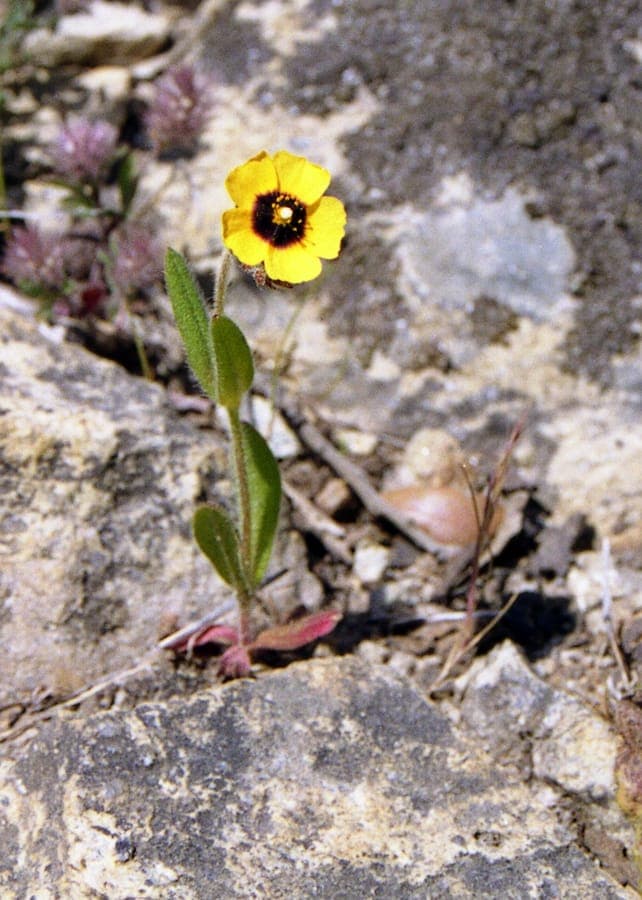
Velela / CC BY-SA 2.5, via Wikimedia Commons
Spotted rock-rose: complete guide
Tuberaria guttata
Want to see Spotted rock-rose: complete guide in your garden?
1 minute, no credit card
Overview
The spotted rock-rose (Tuberaria guttata) is a charming small herb native to Mediterranean and sub-Mediterranean regions. This annual or winter-green plant is renowned for its delicate, pale yellow flowers with characteristic red or brown spots at the base of the petals. It is a typical plant of dry slopes, rocky ground, and sandy terrain in the Mediterranean region, hence the botanical name guttata referring to the spots or speckles. Despite its small size, this plant adds considerable charm and color to gardens.
Appearance and Bloom
Tuberaria guttata grows as an upright, branched plant, usually 15-40 cm tall. The stems are hairy and reddish-brown tinted. The leaves are small, oblong-lanceolate and green, 10-25 mm long, with distinct veination. They grow predominantly at the lower portion of the plant. Flowers appear from May to June and measure 10-15 mm in diameter. They have five yellow petals, often with red or brown spots at the base, making the plant very striking. Stamens are numerous and yellow. After blooming, the plant forms small, three-celled seed capsules containing numerous seeds, allowing easy self-propagation.
Ideal Location
Tuberaria guttata grows best in warm, dry locations with full sun. This plant thrives only in sunlight and requires at least 6-8 hours of direct sunlight daily. Locations with southern or southwestern exposure are ideal. The plant tolerates strong wind well and even grows better in windy locations. Shelter from heavy wind may reduce growth and promote disease.
Soil
Tuberaria guttata is very soil-demanding and grows best in well-draining, acidic to neutral soil. Heavy clay must be amended with sand, shells, or gravel. The plant tolerates poor soils and even grows better in nutrient-poor conditions. The plant thrives in sandy, stony, or even rocky soils. Drainage is crucial because the plant cannot tolerate waterlogging. Adding organic matter may sometimes limit growth.
Watering
Tuberaria guttata is extremely drought-tolerant and requires virtually no supplemental watering after establishment. In very dry periods, light watering may help, but should be minimal. Young plants after seeding require gentle watering until well-established, then watering must be drastically reduced. Water must be strictly limited because excessive moisture causes root rot.
Pruning
This small plant requires no pruning. Allow the plant to naturally self-seed and spread. Removing spent flowers may encourage more blooming but is unnecessary.
Maintenance Calendar
Spring: Sow seeds directly in dry soil. Water very carefully if needed. Summer: No maintenance required. Plant blooms in full sun. Fall: Let seed mature on plant. Seeds are consumed by birds and spread by wind. Winter: In mild Mediterranean climates, plant may overwinter. In harsher regions, plant dies off.
Winter Hardiness
Tuberaria guttata is frost-sensitive and grows only in USDA zone 8-10 (minimum temperature above -10 degrees Celsius). In harsher climates, it is grown as an annual. In mild climates, it may overwinter as a winter annual or short-lived perennial.
Companion Plants
Combine Tuberaria guttata with other Mediterranean drought-tolerant plants. Lavender, cistus, rosemary, and other drought-tolerant herbs fit perfectly. Also pair with saxifrages, stonecrops, and other rockery plants. These combinations create authentic Mediterranean garden atmosphere.
Final Thoughts
Tuberaria guttata is a beautiful, low-maintenance flower for gardens in warm, dry climates. Its tough nature, wildlife value, and elegant yellow blooms make it valuable for Mediterranean gardens and drought-tolerant landscapes. With minimal attention and good drainage, this plant grows beautifully. For gardeners wishing to create Mediterranean gardens, this plant is an essential addition.
Want to see Spotted rock-rose: complete guide in your garden? Make a free design now.
Upload a photo, pick a style, and get a photorealistic design with plant list in under a minute.
No credit card required


Similar plants
Curled-leaf rock rose: complete guide
Cistus crispus
Everything you need to grow Cistus crispus, the curled-leaf rock rose from the western Mediterranean. Siting, soil, pruning, and winter care fully explained.
Marjoram-leaved sun rose: complete guide
Helianthemum marifolium
Everything about Helianthemum marifolium, the marjoram-leaved sun rose: location, dry soil, flowering season and care for this Mediterranean rock plant in your garden.
Beach-heath: complete guide
Hudsonia tomentosa
Complete guide to Hudsonia tomentosa: growing this woolly sand-heath on poor sandy soils, its care needs, companions and garden uses.